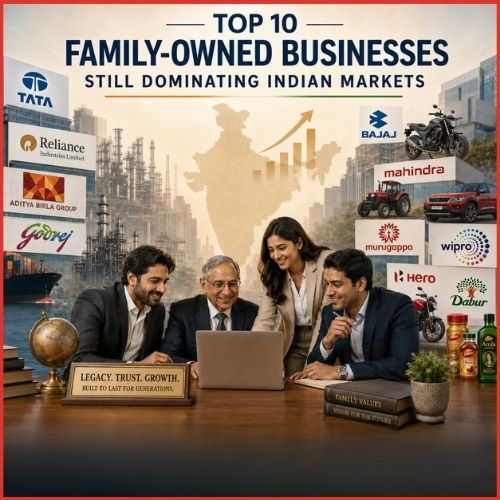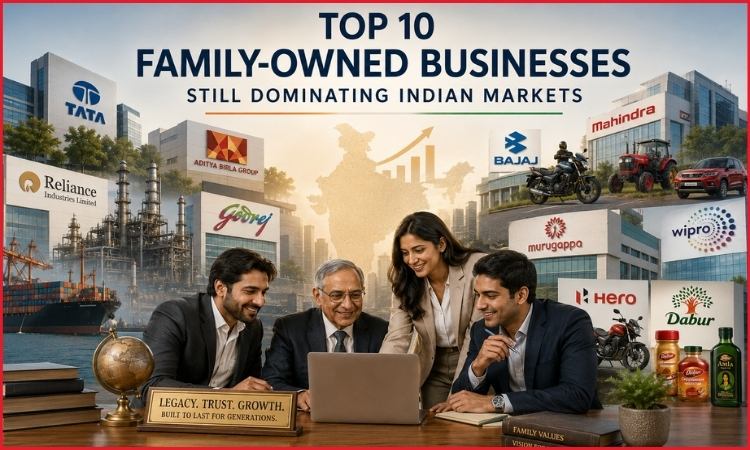
Walk into any boardroom on Mumbai’s Nariman Point, and the surname on the visiting card is often older than the company logo itself. Roughly three in every four rupees of India’s GDP now flows through enterprises still controlled by a single family. That single number reframes what corporate India means: family founders aren’t a footnote here; Indian family business has been the default operating model for over a century.
This list ranks the top family-owned businesses in India by a blended score of revenue, market capitalisation, longevity under family control, and brand influence as of 2026, since a pure revenue ranking would bury century-old institutions under newer, larger groups. That blend matters: family-run firms have consistently posted higher revenue growth than non-family peers over the past decade. What follows is a working map of where ten of India’s most powerful business dynasties are placing their next bets.
How We Ranked
Ranking isn’t based on revenue alone, but on overall standing among the largest family-owned companies in India – factoring in turnover, market capitalisation, generations of active family control, and how visibly the group has shaped Indian industry. A newer, larger revenue base doesn’t automatically outrank an older institution with a smaller but deeply entrenched footprint.
The ten names span diversified conglomerates, IT services, two-wheeler manufacturing, and FMCG, so this is a broad comparison of Indian business families rather than a strict sector-by-sector ranking. The goal: spotlight the family enterprises with the widest combined impact on investors, employees, and consumers across the Indian economy in 2026.
Quick Glance
A snapshot of the legacy businesses in India covered below, ranked by the criteria above:
| Name | Founded | Sector / Focus | Key Metric (FY25) | Regional Presence | Core Strength |
| Tata Group | 1868 | Diversified conglomerate | ₹15.34 lakh cr revenue | 100+ countries | Steel-to-software diversification |
| Reliance Industries | 1966 | Energy, telecom, retail | ₹9.98 lakh cr revenue | Nationwide + global ops | Jio and retail scale |
| Aditya Birla Group | 1857 | Cement, metals, fashion, telecom | $67 bn revenue (est.) | 41 countries | Global manufacturing footprint |
| Godrej Group | 1897 | Consumer goods, real estate, appliances | Split into two entities, 2024 | Pan-India | 125+ years of consumer trust |
| Bajaj Group | 1926 | Automobiles, financial services | ~₹9-10 lakh cr combined m-cap | Nationwide + exports | Two-wheeler and NBFC leadership |
| Mahindra Group | 1945 | Autos, farm equipment, IT, hospitality | ₹1.21 lakh cr group revenue | 100+ countries | SUV and tractor dominance |
| Murugappa Group | 1900 | Engineering, agri, financial services | ₹90,178 cr turnover | 40+ countries | Cholamandalam & CG Power turnarounds |
| Wipro | 1945 | IT services and consulting | ₹89,088 cr revenue | 167 countries | Enterprise AI and consulting |
| Hero MotoCorp | 1984 | Two-wheelers | ₹41,967 cr revenue | 40+ countries | World’s largest two-wheeler maker by volume |
| Dabur | 1884 | FMCG, Ayurveda | ₹13,113 cr revenue | 120+ countries | Herbal and Ayurvedic brand trust |
1. Tata Group
Jamsetji Tata opened a trading firm in Bombay in 1868 with money borrowed from his father; the group he seeded now spans steel, software, salt, and aircraft manufacturing. Under chairman N. Chandrasekaran, Tata Sons reported group revenue of ₹15.34 lakh crore in FY25, with Tata Consultancy Services alone contributing 43% of net earnings. What earns Tata the top spot isn’t just size – 66% of Tata Sons’ equity sits with philanthropic trusts, an ownership structure almost no other business family here has replicated at scale.
Explore the full Tata Group Success Story for the century-and-a-half arc.
2. Reliance Industries
Dhirubhai Ambani started out trading yarn and spices before incorporating Reliance Textiles in 1966; the company crossed ₹9.98 lakh crore in FY25 revenue under son Mukesh Ambani, powered by Jio’s 500-million-plus subscribers and Reliance Retail’s nearly 19,000 stores. Succession is already underway in public view – Akash, Isha, and Anant Ambani now each head a separate vertical, a test many Indian business families are watching closely as they plan their own handovers.
3. Aditya Birla Group
The Birla family’s roots trace to cotton trading in 1857, and Kumar Mangalam Birla now runs a group generating an estimated $67 billion in FY25 revenue across cement, metals, fashion, and telecom. Hindalco’s aluminium arm alone pulls in roughly $27 billion, with 70% from overseas operations – a hedge few names in Indian family business have matched while keeping one holding structure intact across five generations.
4. Godrej Group
Ardeshir Godrej built his first lock in 1897 after failing as a lawyer, and the brand that followed became so trusted it now sits inside millions of Indian kitchens and almirahs – Godrej even supplied the voting boxes used in India’s first general election. In 2024, the family formally split the empire into two entities, Godrej Industries Group under Nadir Godrej and Godrej Enterprises Group under Jamshyd Godrej, a separation done amicably after 127 years under one roof that may end up studied as a succession playbook by other Indian business families.
5. Bajaj Group
Jamnalal Bajaj founded the group in 1926, and nearly a century later, Bajaj Auto and Bajaj Finance together sit at a combined market capitalisation near ₹9-10 lakh crore, with Bajaj Auto ranking as the world’s fourth-largest two- and three-wheeler manufacturer and Bajaj Finance among India’s most valuable NBFCs. The family split management between cousins Rajiv Bajaj (autos) and Sanjiv Bajaj (financial services) years ago, keeping both businesses independently competitive rather than compromised by one overstretched leader.
6. Mahindra Group
J.C. Mahindra and K.C. Mahindra started out trading steel in 1945, and the group Anand Mahindra now chairs has grown into a diversified conglomerate valued above ₹5.4 lakh crore, spanning SUVs, tractors, IT, and hospitality. Group revenue sits around ₹1.21 lakh crore, smaller than several names above it, but Mahindra remains India’s largest tractor maker by volume and one of the more aggressive electric-mobility bettors among India’s most innovative companies, keeping it among the largest family-owned companies in India.
7. Murugappa Group
The Murugappa story starts in Burma in 1900, as a money-lending business run by Dewan Bahadur A.M. Murugappa Chettiar; the family rebuilt almost from scratch after relocating to Chennai ahead of the Japanese invasion of Myanmar. Fourth- and fifth-generation members now run a ₹90,178 crore conglomerate spanning Cholamandalam Finance, CG Power, and EID Parry, with CG Power’s turnaround alone taking it from a loss-making unit to ₹1,348 crore profit before tax in FY25. Read the full Murugappa Group Success Story to see how a century-old unwritten rule on succession has kept the family largely out of public boardroom disputes – one of the quieter family business success stories in Indian industry.
8. Wipro
Mohamed Premji founded Wipro in 1945 to trade vegetable oil, and it stayed a cooking-oil business for nearly four decades until his son, Azim Premji, pivoted it toward computing in the 1980s a bet that closed FY25 with ₹89,088 crore in revenue and profit up nearly 19% year-on-year under CEO Srini Pallia. Premji still holds roughly 73% of the company and has given away more personal wealth to philanthropy than almost any other name in Indian family business, a detail explored further in Azim Premji’s Success Story.
9. Hero MotoCorp
Brijmohan Lall Munjal built Hero into a cycle-making name decades earlier, but it was the 1984 Hero Honda joint venture that laid the foundation his son, Pawan Munjal, now runs as the world’s largest two-wheeler manufacturer by volume – a leadership story covered among India’s Top 15 Highest-Paid CEOs. FY25 revenue came in at ₹41,967 crore, and the company has since pushed into electric mobility via its Vida brand. Unlike the diversified conglomerates above it, Hero has stayed almost entirely focused on two-wheelers for four decades depth over breadth- and a bet that has kept it profitable through multiple industry downturns.
10. Dabur
S.K. Burman built Dabur in Kolkata in 1884 as a small Ayurvedic medicine practice, making it, alongside Tata, one of the oldest continuously operating family businesses in India. The Burman family still holds a controlling 66% stake, and FY25 revenue reached ₹13,113 crore on the strength of herbal healthcare and personal care categories that barely existed when the company was founded, proof that not every entry among the largest family-owned companies in India needs a ten-figure balance sheet to earn its place.
What These Companies Have In Common
Every name here survived at least one leadership handover without losing family control; some navigated three or four. None diversified purely for size; each expansion, from Tata’s software pivot to Wipro’s exit from cooking oil, followed a genuine market opening rather than a founder’s ego. And nearly all now run parallel succession tracks, grooming multiple family members across separate verticals, a pattern showing up again and again across Indian business families and their most durable family business success stories.
Key Takeaways
- Family-owned businesses generate more than 75% of India’s GDP – Indian family business remains central to the wider economy.
- Longevity beats pure scale: five of the ten legacy businesses in India here are over a century old, led by Aditya Birla Group’s 1857 origins.
- Structured succession, not just capable heirs, separates enterprises that endure from those that fracture; Godrej’s 2024 split and Bajaj’s cousin-led division are contrasting examples.
- Diversification worked only when it tracked a real market shift IT for Wipro and Tata, electric mobility for Hero MotoCorp and Mahindra.
- Family-owned firms delivered roughly 2.3 points higher revenue growth than non-family peers between 2017-2022, a gap investors watch across successful family businesses in India.
- Scale isn’t a prerequisite for relevance: Dabur and Godrej trail the conglomerates on revenue but remain household names across generations.
Conclusion
India’s most enduring companies weren’t built to maximise a single generation’s returns – they were built to survive the next one. That thread connects an 1868 trading firm in Bombay to a Ghaziabad-based Ayurveda brand nearly as old, and it’s why successful family businesses in India keep outlasting flashier, professionally managed rivals. As sectors like AI, EVs, and clean energy open up, the next chapter of family business success stories in India will be written by how well these Indian business families manage the handover to generation five or six – worth tracking alongside newer legacy businesses in India.
Frequently Asked Questions
1. What makes a company a family-owned business in this ranking?
A family-owned business here is one where a single family retains controlling ownership or decisive management influence, even if the company is publicly listed. Tata Sons, for instance, is largely held by philanthropic trusts but still operates under Tata family governance principles.
2. Why does the ranking combine several metrics instead of just revenue?
A pure revenue ranking would give an advantage to the newer, larger conglomerates and discount century-old institutions that maintained small but well-established businesses. The largest family-owned companies in India can be best judged when revenue, market cap, longevity, and influence of the industry are considered together.
3. Which of these companies is the oldest family business?
Aditya Birla Group was the oldest of the companies here, followed by Dabur’s 1884 and Tata Group’s 1868.
4. Do family-owned businesses really outperform professionally managed firms in India?
On several measures, yes, family-owned businesses have posted noticeably higher revenue growth than non-family peers over the past decade, with shareholder returns running roughly twice as high over a similar stretch, a gap that has kept Indian family business firmly ahead of professionally managed rivals on returns.
5. Are all ten companies in the same industry?
No, deliberately so the list spans conglomerates, IT services, automobiles, and FMCG, since the goal is comparing successful family businesses in India broadly rather than ranking within one sector.
6. Is Godrej still a single family business after its 2024 split?
Yes, though it now operates as two separately run entities, Godrej Industries Group and Godrej Enterprises Group, each still controlled by branches of the same family rather than external owners.