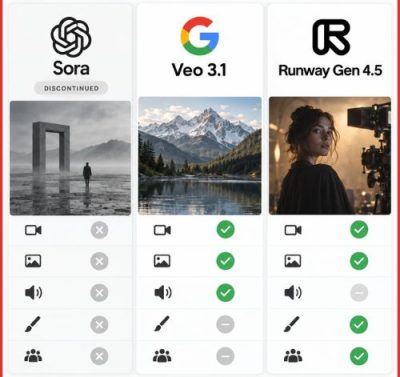
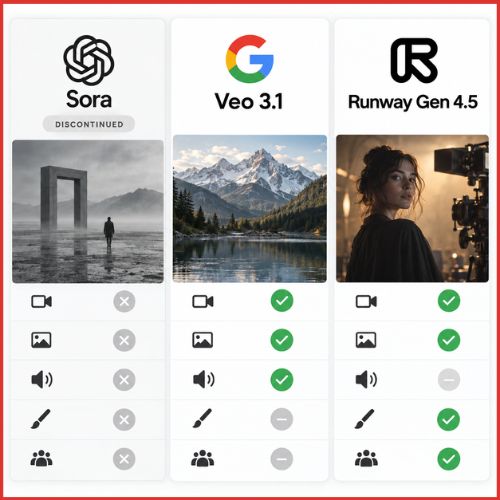
The AI video market looks very different from the one that existed a year ago.
Google has pushed Veo deeper into realistic video, native audio and higher resolution output. Runway has moved beyond being a simple video generator and is building a broader production environment around its models. OpenAI, meanwhile, has taken the most surprising step of all: Sora is no longer available as a consumer product.
That changes the question behind the usual Sora vs Veo vs Runway debate.
For someone choosing a video tool in September 2026, this is no longer a straightforward contest between three active products. Sora’s web and app experience was discontinued on April 26, 2026, and OpenAI says its API is scheduled to shut down on September 24, 2026.
So which platform is actually best?
For most professional creative work, Runway remains the stronger production choice because it combines generation with a wider set of creative controls and editing tools. Veo 3.1 is the stronger choice when realism, native audio and high resolution output matter more than having a broader editing environment. Sora is no longer a sensible choice for a new workflow, regardless of how strong its underlying model remains.
That distinction matters because the best AI video model is not necessarily the best AI video product.
Sora vs Veo vs Runway at a glance
| Area | Sora | Veo 3.1 | Runway Gen 4.5 |
| Current product status | Web and app discontinued | Active | Active |
| Core strength | Strong video generation and character focused creation | Realism, audio and cinematic generation | Creative control and production workflow |
| Native audio | Yes in Sora 2 | Yes | No in Gen 4.5 |
| Maximum duration in current documented API | Product discontinued | 8 seconds | 10 seconds |
| Maximum resolution | Previously up to 1080p | Up to 4K in API preview | Depends on workflow and model output |
| Image to video | Yes | Yes | Yes |
| Video editing workflow | Discontinued product | Growing through Google Flow | Strong |
| Best fit today | Existing users preparing to migrate | Creators seeking realistic shots with audio | Professional creative teams |
The specifications come with an important warning. Video models are being updated quickly, and benchmark scores can change as new models enter the field. A feature list therefore tells only part of the story.
The more useful question is what happens after the first generation.
Sora has become the odd one out
Sora still deserves a place in the discussion because it helped define the modern AI video category. Sora 2 introduced video generation with synchronized dialogue and sound effects, stronger physical realism and more controllable scenes. OpenAI described it as its flagship video and audio generation model.
But commercial buyers need to separate model quality from product availability.
OpenAI discontinued the Sora web and app experience on April 26, 2026. The company has also announced that the Sora API will be discontinued on September 24, 2026. OpenAI is advising users to export their Sora content and says associated data will eventually be deleted after the applicable export period.
That makes Sora difficult to recommend for a fresh project.
A filmmaker starting a six month production workflow does not simply need an impressive model. The platform needs to remain available, predictable and commercially useful throughout the project. A developer building a video feature into a product needs the same confidence.
Sora’s disappearance is therefore more significant than a normal product update. It changes its place in the competitive landscape.
For teams already using Sora, the question is now migration. For everyone else, the practical contest is largely between Veo and Runway.
Veo 3.1 is built around realism and sound
Google’s Veo 3.1 takes a different approach from Runway.
Google is placing considerable emphasis on realism, physical behaviour, prompt adherence and native sound. Veo can generate dialogue, sound effects and ambient audio as part of the video generation process rather than requiring creators to build the soundtrack separately.
That is more useful than it might sound on a feature sheet.
Imagine a marketer producing a short product film. With a traditional AI video workflow, the team might generate the visual, create or source a voice, add sound effects, find background ambience and synchronise everything in an editor.
Veo can collapse several of those steps into the initial generation.
Google’s current API documentation lists Veo 3.1 as an 8 second generation model available in 720p, 1080p and 4K, with native audio. It also supports portrait output, video extension, first and last frame based generation and up to three reference images for visual direction.
This makes Veo particularly attractive for short form advertising, social media, product demonstrations and dialogue driven scenes.
The obvious limitation is duration.
An eight second clip can look spectacular, but most meaningful video projects are not eight seconds long. A commercial, brand film or explainer usually needs many shots stitched together. That means the value of Veo increasingly depends on how well it fits the rest of a production workflow.
For a single hero shot, that is less of a problem.
Runway’s advantage is not just the model
Runway’s biggest strength is that it thinks like a creative software company, not simply a model provider.
Its latest flagship model, Gen 4.5, supports text to video and image to video generation, with durations ranging from two to ten seconds and a cost of 12 credits per second.
On its own, that does not sound dramatically different from competing systems.
The difference appears when the creator moves beyond the first generation.
Runway has built a larger collection of tools around video production, including character performance, video editing and workflow features. Its platform also supports models from other companies, giving users access to several generation systems within the same environment.
That matters for professional users.
A video producer rarely asks an AI tool to produce one perfect clip and then stops. The real process usually involves generating alternatives, changing framing, adjusting motion, replacing elements, extending scenes and assembling multiple shots.
A platform that handles those steps in one environment can save more time than a model that produces a slightly better first frame.
That is where Runway has a genuine strategic advantage.
Which produces the better looking video?
This is where benchmark results become tricky.
Runway announced Gen 4.5 with an Artificial Analysis text to video score of 1,247 Elo, putting it ahead of Google Veo 3 and Sora 2 Pro at the time of that evaluation. The ranking was based on blind human preference testing.
But current public comparisons show that the gap is no longer straightforward.
A September 2026 comparison using the V benchmark rated Veo 3.1 ahead of Runway Gen 4.5 overall, with Veo scoring 62.4 against 60.5 for Runway. The same evaluation gave Veo a notable advantage in object handling and prompt adherence, while Runway scored better in areas such as logic consistency and cinematography.
That is a useful reminder not to treat a single leaderboard as a universal ranking.
Video quality is not one thing. A model can win at realism and lose at composition. It can generate convincing people while producing weaker typography. Another system may create more controlled camera movements even when individual details are slightly softer.
For business users, this is important because a marketing team is rarely evaluating video by asking which model wins an abstract visual contest.
The better question is whether the generated footage is usable.
For photorealistic scenes, Veo has a strong case
Veo’s appeal becomes clearer when the brief depends on physical realism.
Google specifically highlights improvements in physics, realism, prompt adherence and audio. Veo 3.1 also supports reference images and controlled frame based generation, giving creators more influence over how a scene begins and ends.
That combination is valuable for scenes involving people, products, vehicles, environments and dialogue.
A luxury brand, for example, may care less about having twenty editing controls and more about getting one product shot that looks convincing enough to put in front of a customer.
The same applies to creators producing cinematic social content.
Native audio can also make a bigger difference here than resolution numbers suggest. A convincing voice, background atmosphere and environmental sound can make a short clip feel complete before it reaches an editor.
Runway wins when control becomes more important than generation
Runway’s advantage appears when the project grows in complexity.
Gen 4.5 is designed to respond to detailed instructions involving camera movement, scene composition, timing and changes in action. Runway’s documentation specifically highlights complex sequenced instructions and precise camera choreography.
That makes it attractive to filmmakers, advertisers and creative teams that want to direct the generation rather than simply describe a scene.
There is also a business reason to value that control.
A production team can generate several versions of a shot, compare them, alter specific elements and move the accepted footage further through the same ecosystem. The platform becomes part of the production process rather than a separate generator sitting at the start of it.
That distinction becomes increasingly important as businesses move from experimentation to repeatable content production.
The audio question is more important than it looks
Here Veo has one of the clearest advantages.
Veo 3.1 generates audio natively, including dialogue, sound effects and ambient sounds.
Runway Gen 4.5’s current official documentation lists text to video and image to video generation, but not native audio generation as part of Gen 4.5 itself. Runway instead provides separate audio and post production workflows within its broader platform.
That difference matters depending on the type of content.
For a social creator who wants a character to speak while footsteps, room noise and environmental sounds are already present, Veo’s approach is highly convenient.
For a professional editor who is going to replace the soundtrack anyway, native audio matters much less.
In other words, Veo’s audio advantage is strongest when the output needs to be close to finished straight from the generator.
What about the cost?
Price comparisons can be misleading because these platforms use different billing systems.
Runway’s current credit structure charges Gen 4.5 at 12 credits per second. Its Standard plan provides 625 monthly credits, while Pro and Unlimited provide 2,250 credits and the newer Max plan provides 9,500 monthly credits. Runway is also phasing out its traditional Unlimited model in favour of a more predictable credit based approach for heavy users.
Google’s Gemini API pricing for Veo 3.1 is based directly on video duration. The standard Veo 3.1 model costs $0.40 per second for 720p and 1080p output, or $0.60 per second at 4K. Veo 3.1 Fast is considerably cheaper, at $0.10 per second for 720p and $0.12 for 1080p.
That creates an interesting tradeoff.
Runway can be more attractive for teams that generate repeatedly inside a broader creative platform.
Veo can be attractive when a business wants to pay directly for generated seconds and selectively choose a cheaper or more expensive model depending on the job.
The cheapest generation is not necessarily the cheapest finished video. If one platform requires multiple retries or substantial post production, a lower per second price can disappear quickly.
The business picture is different for all three
There is another reason this comparison is unusual.
Google and OpenAI have enormous financial and technical resources behind their AI products. Runway is a much smaller specialist company, but it has also become a significant player in its own right.
Runway raised $315 million in its Series E round in February 2026 at a reported valuation of $5.3 billion.
The company has also said that its business more than doubled during 2026 and that net revenue retention rose above 300 percent, while enterprise adoption expanded among companies including Amazon, Microsoft, Allstate, Adobe and Robinhood. These figures come from Runway itself, so they should be treated as company reported metrics rather than independently audited market data.
OpenAI operates on an entirely different scale. A February 2026 funding round valued the company at about $840 billion.
That financial difference should not be interpreted as a quality ranking.
A larger company can spend more on compute and research, but a smaller specialist can sometimes move faster because its entire product strategy is centred on one category.
Runway’s survival and growth are therefore important to watch because the company is trying to become more than a video generator. Its stated direction increasingly includes world models and enterprise applications beyond media production.
Who should actually use each one?
Choose Veo 3.1 for finished looking short scenes
Veo is the strongest fit for users who care about visual realism, native sound and high resolution output.
It is particularly appealing for advertisements, social clips, product visuals, cinematic experiments and dialogue driven scenes where the audio needs to feel connected to the visual action.
It also makes sense for businesses already invested in Google’s ecosystem.
Choose Runway for serious creative production
Runway is the better choice for filmmakers, agencies, marketing teams and creators who need more than raw generation.
Its wider production environment, creative controls and expanding model ecosystem make it easier to build a repeatable workflow around AI video.
The platform is also a stronger choice when a team expects to generate many variations rather than a handful of showcase clips.
Do not choose Sora for a new project
Sora is the easiest decision of the three.
Its underlying technology remains significant, and Sora 2 demonstrated impressive video and audio capabilities. But OpenAI has already discontinued the consumer product and has announced the upcoming API shutdown.
For a new commercial project, that makes Sora a poor long term bet.
The issue is not whether Sora can produce good video. The issue is whether a business should build around a platform that is being retired.
The real winner depends on the job
There is no single winner across every category.
For raw photorealistic generation, Veo 3.1 has the stronger case. For native audio, Veo 3.1 wins clearly. For creative control and production workflow, Runway is ahead.
For a new business workflow in 2026, Runway and Veo are the sensible choices. For existing Sora users, the priority should be migration before the September 24 API shutdown.
This also explains why simple model rankings are becoming less useful.
The market is shifting from a race to produce the prettiest eight second clip toward a competition over who can own the complete creative workflow.
That is a much bigger business opportunity.
Verdict: Runway is the better overall choice, Veo is the better specialist
If a company can pay for only one AI video platform, Runway is the safer overall recommendation for professional creative work.
Its advantage is not that every generated frame is better than Veo. Current independent testing does not support such a simple conclusion. In fact, some recent evaluations put Veo ahead overall.
Runway wins because the product is designed around what happens after generation.
That matters to agencies, filmmakers and marketing departments that need to create, revise, organise and produce content repeatedly.
Veo 3.1 is the more compelling choice for users whose priority is the quality of the individual shot, particularly when native dialogue, sound effects and realistic audio are important.
Sora, despite its historical importance, has effectively left this particular race.
The headline answer to the Sora vs Veo vs Runway debate is therefore more nuanced than the usual leaderboard suggests: Runway is the best overall production platform, Veo 3.1 is the best specialist choice for realistic video with native audio, and Sora is no longer a practical option for new users.
And that may be the most important lesson from the 2026 AI video market. The winner is no longer simply the model that generates the most impressive clip. It is the platform that helps people turn generated clips into useful work.
Frequently Asked Questions
1. Is Veo 3.1 better than Runway Gen 4.5 for AI video generation?
Veo 3.1 is particularly strong for realistic video, native audio and high resolution output, while Runway Gen 4.5 offers broader creative controls and a more comprehensive production workflow. The better option depends on whether the priority is individual shot quality or an end to end creative workflow.
2. Is Sora still available after the 2026 shutdown?
No. OpenAI discontinued the Sora web and app experience on April 26, 2026. OpenAI has also announced that the Sora API will be discontinued on September 24, 2026, making Sora unsuitable for new long term video projects.
3. Which is better for professional video creation, Veo 3.1 or Runway Gen 4.5?
Runway Gen 4.5 is designed for professional users who need generation, creative controls, editing and repeatable production workflows. Veo 3.1 can be a better fit for projects that prioritise realistic video, native audio and high resolution output.
4. How much does Veo 3.1 cost compared with Runway Gen 4.5?
Veo 3.1 uses per second API pricing, while Runway Gen 4.5 uses a credit based system. The final cost depends on video duration, resolution, model selection and the number of generations required. Comparing the cost of producing a finished video is more useful than comparing the price of a single generation.