Retailers may still complete the sale, but they are increasingly losing control of the conversation that happens before it.
New McKinsey research covering around 21,000 consumers across 11 markets shows that artificial intelligence is becoming an important starting point for shopping. Among consumers who use AI for shopping, 29% said AI chat or search tools had the biggest influence on their most recent purchase.
Only 9% gave the same answer for traditional search engines. Retailer platforms and retailers’ own AI assistants combined accounted for 21%.
That shift puts AI shopping tools in an unusually powerful position. They may not own the product, inventory or final checkout, but they increasingly decide which products a shopper sees first.
More Than Half of Consumers Already Use AI for Shopping
Across the 11 markets included in McKinsey’s research, 53% of consumers said they now use AI as part of shopping.
Adoption varies considerably by country.
China leads at 80%, followed closely by India at 76%. The US sits below the global average at 48%, while adoption is lower in France at 44% and Japan at 37%.
India’s number is particularly notable.
It suggests AI-powered shopping in India is already moving beyond a niche behaviour among technology enthusiasts. Three out of four consumers in the survey said they were using AI somewhere in the shopping process.
That can mean asking for product recommendations, comparing prices, understanding features or narrowing a long list down to two or three options.
And that early-stage influence matters more than it may appear.
AI Is Becoming the Place Where Shoppers Build Their Shortlists
Retailers have traditionally fought hard to bring consumers onto their own websites and apps.
Once a shopper enters a retailer’s digital storefront, the company can control search results, recommendations, promotions and sponsored placements.
AI changes that sequence.
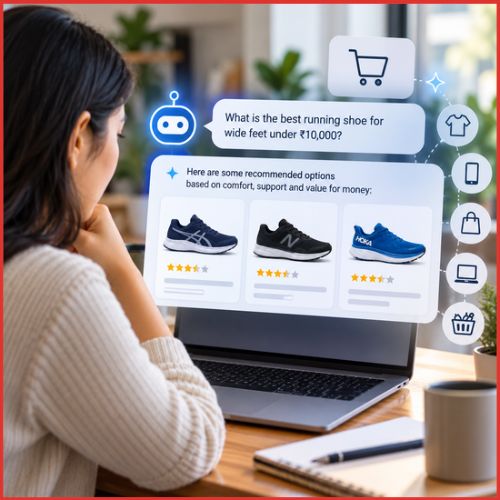
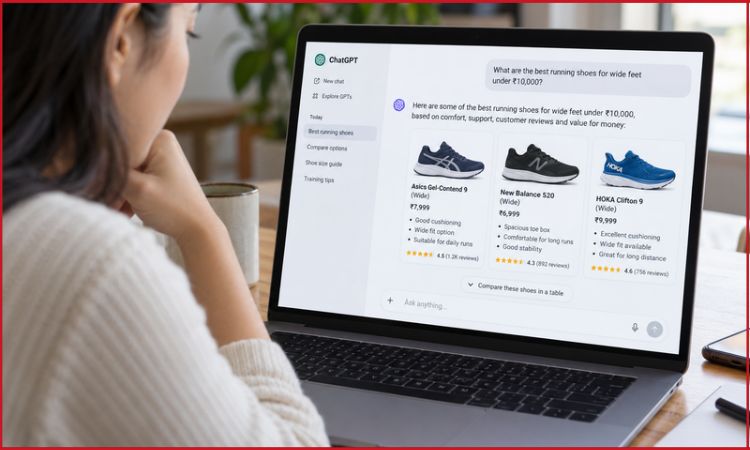
A customer might now begin with a question such as: “What is the best running shoe for wide feet under ₹10,000?” or “Which 55-inch television gives the best picture quality without paying for premium gaming features?”
An AI assistant can compare options before the shopper has opened a retailer’s website.
By the time that person reaches Amazon, a brand site or another marketplace, much of the consideration process may already be over.
McKinsey has described this shift as a new front door to the internet, where product research increasingly happens before a traditional website visit.
For retailers, AI product discovery therefore creates a visibility problem.
A product that never appears in the AI-generated shortlist may never get a chance to compete at checkout.
AI Chat Is Beating Retailer Assistants for Inspiration
The gap becomes clearer when looking at shopping inspiration.
Among AI users surveyed, 45% said they use AI chat and search tools for inspiration.
Only 23% use retailers’ own assistants for the same purpose.
That means independent AI tools are being used almost twice as often at the discovery stage.
Retailers still regain some ground later.
Around 15% of AI users had completed a purchase using a retailer’s assistant, compared with 14% who had purchased through a general AI chat or search tool.
So the transaction has not fully moved away from retailers.
The attention increasingly has.
US Purchases Through AI Have Risen 70%
The change is also moving beyond research.
Among US consumers already using AI, the share completing a purchase through an AI tool increased from 10% in December 2025 to 17% in the latest research.
That is a 70% increase in less than a year.
Among all US adults, including those who do not regularly use AI, the share completing an AI-assisted purchasedoubled from 5% to 9%.
The numbers remain relatively small compared with conventional e-commerce.
The direction is harder to ignore.
AI started as a tool for asking questions. It then became useful for comparing products. Now it is beginning to move closer to the transaction itself.
That progression is what retailers need to prepare for.
AI Shopping Is Spreading Into Groceries and Beauty
The behaviour is not limited to technology products.
Consumer electronics remain one of the largest categories, with 38% of AI shoppers using AI to research or decide what to purchase.
Clothing follows at 37%, with travel at 35%.
But traditionally slower online categories are catching up. Beauty has reached 34% and groceries 32%.
In the US, 42% of AI users have already used the technology for grocery decisions.
The share actually buying groceries through AI has risen by 11 percentage points since December 2025, the biggest increase of any category in McKinsey’s research.
That matters because groceries are repetitive.
If consumers eventually allow an agent to reorder routine items automatically, the shopping journey becomes very different from somebody manually browsing supermarket categories every week.
Retailers Need Product Data AI Can Actually Understand
This creates a practical problem for brands.
Traditional e-commerce optimisation has been built largely around people and search engines.
Product titles, images, descriptions, ratings and keyword placement were designed to help consumers find something through a search page.
AI agents need structured information too.
An agent answering a detailed request may need to understand price, availability, material, dimensions, delivery time, return policy, customer reviews and compatibility before recommending a product.
McKinsey argues that retailers need product information that AI systems can interpret and transaction infrastructure that authorised agents can use.
That makes agentic commerce partly a data problem.
A strong product with poor machine-readable information may become harder for AI tools to surface.
Retail Media Could Face an Even Bigger Disruption
There is another business at risk: retail advertising.
Retailers have built large media networks by selling sponsored positions inside their websites and apps.
That model works because shoppers visit the retailer and see those advertisements.
But imagine the entire research phase happening inside an AI assistant.
The user asks for three suitable products, reads the comparison and chooses one without ever browsing a category page.
The retailer may still fulfil the order, but its sponsored search placement was never seen.
McKinsey has estimated that more than $3 trillion in global consumer commerce could eventually be mediated by AI agents by 2030.
That does not mean retailer websites disappear.
It means the economic value of controlling the beginning of the journey could move elsewhere.
Retailers Still Have Time, but the Front Door Is Moving
The biggest takeaway from the McKinsey AI shopping research is not that people have stopped using retailers.
They haven’t.
Retailers are still strong at checkout, fulfilment, service and physical product interaction.
What is changing is where the decision begins.
If 29% of AI shoppers already say AI chat or search had the greatest influence on their latest purchase, product discovery is moving outside the environments retailers have spent years building.
For brands, that means being visible on Google or inside a marketplace is no longer enough.
They increasingly need to be understandable, recommendable and purchasable by an AI agent as well.
The retailer may still own the checkout button.
AI is starting to own the shortlist.
Source: