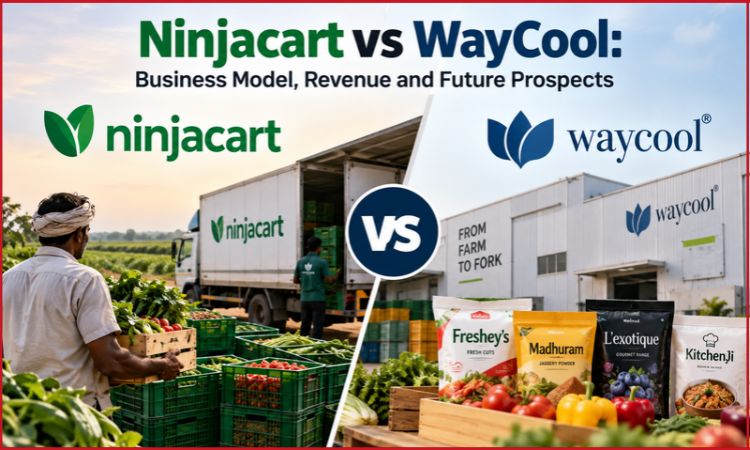
The Ninjacart vs WayCool comparison highlights two different approaches to India’s agricultural supply chain. Both companies aim to make it easier for farmers to sell their produce and for businesses to source food. However, their strategies differ.
The EBITDA profits were earned by Ninjacart in July 2026 and it was able to raise $6 million from its existing investors. WayCool has raised ₹210 crore from Lightrock India in March 2026 as it was working towards financial viability.
Now the big question is, which of the two companies has better chances of building sustainable businesses?
The focus of Ninjacart business has been on procurement and distribution of fresh products. WayCool works on a broader food value chain of distribution, processing, and brands.
Let’s compare their business models, financial performance, funding and future prospects.
Ninjacart vs WayCool: Company Overview
Both companies were founded in 2015, but their businesses have developed in different directions.
| Company Details | Ninjacart | WayCool Foods |
|---|---|---|
| Founded | 2015 | 2015 |
| Headquarters | Bengaluru | Chennai |
| Founders | Kartheeswaran K.K., Thirukumaran Nagarajan and others | Karthik Jayaraman and Sanjay Dasari |
| Core business | Fresh produce procurement and distribution | Food sourcing, distribution, processing and brands |
| Main customers | Retailers, quick-commerce companies and food businesses | Retailers, restaurants and institutional buyers |
| Latest funding development | $6 million in July 2026 | ₹210 crore in March 2026 |
The main distinction is obvious. While Ninjacart focuses on the efficient transportation of fresh produce, WayCool takes into consideration several more phases of the food chain.
Such distinction influences their revenue generation and cost control methods.
1. Business Model: Ninjacart vs WayCool
Ninjacart: Focused on Fresh Produce
Ninjacart connects farmers and agricultural suppliers with retailers and other business customers.
It does more than just connecting buyers and sellers online. The company coordinates sourcing, quality checks, demand planning and delivery of the products.
Consider a retailer that needs fresh vegetables every morning. The retailer wants consistent quality, timely delivery and prices that leave room for profit.
Ninjacart works to meet these needs through its procurement and distribution network.
Technology assists the company to plan for demand, inventory management and logistics coordination. This is essential since the freshness of produce might be lost fast if the produce does not sell or is damaged.
The key benefit is focus. Ninjacart will be able to concentrate on enhancing the sourcing of fresh produce.
However, fresh produce distribution is a difficult business. Even when sales increase, transport costs, spoilage and low margins can limit profits.
WayCool: A Broader Food Supply Chain
WayCool follows a wider farm-to-fork model.
Its activities include agricultural sourcing, food distribution, processing and consumer brands such as Madhuram, KitchenJi, L’exotique and Freshey’s.
This method gives the company more ways to serve customers.
For example, an established distribution network can help WayCool supply different food categories to retailers and businesses. Processing and branded products also allow it to sell beyond basic agricultural commodities.
But a broader business brings additional costs. Processing requires equipment and packaging, while consumer brands need marketing and distribution.
WayCool must manage these activities without allowing operating expenses and inventory costs to grow too quickly.
Which Business Model Is Better?
Neither model is necessarily better than the other one.
The Ninjacart model enjoys the advantage of an efficient operating approach, but it has to show that it can make profit through efficiency.
WayCool has more chances to make money in the food chain, but it has to handle a more complicated business.
In the end, the superior model is the one that earns more money without relying constantly on new financing.
2. Supply-Chain Efficiency: Where Do They Stand?
Agricultural supply chains face a common problem: getting the right products to the right buyers at the right time and cost.
Ninjacart claimed in July 2026 that Ninjacart served more than 40 cities, carried over 150 varieties of fresh produces, and transported more than 1,500 tonnes of produce daily.
It also added that their core business grew three times during the last year due to demand from quick commerce firms and modern retails.
Clearly the firm is operating at a large scale. Increased order sizes can help reduce certain costs on a per order basis as long as delivery and inventory is managed efficiently.
However, scale alone does not guarantee profitability. Poor demand planning, damaged produce or expensive deliveries can quickly reduce margins.
WayCool’s supply chain has greater reach than Sprout. As per a report regarding its fundraising of March 2026, its platform called Outgrow engaged more than 85,000 farmers.
This enables WayCool to source their crops through its network. But the number of farmers doesn’t tell how well its supply chain is being managed currently by the company.
A fair comparison would require updated comparative numbers regarding delivery cost, wastages, inventories, etc., which were not available from public reporting regarding both these companies considered for this article.
Therefore, Ninjacart offers a clearer picture of its recent fresh-produce operating scale, while WayCool’s overall efficiency remains harder to assess.
3. Revenue and Profitability: What Do the Numbers Show?
Revenue tells us how much a company earns from its operations. Profitability shows whether it can keep enough money after covering its costs.
This is especially important in food distribution, where sales can be large but margins are often tight.
Ninjacart Revenue and Financial Performance
Ninjacart reported the following operating revenue and net loss figures:
| Financial Indicator | FY24 | FY25 |
|---|---|---|
| Operating revenue | ₹2,007 crore | ₹1,634 crore |
| Net loss | ₹260 crore | ₹256 crore |
Its revenue fell by approximately 19% in FY25, while its net loss narrowed slightly.
The company has said that it shifted its focus towards profitability and exited selected low-margin business segments.
This approach can make sense if the remaining operations generate better returns. However, the FY25 figures show that the company was still reporting a substantial net loss.
The EBITDA profitability milestone for Ninjacart was reached in July 2026 and was attributed to better product mix, better procurement, reduced wastage, and efficient supply chain management.
This is promising news but there is one important difference. EBITDA profitability does not necessarily mean net profitability.
Interest, Taxes, Depreciation and Amortization are not included in the EBITDA. Therefore, it is possible for a company to show positive EBITDA while posting a net loss.
It is now time for Ninjacart to sustain the positive EBITDA and move towards net profits.
WayCool Revenue and Financial Performance
WayCool reported operating revenue of ₹1,251.4 crore in FY23, compared with ₹772.3 crore in FY22.
The net loss recorded by WayCool in FY23 is nearly ₹685 crore after adjusting for certain non-cash costs. The accounting loss including these non-cash costs is estimated to have been ₹2,591.6 crore.
This demonstrates considerable financial pressure at this time. However, the bigger accounting loss cannot be considered as the equivalent amount of cash that was lost, owing to the inclusion of many non-cash costs.
A better financial comparison could have been provided in recent years. However, the information gathered for this report does not provide us with a similar revenue figure for WayCool.
It would be misleading to compare WayCool’s FY23 revenue directly with Ninjacart’s FY25 revenue and treat the difference as a measure of their current size.
Financial Comparison at a Glance
| Indicator | Ninjacart | WayCool |
|---|---|---|
| Latest revenue figure used | ₹1,634 crore in FY25 | ₹1,251.4 crore in FY23 |
| Reported loss | ₹256 crore in FY25 | Approximately ₹685 crore in FY23, excluding specified non-cash expenses |
| Recent development | Announced EBITDA profitability in July 2026 | Raised ₹210 crore in March 2026 |
| Main financial question | Can EBITDA gains lead to net profits? | Can the company demonstrate a sustainable financial recovery? |
The figures cover different financial years and accounting measures, so they do not establish which company is currently larger or more profitable.
Ninjacart has a clearer recent financial picture. WayCool needs more recent, comparable disclosures to make a fair assessment of its progress.
4. Funding and Leadership: Different Paths to Growth
Funding gives companies money to expand or improve their operations. However, it does not guarantee that their business models will succeed.
Ninjacart: Improving Operating Efficiency
Ninjacart is led by co-founder and CEO Kartheeswaran K.K.
Its recent strategy has focused on improving the economics of its core business rather than pursuing growth at any cost.
Exiting selected low-margin activities, improving sourcing and reducing waste can help the company build a stronger financial foundation.
In July 2026, Ninjacart raised $6 million from existing investors, including Accel, Nandan Nilekani and Tiger Global, as the first tranche of a larger funding round.
The company has also discussed preparing for a potential public listing within the next two years. This is an intention, not a confirmed IPO date.
The key question is whether Ninjacart can maintain its operating improvements and demonstrate sustainable profitability.
WayCool: Funding During a Turnaround
WayCool has faced financial and organisational challenges.
Co-founder Sanjay Dasari stepped back from day-to-day operations in December 2024 but said he would continue supporting the company in an advisory role.
In March 2026, WayCool raised ₹210 crore through a rights issue backed by existing investor Lightrock India.
The investment provides additional capital as the company works towards financial sustainability.
However, fresh funding is only one part of a recovery. WayCool must also demonstrate that its distribution, processing and branded-food businesses can generate sufficient returns.
The difference is one of emphasis: Ninjacart’s recent story centres on operating efficiency and reported EBITDA profitability, while WayCool’s centres on fresh capital and the need to demonstrate a financial recovery.
5. Future Prospects: Which Company Is Better Positioned?
Both companies have opportunities in India’s agricultural market. Their success will depend on how well they manage costs, serve customers and turn revenue into profits.
Ninjacart’s Growth Opportunities
Ninjacart can build on its existing relationships with retailers, quick-commerce companies and other business customers.
Higher order volumes could improve its operating economics if the company can control delivery costs, reduce waste and maintain healthy margins.
Its reported EBITDA profitability is a positive development after the net loss recorded in FY25.
However, the next step is more important than the announcement itself. Ninjacart must show that the improvement can last and eventually support consistent net profits.
Its potential IPO plans also make reliable financial performance increasingly important.
WayCool’s Recovery Opportunities
WayCool’s broader model gives it several possible growth paths.
Its distribution network can support different food categories, while processing and consumer brands offer opportunities to move beyond basic commodity sales.
But diversification only creates value when the additional revenue justifies the cost of managing these activities.
WayCool must show that its business can grow without creating excessive inventory costs, operational complexity or dependence on fresh funding.
More recent financial statements would help establish whether its revenue, losses and cost structure are improving.
Conclusion
Ninjacart and WayCool are trying to solve the same problem: making India’s agricultural supply chain more efficient and commercially sustainable.
Ninjacart focuses on fresh produce procurement and distribution. Its recent EBITDA profitability announcement suggests progress, but its next challenge is to turn operating gains into consistent net profits.
WayCool combines sourcing and distribution with processing and consumer brands. This creates more opportunities, but also brings higher operational complexity. Its recent funding provides additional capital, although its current financial trajectory remains difficult to establish from comparable public figures.
Neither firm should be assessed merely on the basis of revenue and funding.
Ninjacart needs to demonstrate that its specialization can generate sustainable profitability. WayCool needs to demonstrate that its comprehensive approach can create sustainable profitability.
Ultimately, the winner depends on how efficiently they are able to manage costs, satisfy customers, and develop companies that can scale without always needing new funding.
Frequently Asked Questions
1. What is the main difference between Ninjacart and WayCool?
Ninjacart concentrates on procurement of fresh produce, B2B business, and distribution. WayCool engages in a more extensive food value chain involving sourcing of agriculture produce, processing, distribution, and brands.
The two companies employ technological means as well as supply chains to link agricultural produce with businesses.
2. What was Ninjacart’s revenue in FY25?
Ninjacart has claimed operating income of ₹1,634 crore in FY25 compared to ₹2,007 crore in FY24. Its net loss stood at ₹256 crore. Ninjacart declared in July 2026 that it had made itself EBITDA profitable, but it does not mean that it is profitable overall.
3. What is WayCool’s latest reported revenue?
The most recent and verified operating income for the purpose of comparison is ₹1,251.4 crore for FY23. However, no other recent and audited figure can be identified from the analysis conducted. Hence, this figure should not be considered when comparing WayCool with Ninjacart’s FY25 operating income.
4. Which company has better future prospects?
Ninjacart seems to have a better operating track record recently, given its profitability in terms of EBITDA and its emphasis on efficient supply chain.
WayCool has more potential to create value through processing, distribution, and branding. However, its future will be determined by how well it recovers financially.