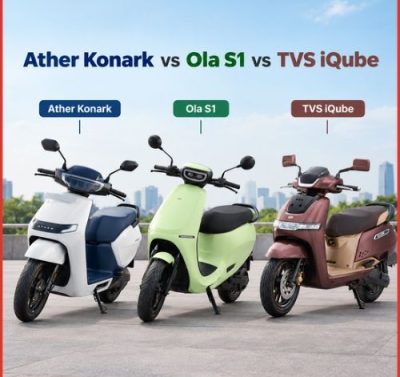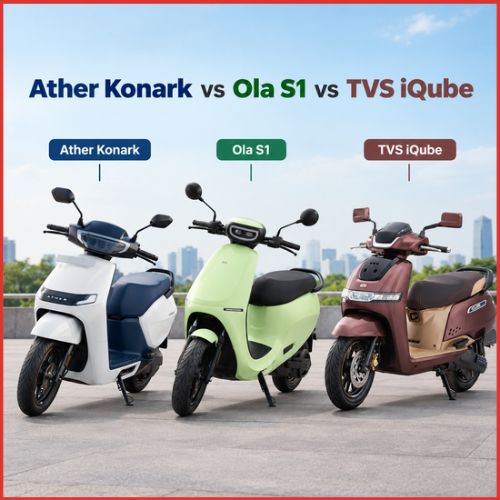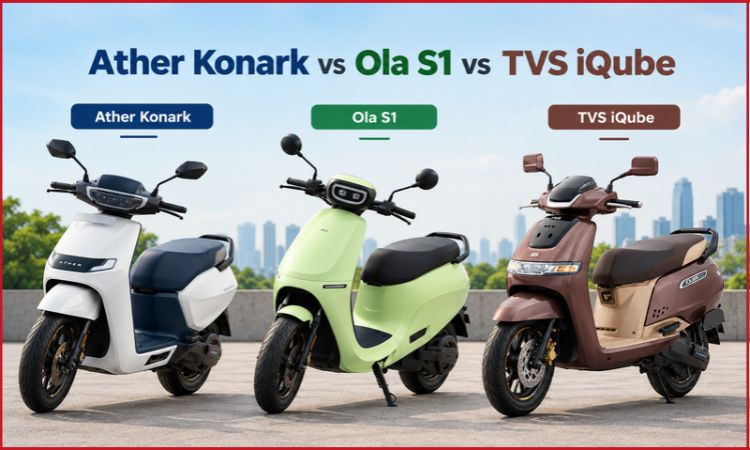
Walk into any two-wheeler showroom in an Indian city today and the electric section has gotten noticeably crowded. A first-time buyer comparing Ather Konark vs Ola S1 vs TVS iQube isn’t short on options anymore the problem now is picking one without regret six months later. All three sit in that increasingly competitive budget electric scooters in India bracket, priced close enough that the decision usually comes down to range, service experience and what a rupee actually buys you on the spec sheet.
This comparison looks at where each of these best electric scooters 2026 has to offer actually stands: how the newly launched Ather Konarc electric scooter fits against the established Ola S1 comparison and TVS iQube comparison, what electric scooter price and range India buyers can realistically expect, and which one suits which kind of rider. Prices, specifications and availability for electric vehicles change often, so treat the figures here as a snapshot rather than gospel, and always check current listings before booking.
Why This Segment Suddenly Matters
Electric scooters crossed a psychological line this year. When a scooter from a brand known for premium positioning can be bought for under a lakh, and rivals response with battery-warranty extensions and price cuts of their own, it signals that electric two-wheelers are no longer a niche purchase for early adopters they are trying to displace the humble petrol commuter scooter that most Indian households still ride.
That shift explains why the Ather Konark vs Ola S1 vs TVS iQube conversation has become so common in owner forums and comparison searches. Ather, historically the most expensive of the three, has entered the mass-market fight with a genuinely low starting price. Ola continues to compete on raw specification per rupee. TVS, meanwhile, leans on something neither rival can match overnight: a two-wheeler dealership and service network built up over decades. Each approach appeals to a different kind of buyer, which is exactly why a straight number-for-number comparison only tells part of the story.
Meet the Contenders
Ather Konarc (commonly searched as Ather Konark) is the newest of the three, unveiled at Ather Community Day on August 29, 2026. Built on the company’s new EL platform, it is a deliberate departure from the sporty 450 series a simpler, family-oriented design with a metal body, a steel unibody chassis, a 14-inch front wheel and 12-inch rear wheel, and long-travel suspension meant to soak up ordinary Indian roads rather than chase lap times. It comes in S and Z lines across several battery sizes, with a DeepView digital display on the base variants and a TFT touchscreen plus features like AutoHold and MagicKey reserved for higher trims.
Ola S1 needs less introduction; it has been the price-and-features benchmark that other manufacturers get measured against since its debut. The lineup today is really a ladder: the S1 X anchors the value end, mid-tier S1 X variants add battery capacity and range, and the S1 Pro sits at the top with the most performance and the fullest feature set, including a large touchscreen, cruise control, reverse mode and regular over-the-air software updates.
TVS iQube is the veteran here, on sale since 2020 and now in its third or fourth round of variant updates. It has quietly become one of India’s best-selling electric scooters, not by chasing headline specifications but by feeling like a scooter people already know how to ride comfortable seat, familiar switchgear, and TVS’s dealer network standing behind it in towns where newer EV brands simply don’t have a service centre yet.
Detailed Comparison: Price, Range and Performance
Here’s how the three stack up on the numbers that matter most to a budget-conscious buyer. Battery-pack naming varies by brand, so figures below reflect the broad range across each scooter’s variant lineup rather than one single configuration.
| Scooter | Ex-showroom Price (approx.) | Claimed Range | Top Speed | Notable Features |
| Ather Konarc (Konark) | ₹99,999 – ₹1.45–1.52 lakh | 100 km – 200 km (IDC) | 70–80 km/h | Metal body, steel unibody chassis, CCS fast charging, TFT touch on top trims |
| Ola S1 (X to Pro) | ₹69,999 – ₹1.75 lakh | 95 km – 190 km+ | 85–90 km/h | Large touchscreen, cruise control, reverse mode, OTA updates, 8-yr battery warranty |
| TVS iQube | ₹1.11 lakh – ₹1.62 lakh | 94 km – 212 km | 75–82 km/h | 32-litre underseat storage, wide dealer network, disc/drum brake options by trim |
A few things stand out in this electric scooter price and range India snapshot. Ather Konark’s entry price of ₹99,999 undercuts what most buyers would have expected from the brand a year ago, though that specific variant carries the shortest claimed range in its lineup buyers wanting the full 200 km IDC figure need to move up to a pricier battery pack. Ola S1’s value proposition still looks the strongest on paper at the bottom of its ladder, with the S1 X range starting under ₹70,000 in some cities depending on active subsidies. TVS iQube costs more at entry level than either rival but offers the widest spread of variants to fine-tune between price and range, and its ST trim’s 212 km claimed figure remains among the highest in the segment.
Claimed IDC or ARAI figures rarely match real-world range once you factor in Indian traffic, weather, payload and riding style expect actual range to run noticeably lower than the certified number on all three scooters, generally by 15 to 30 percent depending on how the vehicle is ridden.
What to Consider Before You Decide
Price and range headline every ad, but they aren’t the only factors that decide whether an electric scooter purchase turns out well.
- Service network: TVS’s decades-old dealership reach still outpaces Ather and Ola in tier-2 and tier-3 towns; if you don’t live near a company-owned service centre, this can matter more than a few extra kilometres of range.
- Charging setup: Ather Konark’s optional off-board charger cuts home charging time meaningfully, but it’s an added cost check whether it’s bundled or sold separately in your variant.
- Software and connectivity: Ola’s touchscreen and app ecosystem feel the most smartphone-like of the three, which appeals to tech-forward buyers but adds another system that can occasionally need troubleshooting.
- Resale and battery warranty: compare the battery warranty period (in years and kilometres) rather than just the headline price, since battery replacement cost is the single biggest expense over an electric scooter’s life.
- Braking and safety kit: variants differ some base trims use drum brakes on both wheels while higher trims add a front disc, so don’t assume feature parity across a brand’s own lineup.
- Local subsidies: state-level EV subsidies and the central EMPS scheme shift effective prices city to city, so the number you see on a manufacturer’s website may not match what you’re quoted at a dealership.
Practical Recommendations by Buyer Type
For the strict first-time EV buyer on a tight budget, the Ola S1 X’s lower-battery variant remains hard to beat on pure entry price, provided you have reasonable access to Ola’s service points nearby.
For someone who wants a scooter that looks and feels like a premium product without paying premium-scooter money, Ather Konark’s mid-tier variant is worth a serious look you get Ather’s build quality and software polish at a price that would have bought only the entry Ather 450 a couple of years ago.
For buyers in smaller towns, or anyone who values walking into a familiar dealership for service rather than depending on app-based support, TVS iQube’s dealer reach and long track record make it the safer, if slightly pricier, choice particularly the mid-range 3.1 kWh variant that balances price and range sensibly.
For families needing two-up comfort and generous storage for daily errands, both TVS iQube and the Ather Konarc’s longer, lower design suit that use case better than Ola’s sportier stance.
Final Verdict
There’s no single winner in the Ather Konark vs Ola S1 vs TVS iQube contest only a better fit depending on what you’re optimising for. Choose Ola S1 if entry price and tech-forward features top your list. Choose Ather Konark if you want premium build quality and design at a genuinely accessible price point for the first time. Choose TVS iQube if long-term service peace of mind and a proven track record matter more to you than shaving a few thousand rupees off the sticker price.
Whichever way you lean, treat every figure in this comparison price, range, top speed as a starting point for your own test ride and dealership visit, since electric scooter price and range India listings shift with subsidies, new variants and city-specific offers more often than the petrol-scooter market ever did.
Frequently Asked Questions
Which is cheaper, Ather Konark or Ola S1?
At entry level, Ola’s smallest-battery S1 X variant is typically priced lower than Ather Konark’s base variant, though Ather’s ₹99,999 starting price closes that gap considerably compared with its older models. Exact pricing depends on your city and any active subsidy.
Does the TVS iQube offer better range than Ather Konark or Ola S1?
TVS iQube’s top ST variant claims up to 212 km of range, edging out the highest Ather Konark and Ola S1 configurations on paper, but all three brands’ claimed figures should be treated as ceiling numbers rather than everyday expectations.
Which of these budget electric scooters in India has the best resale value?
Resale data for newer EV models is still limited, but TVS iQube’s longer market presence and wider owner base generally give it a more established resale trail than the newer Konarc or Ola’s frequently updated S1 lineup.
Is the Ather Konark worth buying over the older Ather 450 series?
If budget is the primary concern, yes Konark brings Ather’s build and software down to a much lower starting price. Buyers wanting sportier performance or the brand’s highest range figures may still prefer the 450 series.
How does charging time compare across Ather Konark, Ola S1 and TVS iQube?
Charging times vary by battery size and charger type across all three brands, generally falling somewhere between roughly 2 hours (with faster/optional chargers) and 5-6 hours for a full charge on standard home chargers. Always confirm the figure for your specific variant.
Which brand has the widest service network for these budget electric scooters in India?
TVS currently has the broadest physical dealership and service reach of the three, owing to its long history in the conventional two-wheeler business, though Ather and Ola have both been expanding their own networks steadily.
Are government subsidies still available on Ather Konark, Ola S1 and TVS iQube?
Subsidy schemes and their amounts change periodically at both the central and state level, so the effective on-road price of any of these electric scooters can shift; check current EMPS or state EV policy details before finalising a purchase.