A regular filter coffee costs a fraction of what a Starbucks cup does, yet the queues outside its stores rarely thin out. That gap between price and demand is really the starting point for understanding the Starbucks business model. Starbucks is not just selling coffee; it is selling convenience, customisation and a recognisable brand experience wrapped around every cup. Company-operated stores, licensed outlets, packaged products, a loyalty programme and a mobile app all pull in the same direction, and each piece adds its own layer to the wider Starbucks revenue model that keeps the company growing even in a tough year for consumer spending.
This piece breaks down how Starbucks makes money, why its business strategy leans so heavily on scale and repeat purchases, and where the model is now being tested by rising costs and slower footfall.
Starbucks Business Model at a Glance
| Business Model Component | How It Generates Revenue | FY2025 Contribution |
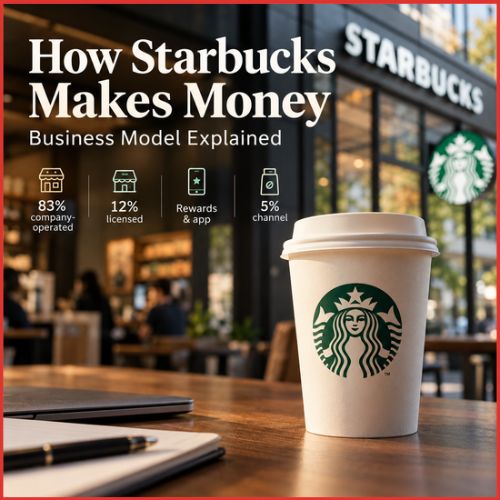
| Company-operated stores | Direct sales of beverages, food, and merchandise | ~83% of net revenue |
| Licensed stores | Royalties, licence fees, product and equipment sales to partners | ~12% of net revenue |
| Channel development | Packaged coffee, ready-to-drink products, Global Coffee Alliance with Nestlé | ~5% of net revenue |
| Starbucks Rewards | Drives frequency and higher spend among loyalty members | ~60% of US company-operated revenue |
| Digital and mobile ordering | Convenience-led repeat purchases through the app | Embedded across all segments |
| Premium pricing | Higher average ticket per transaction | Supports margin across the model |
Starbucks Corporation reported total net revenue of $37.18 billion for fiscal 2025 (year ended September 28, 2025), up close to 3% from $36.18 billion in fiscal 2024, according to its fiscal 2025 annual report and fourth-quarter results released in October 2025. Understanding how that figure is built is the fastest way into the Starbucks business model.
How Does Starbucks Make Money?
The cleanest way to answer how Starbucks makes money is to split the business into company-operated stores and licensed stores, then layer packaged products and loyalty spend on top.
1. Company-Operated Stores
Company-operated stores are the backbone of the Starbucks revenue model. Starbucks owns these locations outright, which means it carries the rent, staffing, equipment and inventory costs itself, but it also keeps the full retail revenue from every transaction.
In fiscal 2025, company-operated stores brought in $30.74 billion, or roughly 83% of total net revenue, according to Starbucks’ fiscal 2025 Form 10-K filed with the SEC. Growth here came mainly from net new store openings, which added 5% more company-operated locations over the year, even after the company closed 627 underperforming cafes late in the fourth quarter as part of its restructuring plan.
The menu itself does a lot of work inside this part of the Starbucks business strategy. A single store can serve:
- Espresso-based beverages and cold brews
- Refreshers and iced tea
- Bakery items and hot food
- Seasonal and limited-time drinks
- Packaged coffee and merchandise
Because the same store can serve a morning commuter, a lunchtime customer and an evening browser, company-operated stores support multiple visit occasions in a single day, which is central to how Starbucks makes money at scale.
2. Licensed Stores
The second pillar of the Starbucks business model is the licensing arrangement. Under the Starbucks licensing model, a local partner runs the store day to day, while Starbucks earns a royalty on retail sales plus a margin on the branded products, equipment and supplies it sells to that partner.
Licensed stores generated $4.35 billion in fiscal 2025, about 12% of total net revenue, per the company’s annual report. That is a smaller slice than company-operated sales, but the licensing model is comparatively capital-light: the licensee, not Starbucks, funds store build-out and covers day-to-day operating costs. This is why the Starbucks licensing model is so useful in airports, university campuses, hospitals and other high-footfall sites where running a store directly would be impractical.
At the close of fiscal 2025, Starbucks operated 40,990 stores across 89 markets worldwide, split almost evenly between 21,514 company-operated stores (52%) and 19,476 licensed stores (48%), based on the company’s fiscal 2025 annual report.
The Starbucks Revenue Model Beyond the Coffeehouse
A large part of what makes the Starbucks revenue model resilient is that it does not depend on coffeehouse visits alone.
Packaged Products and the Global Coffee Alliance
Starbucks sells packaged coffee, tea and ready-to-drink beverages through grocery and foodservice channels, largely through its Global Coffee Alliance with Nestlé. This channel development segment contributed close to 5% of total net revenue in fiscal 2025 and lets Starbucks reach households that may never step inside one of its cafes.
Loyalty Spend as a Revenue Stream
Starbucks Rewards has quietly become one of the most important Starbucks revenue streams in its own right. Members drove nearly 60% of US company-operated revenue in fiscal 2025, equal to more than $13 billion in spend, and the programme reached an all-time high of over 35 million 90-day active members, according to Starbucks’ own corporate newsroom updates in 2026. A customer who joins Rewards is far more likely to keep coming back, which is exactly what a subscription-style loyalty engine is built to do.
Why Starbucks Can Charge Premium Prices
Price is where the Starbucks business model gets interesting. Starbucks rarely competes on being the cheapest cup in town. Instead, it stacks several things on top of the coffee itself:
- A globally recognisable brand
- Convenient, high-visibility store locations
- Deep customisation of every drink
- A consistent experience from one city to the next
- Mobile ordering and payment
- Loyalty benefits tied to Rewards
- Rotating seasonal menus
Put together, this is what lets Starbucks sustain a premium coffee business model even when a cheaper cup is available two doors down.
Starbucks Business Strategy: Scale, Stores, and Supply Chain
Scale sits at the centre of the Starbucks business strategy. More stores create more customer touchpoints; more touchpoints create more transactions; and higher transaction volume supports the marketing, technology and supply chain investment that keeps the brand consistent everywhere it operates.
Starbucks deliberately places company-operated stores in high-traffic spots such as downtown districts, office parks and university campuses, while using the licensing model to reach airports, hospitals and other locations it would not build out on its own. Behind the counter, the company runs its own coffee sourcing, roasting and distribution network so that a cappuccino in Lucknow tastes recognisably like one in London. That consistency is not incidental; it is a deliberate part of the Starbucks business strategy that protects the brand as the store count grows.
Starbucks Business Model in India
India is a useful case study in how the Starbucks business model adapts to a new market rather than simply copying the US playbook.
Starbucks entered India in 2012 through Tata Starbucks, a 50:50 joint venture with Tata Consumer Products. By 2026, the venture operated more than 500 stores across roughly 80 Indian cities, according to reports citing the joint venture’s own disclosures, and the company has said it wants to reach 1,000 stores by 2028. In June 2026, Tata Consumer Products chairman N. Chandrasekaran told shareholders that the venture could eventually scale to around 8,000 stores in India, adding that the Starbucks business in the country had turned EBITDA-positive in fiscal 2026.
Starbucks has also been building out its India-based technology capabilities, with reports in 2026 pointing to plans for a standalone corporate office focused on engineering, cloud infrastructure and digital platform roles, expected to begin operating from fiscal 2027. Rather than replicating its US store format, the India business leans on local partnership, Tier II and Tier III expansion, and drive-through and airport formats suited to Indian cities a good example of how the Starbucks licensing and joint-venture approach flexes by market.
Challenges Facing the Starbucks Business Model
No business model is free of strain, and fiscal 2025 exposed some real pressure points in this one.
Running thousands of company-operated stores is expensive, and Starbucks felt that in its margins. GAAP operating margin contracted 710 basis points year over year to 7.9% in fiscal 2025, driven largely by restructuring costs, inflation and continued investment in labour hours under the company’s turnaround plan, according to its Q4 and full-year fiscal 2025 results released in October 2025. Global comparable store sales had also declined earlier in the year before turning positive again by the fourth quarter.
Starbucks’ “Back to Starbucks” strategy, launched under CEO Brian Niccol, has involved closing underperforming cafes 627 of them in the fourth quarter of fiscal 2025 alone while simplifying its corporate support structure. The company has framed this as a multi-year turnaround rather than a quick fix, which is a reminder that a high headline revenue number does not automatically translate into higher profitability.
What Makes the Starbucks Business Model Work
The real strength of the Starbucks business model is that its pieces reinforce one another rather than operating in isolation. A customer notices the brand, visits a conveniently located store, orders a customised drink, joins Starbucks Rewards, starts using the app, and comes back more often because of it. Licensed stores extend the same brand into places Starbucks would not build alone, and packaged products carry it into homes that never see the inside of a cafe. Together, these Starbucks revenue streams turn a fairly simple product, a cup of coffee, into a business generating tens of billions of dollars a year.
Key Takeaways
- Starbucks generated $37.18 billion in total net revenue in fiscal 2025, with company-operated stores contributing about 83% of that figure.
- The Starbucks licensing model lets partners run stores in airports, campuses and hospitals while Starbucks earns royalties and product revenue.
- Starbucks Rewards drove nearly 60% of US company-operated revenue in fiscal 2025, worth more than $13 billion in member spend.
- The company operated 40,990 stores across 89 markets at the end of fiscal 2025, split almost evenly between company-operated and licensed formats.
- India, run through the Tata Starbucks joint venture, has crossed 500 stores and is targeting 1,000 by 2028.
- Rising costs and store closures under the “Back to Starbucks” plan show that scale alone does not guarantee margin growth.
Conclusion
Coffee is the product people see, but it is not really what powers the Starbucks business model. Company-operated stores generate the bulk of the revenue, licensed stores extend the brand at lower capital cost, packaged products carry it into homes, and Starbucks Rewards keeps millions of customers coming back on a schedule. Fiscal 2025 also showed the other side of that scale: restructuring costs and store closures can eat into margins even as top-line revenue keeps climbing. Taken together, that is what makes the Starbucks business model worth studying: a fairly ordinary product turned into a global, technology-enabled retail business that still has to keep proving itself every quarter.
FAQs
1. What is the Starbucks business model?
The Starbucks business model combines company-operated coffeehouses, licensed stores, packaged products, digital ordering and a loyalty programme. Company-operated stores are the largest single revenue source, but licensing, channel development and Rewards spend all add meaningfully to the total.
2. How does Starbucks make money?
Starbucks makes most of its money selling beverages and food through company-operated stores. It also earns royalties and product revenue from licensed stores, and sells packaged coffee and ready-to-drink beverages through grocery and foodservice partnerships such as its Global Coffee Alliance with Nestlé.
3. What is the Starbucks licensing model?
Under the Starbucks licensing model, a local partner operates the store and covers its running costs and capital investment, while Starbucks earns a royalty on retail sales and a margin on the branded products and equipment it supplies to that partner.
4. Why is Starbucks so profitable, and why did margins fall in fiscal 2025?
Starbucks’ scale, premium pricing and loyalty programme have historically supported strong margins, but GAAP operating margin fell to 7.9% in fiscal 2025 as restructuring costs, store closures and labour investment under the “Back to Starbucks” plan weighed on profitability, even as revenue kept growing.
5. What is Starbucks’ biggest revenue source?
Company-operated stores are Starbucks’ largest revenue source, generating $30.74 billion in fiscal 2025 compared with $4.35 billion from licensed stores, according to the company’s fiscal 2025 annual report.
6. How big is Starbucks’ presence in India?
Starbucks operates in India through Tata Starbucks, a joint venture with Tata Consumer Products that had crossed 500 stores across roughly 80 cities by 2026, with a public target of 1,000 stores by 2028.