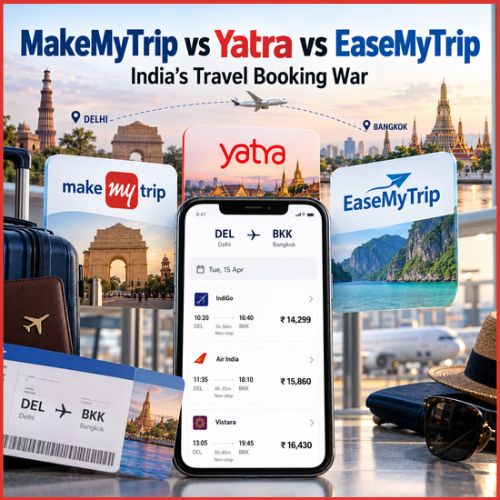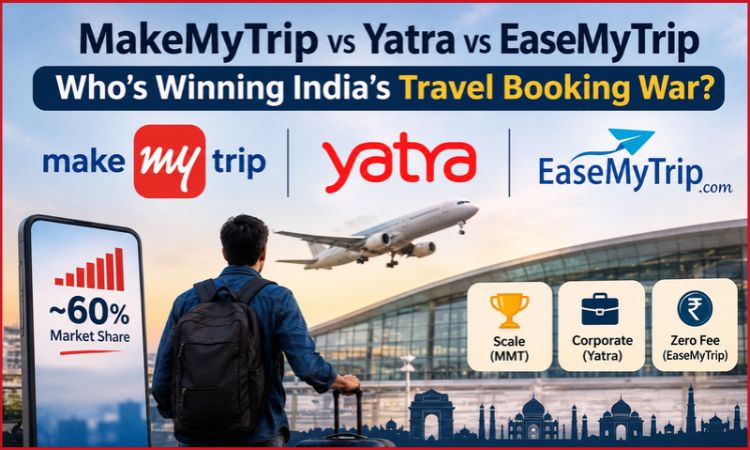
Book the same Delhi-to-Bangkok trip on three different apps and you will get three different final prices, three different loyalty pitches, and three very different corporate stories behind them. That gap sits at the centre of the MakeMyTrip vs Yatra vs EaseMyTrip rivalry that now shapes how millions of Indians plan travel.
One platform built an empire through scale and acquisitions. Another leaned hard into corporate accounts and stayed there. A third turned “zero convenience fee” into its entire personality. Whether you are studying the stocks, building a competing product, or just deciding where to book your next flight, the differences are worth knowing.
This piece looks at where each company came from, how their business models actually diverge, and what the numbers say about who leads India’s online travel market today.
Full Comparison Table
| Dimension | MakeMyTrip | Yatra | EaseMyTrip |
| Founded | 2000 | 2006 | 2008 |
| Founder(s) | Deep Kalra | Dhruv Shringi, Manish Amin, Sabina Chopra | Nishant, Rikant, Prashant Pitti |
| Headquarters | Gurugram | Gurugram | New Delhi |
| Core Focus | Full-service OTA (air, hotels, holidays, bus, rail) | Corporate travel + consumer bookings | Budget-first OTA, zero convenience fee |
| Listing | Nasdaq IPO, 2010 (~$80.5M raised, $478M valuation) | Nasdaq via reverse merger, Dec 2016 (~$92.5M raised); added NSE/BSE in 2023 | NSE & BSE IPO, March 2021 (₹510 crore, entirely offer-for-sale) |
| Key Metric | ~$9.8 billion gross bookings, FY25 | ₹422 crore revenue, FY24 | ₹8,691.6 crore gross booking revenue, FY25 |
| Market Share (OTA segment) | ~60% | ~5% | ~8-10% |
| Revenue Mix | Hotels & holidays now exceed air ticketing; multi-brand (MakeMyTrip, Goibibo, redBus) | Corporate contracts + consumer leisure bookings | Heavily air-ticketing dependent |
| Key Differentiator | Scale, brand recall, multi-brand inventory | Corporate account stickiness | No convenience fee, price transparency |
| Main Risk | Exposure to India-only economy, intense local competition | Overexposed to corporate travel slowdowns | Thin margins from fee-free model, air-ticketing dependence |
| Notable Move | 2016-17 ibibo Group merger (Goibibo, redBus) | Nov 2025 leadership shift — Shringi to Executive Chairman, Siddhartha Gupta as CEO | Bootstrapped pre-IPO; recent bets in AI booking tools and payments |
Background of MakeMyTrip
MakeMyTrip
Deep Kalra started MakeMyTrip in the United States in 2000, aiming it at non-resident Indians who wanted an easier way to book trips home. The India-facing business began only in September 2005, with airline ticketing as the entry point before holidays and hotels followed.
It listed on Nasdaq in 2010, raising close to $80.5 million at a $478 million valuation, becoming the first Indian company to IPO in the United States (company IPO filings, 2010). The defining move came later: the 2016 to 2017 merger with the Naspers-backed ibibo Group, folding in Goibibo and redBus and reshaping the competitive map for travel booking platforms in India.
Background of Yatra
Yatra launched in January 2006 out of Gurgaon, founded by Dhruv Shringi along with Manish Amin and Sabina Chopra. Where MakeMyTrip chased consumer scale, Yatra travel booking built its identity around corporate accounts, eventually serving several hundred large Indian companies for staff travel.
It listed on Nasdaq in December 2016 through a reverse merger with Terrapin 3 Acquisition Corporation, raising more than $92.5 million, becoming only the second Indian e-commerce company on that exchange (company press release, 2016). It added a dual listing on the NSE and BSE in 2023. More recently, in November 2025, Yatra elevated co-founder Dhruv Shringi to Executive Chairman and named Siddhartha Gupta as CEO for its next growth phase.
Background of EaseMyTrip
The EaseMyTrip story starts in a Delhi garage in 2008, when brothers Nishant and Rikant Pitti noticed their father being overcharged by a travel agent and decided to book flights online themselves. That frustration became Duke Travels, then EaseMyTrip, built almost entirely without outside funding.
Its signature move was dropping the convenience fee every other OTA charged, a simple pricing decision that built real loyalty among price-sensitive travellers. The company went public in March 2021 through an IPO worth ₹510 crore, structured entirely as an offer for sale by the Pitti brothers rather than fresh capital for the business (Business Standard, 2021).
Business Model: How Each One Actually Makes Money
MakeMyTrip runs a diversified, multi-brand engine. Air ticketing was once its largest contributor, but hotels and holiday packages have since overtaken it as the priority, since they carry fatter margins and lean on a fragmented Indian hotel market that rewards aggregation. Running MakeMyTrip, Goibibo and redBus under one roof gives the group pricing power a single-brand rival cannot match.
Yatra’s model looks almost inverted. Corporate travel contracts create switching costs that consumer OTAs rarely enjoy, since an employer that integrates Yatra into its expense and booking workflow is unlikely to churn for a marginally cheaper fare elsewhere. The trade-off is exposure: a slowdown in corporate travel spending hits Yatra harder than platforms built primarily for leisure bookings.
The EaseMyTrip business model still leans heavily on air ticketing, a segment under structural margin pressure across the industry. Zero convenience fee remains its core consumer promise, and the company has since tested adjacent bets in AI-driven booking tools and payments, though these remain early relative to its core business.
Funding, Listings and Scale
| Platform | Listing / IPO | Notable Milestone |
| MakeMyTrip | Nasdaq IPO, 2010 — raised ~$80.5 million at a $478 million valuation | 2016-17 merger with ibibo Group (Goibibo, redBus) |
| Yatra | Nasdaq listing via reverse merger, Dec 2016 — raised over $92.5 million | Added NSE and BSE listing in 2023 |
| EaseMyTrip | NSE and BSE IPO, March 2021 — ₹510 crore, entirely offer-for-sale | No fresh capital raised; founders retained ~75% stake |
Market Strategy and Positioning
Scale is MakeMyTrip’s whole argument. With brand recognition, the widest hotel and flight inventory, and a multi-brand structure that captures customers at different price points, it does not need to compete on convenience fees at all.
Yatra, by contrast, has quietly narrowed itself into a business travel specialist, a strategy that carries less glamour but arguably more resilience against the fare wars that have squeezed leisure-focused OTAs. EaseMyTrip has stayed closest to the original playbook of undercutting on fees, though that same low-fee positioning limits how much margin it can build without new revenue lines.
Here is the honest read on this corner of India’s online travel market: no single dimension decides it. Scale rewards MakeMyTrip. Stickiness rewards Yatra. Price sensitivity rewards EaseMyTrip. Each has picked a different battlefield rather than fighting the same one.
Which One Comes Out Ahead
On raw scale, MakeMyTrip’s market share of close to 60 percent and its $9.8 billion gross booking figure for FY25 leave little room for debate (Mize industry review, 2026). On resilience within one customer segment, Yatra’s corporate contracts give it a stickiness that consumer-facing platforms rarely replicate.
On price transparency, EaseMyTrip’s zero-fee stance remains the strongest consumer pitch of the three, even though its FY25 gross booking revenue of ₹8,691.6 crore is a fraction of MakeMyTrip’s scale. None of this makes one company universally “better.” It clarifies where each one is actually competing.
Meanwhile, India’s online travel market itself is projected to reach $25.38 billion in 2026 (Mordor Intelligence, 2026), which is why all three companies still have room to grow without cannibalising each other outright.
Key Takeaways
MakeMyTrip leads India’s online travel market by a wide margin, built on scale, brand recall and its multi-brand structure after the ibibo merger.
Yatra has traded consumer scale for corporate travel stickiness, a MakeMyTrip vs Yatra comparison that looks less like a fair fight and more like two different businesses sharing one label.
EaseMyTrip’s zero convenience fee model remains its sharpest differentiator, though heavy reliance on air ticketing keeps margins exposed to industry pricing pressure.
All three are now publicly listed, though their listing paths, from Nasdaq reverse mergers to a pure offer-for-sale IPO, differ almost as much as their business models.
India’s fast-growing travel demand leaves room for all three to expand without directly cannibalising each other.
Conclusion
There is no single winner in this fight, and treating it as one misses the point. MakeMyTrip’s scale genuinely sets it apart across travel booking platforms in India, but Yatra’s corporate travel base and EaseMyTrip’s price-led loyalty are real, defensible positions rather than consolation prizes.
For travellers, that competition keeps fares and service standards honest. For anyone tracking the sector, the smarter question is not who wins outright, but which of these three business models still looks durable five years from now as India’s online travel market keeps expanding.
Frequently Asked Questions
1. Which company has the largest market share among MakeMyTrip, Yatra and EaseMyTrip?
MakeMyTrip holds the largest share of India’s OTA segment, at roughly 60 percent, per industry estimates for 2025 and 2026. Yatra and EaseMyTrip both operate at a fraction of that scale.
2. What makes EaseMyTrip’s business model different from its rivals?
EaseMyTrip built its identity around charging zero convenience fees, unlike most OTAs at the time it launched. That pricing choice, backed by call-centre support, helped it build a loyal, price-sensitive customer base.
3. Is Yatra mainly a corporate travel company now?
Yatra still serves individual travellers, but its clearest edge lies in managing travel for large corporate clients. That focus makes it a smaller consumer brand than MakeMyTrip while giving it steadier, contract-based revenue.
4. When did each of these three companies go public?
MakeMyTrip listed on Nasdaq in 2010, Yatra listed on Nasdaq in 2016 through a reverse merger before adding an NSE and BSE listing in 2023, and EaseMyTrip listed on the NSE and BSE in March 2021.
5. How does the MakeMyTrip vs Yatra comparison look in terms of scale?
MakeMyTrip’s gross bookings and revenue run many times larger than Yatra’s, reflecting its consumer scale and broader inventory. Yatra stays smaller but holds a distinct edge in corporate account relationships.
6. Does either Yatra or EaseMyTrip threaten MakeMyTrip’s market share?
Neither currently challenges MakeMyTrip on overall scale, but both have built defensible niches. Yatra’s corporate base and EaseMyTrip’s fee-free pitch keep them relevant without matching MakeMyTrip’s size.