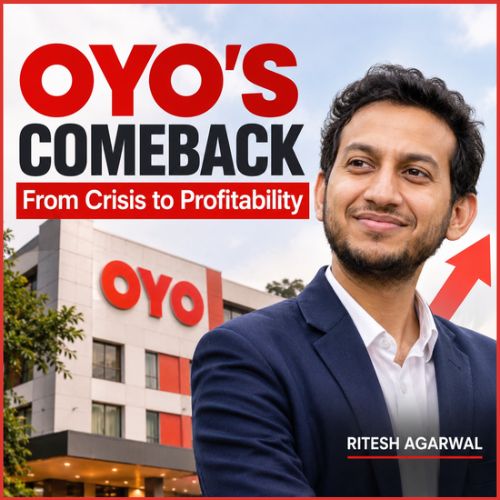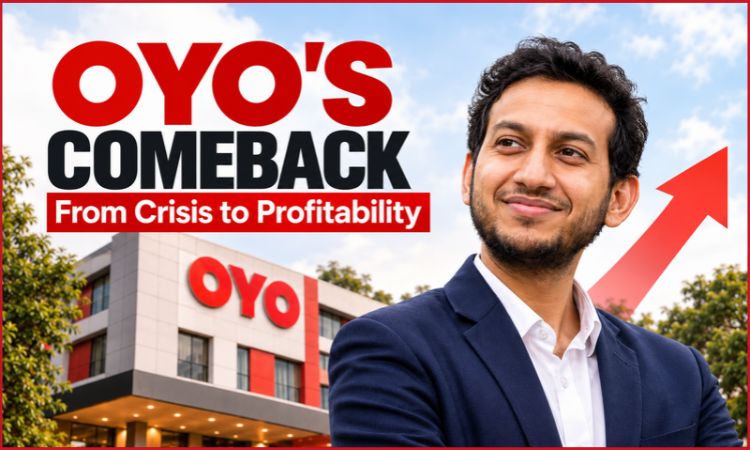
Few Indian startups have swung between hype and crisis quite like OYO. This OYO comeback story is less about a single lucky break and more about a founder who was forced to rethink almost everything he had built. Ritesh Agarwal started with a simple complaint from budget travellers — that finding a clean, dependable room shouldn’t feel like a gamble — and turned that complaint into one of the country’s fastest-growing hospitality startups. Then came the harder part: keeping it alive once the growth story stopped being enough on its own.
What follows traces how OYO’s business model shifted from land-grab expansion to disciplined profitability, why the pandemic nearly broke the company, and what its FY2024 and FY2025 numbers actually tell us about the health of the OYO turnaround. It also looks at where OYO profitability could realistically head next, and whether an OYO IPO is closer than it looked a few years ago.
Quick Glance
| Detail | Information |
| Founder | Ritesh Agarwal |
| Founded as | Oravel Stays (2012), rebranded OYO Rooms (2013) |
| Current corporate identity | PRISM (2025 restructuring) |
| FY2024 profit after tax | ₹229 crore (approx.) |
| FY2025 profit after tax | ₹623 crore (as reported by Ritesh Agarwal) |
| Major 2024 acquisition | G6 Hospitality (Motel 6, Studio 6) — approx. $525 million |
| Reported IPO valuation range | $7–$8 billion (unconfirmed) |
| Key backer | SoftBank, among other investors |
The Beginning of OYO: A Young Founder’s Big Idea
Ritesh Agarwal was barely out of his teens when he launched Oravel Stays in 2012, a listing platform for budget accommodation. A year later, the idea was reworked into OYO Rooms, and the pitch became sharper: bring standardisation, technology, and a recognisable brand to India’s fragmented network of small hotels.
The Thiel Fellowship gave Agarwal both capital and credibility at a stage when most founders his age were still finishing college. That backing let him test a model that, on paper, solved a real problem in the Indian hospitality industry — thousands of independent properties with wildly inconsistent service, and no easy way for a traveller to know what they’d actually get.
The Business Opportunity
India’s hotel market was, and largely still is, dominated by unbranded, independently run properties. OYO’s early pitch to these owners rested on a few ideas:
- A consistent standard of rooms, bedding, and amenities across partner hotels
- Digital discovery and booking, at a time when many small hotels had no online presence at all
- Backend technology for pricing, inventory, and guest management
- Affordable rates for cost-conscious travellers
It was a workable model. Keeping quality consistent across thousands of independently owned properties, though, would turn out to be the company’s most persistent headache — one that outlasted almost every other challenge in the OYO comeback story.
Rapid Expansion: From Startup to Unicorn
Growth, once it started, didn’t slow down for years. OYO added properties at a pace that outstripped most rivals, then took the same playbook abroad — China, Southeast Asia, parts of Europe, and eventually the United States. SoftBank’s backing, alongside other major investors, fuelled a strategy built around visibility and scale rather than near-term margins.
This rapid rise made OYO one of the most closely watched unicorn startups to come out of India, and for a while, the growth numbers did most of the talking. But adding a hotel to the network is a very different task from running that hotel well, and OYO’s expansion soon collided with the operational reality of managing thousands of partners across dozens of markets.
The Problem With Hypergrowth
More properties on a map is not the same as a healthier business. OYO had to manage several problems at once:
- Partner relationships — hotel owners needed commercial terms and support that kept them loyal
- Customer experience — service standards had to hold across properties OYO didn’t directly run
- Operating costs — entering new countries is expensive long before it’s profitable
- Unit economics — revenue growth had to eventually translate into sustainable margins
None of these problems were fatal on their own. Together, and under pressure, they became the backdrop for the crisis that followed.
The Pandemic Crisis: A Major Setback
COVID-19 hit travel and hospitality harder than almost any other sector, and OYO’s business model — built entirely on people leaving their homes and booking rooms — had no shelter from it. Occupancy collapsed. Bookings dried up. Hotel partners that had signed on for growth were suddenly staring at empty properties.
For a hospitality startup that had spent years optimising for expansion, the pandemic forced an abrupt change in priorities. Survival, not scale, became the only metric that mattered.
Why the Crisis Mattered
Hospitality businesses are unusually exposed to swings in travel demand — when rooms sit empty, both the hotel owner and the platform connecting them to guests feel it immediately. The pandemic-era slump exposed a truth that applies well beyond OYO: a business model has to survive the slow years, not just perform well during the boom years. It was this period that pushed Ritesh Agarwal and his leadership team toward the financial discipline that later defined OYO’s turnaround.
Ritesh Agarwal’s Turnaround Strategy
Recovery meant a genuine shift in priorities, not a cosmetic one. OYO moved from chasing expansion for its own sake toward a much narrower focus: OYO profitability, cost discipline, and stronger unit economics baked into the OYO business model itself.
The numbers eventually reflected that shift. OYO reported its first annual profit after tax of roughly ₹229 crore in FY2024, according to The Economic Times. In FY2025, Ritesh Agarwal reported a profit after tax of ₹623 crore — a sharp year-on-year jump that market watchers treated as evidence the OYO turnaround was more than a one-off. These are company-reported figures, worth separating from any forward-looking projections about future performance.
A. Focus on Profitability
Revenue growth alone was never going to save OYO. What mattered more was how efficiently that revenue turned into earnings. The company’s improved FY2024 and FY2025 results point to a business that finally started paying closer attention to margins, not just top-line numbers — a change investors had been asking for well before it arrived.
B. Better Cost Management
Running a hospitality startup across multiple countries makes cost discipline non-negotiable. OYO’s adjustments touched several areas at once:
- Trimming operating expenses that didn’t support core markets
- Improving profitability at the individual property level
- Reducing corporate overhead
- Prioritising markets where the unit economics already worked
- Using technology to cut down on manual, repetitive processes
Cutting costs is the easy part. Doing it without damaging service quality or partner trust is where most turnarounds actually succeed or fail.
C. Strengthening Hotel Partnerships
OYO’s entire business rests on the willingness of independent hotel owners to stay on the platform. That means the commercial terms have to work for both sides — hotels need bookings and operational support, OYO needs partnerships it can sustain financially. Rebuilding that trust after the disruption of rapid expansion and the pandemic became one of the quieter but more important parts of the recovery.
Moving Beyond the Budget Hotel Image
OYO built its early reputation on affordable rooms, but the company has spent the last few years pushing well past that identity. Its 2025 corporate restructuring under the new PRISM name reflected a portfolio that now spans hospitality, vacation homes, and coworking spaces, according to Inc42 Media reporting. Coverage from the same period also pointed to a deliberate push into premium offerings alongside continued international expansion.
The Role of Premium Hospitality
A wider portfolio opens the door to customer segments a pure budget hotel chain would never reach:
- Business travellers who need reliability over price
- Leisure tourists looking for something more than a basic room
- Families and larger groups
- Guests drawn to design-led or boutique-style stays
- Customers willing to pay more for a consistently better experience
None of this comes free. Premium positioning demands real investment in branding, service quality, and guest experience — and OYO’s challenge is expanding that offering without losing the operational grip it fought hard to regain.
The Motel 6 Acquisition: Expanding in the United States
Among the boldest moves in OYO’s international playbook was its 2024 acquisition of G6 Hospitality, the company behind the Motel 6 and Studio 6 brands in the US, for roughly $525 million, per INDmoney‘s reporting. The Motel 6 acquisition gave OYO an established American brand and an operating footprint it would have taken years to build from scratch.
Why the Acquisition Was Important
The deal wasn’t just about adding rooms to a portfolio. It gave OYO:
- A faster route into the US hospitality market than organic growth would have allowed
- An established, recognisable brand with decades of customer trust
- A working operational base to build on rather than start from zero
- Room to modernise digital booking and guest-management systems
Reporting from Inc42 Media in 2025 also pointed to planned investment in G6 Hospitality’s website and app, alongside expansion of the broader hotel network. It’s a shift away from pure organic growth toward buying scale outright — a strategy with its own risks, since integrating different operating systems, guest expectations, and financial structures is rarely straightforward.
Technology as a Competitive Advantage
Technology still sits at the centre of how OYO connects travellers to rooms and helps hotel partners run their properties. In practice, that means:
- Online booking and property discovery
- Visibility for smaller, independent hotels that would otherwise struggle to reach travellers
- Guest communication tools
- Pricing and occupancy management
- Operational monitoring across the network
But software can only do so much. Clean rooms, courteous staff, and well-managed properties still decide whether a guest books again — no booking engine fixes a bad stay after the fact.
OYO’s Financial Recovery and IPO Ambitions
OYO’s path to profitability has always been tangled up with its public-market ambitions. An earlier IPO attempt was delayed and reworked more than once. Reporting through 2025, cited by INDmoney, described renewed preparations and a possible OYO valuation in the $7–$8 billion range — though any proposed number, like the listing timeline itself, remains unconfirmed until it actually happens.
Why an OYO IPO Depends on Profitability
Public-market investors typically weigh a handful of factors before backing a listing:
| Financial Factor | Why It Matters |
| Revenue growth | Shows the scale and trajectory of the business |
| Profitability | Signals whether the company can actually generate earnings |
| Cash flow | Tests financial sustainability beyond the income statement |
| Debt obligations | Flags financial risk and existing commitments |
| Market expansion | Points to where future growth might come from |
OYO’s improved FY2024 and FY2025 numbers strengthen the story it can tell public investors, but a listing still depends on market appetite, regulatory approval, and disclosure requirements that go well beyond a single year of profit.
Challenges OYO Still Needs to Address
A better balance sheet doesn’t erase every problem.
Maintaining Consistent Service Quality – Hotels are physical businesses run by different owners with different standards. Keeping quality consistent across a network this size remains one of OYO’s hardest ongoing tasks.
Managing International Expansion – Every new country brings its own regulations, customer habits, and competitive pressures. Growth abroad adds opportunity, but it adds operational complexity in equal measure.
Balancing Growth and Profit – Every rupee spent on expansion is a rupee not spent on strengthening the core business. Getting that balance wrong in either direction has already cost OYO once.
Building Long-Term Customer Trust – Guests expect what they were promised — accurate listings, reliable bookings, rooms that match the photos. Trust, once damaged, is expensive to rebuild in an industry that runs on repeat bookings and word of mouth.
Key Business Lessons From OYO’s Comeback
Lesson 1: Growth Must Be Sustainable
Expanding fast helps a startup claim territory, but every new market or partnership needs to earn its keep eventually. Growth without a path to profitability is just deferred risk.
Lesson 2: Adaptability Is Essential
Nobody planned for a pandemic to gut global travel demand overnight. The companies that survived, OYO included, were the ones willing to rewrite their strategy mid-flight rather than wait for old conditions to return.
Lesson 3: Profitability Requires Discipline
Visibility and revenue growth look impressive in a pitch deck, but they don’t keep a company alive on their own. OYO’s shift toward earnings discipline is the clearest single explanation for its turnaround.
Lesson 4: Diversification Requires Planning
Moving into new hospitality segments or new countries can open real growth opportunities, but only with the management bandwidth and capital to support it properly.
Lesson 5: Customer Experience Cannot Be Ignored
A slick app gets someone to book a room once. Whether they come back depends entirely on what happens after check-in.
Key Takeaways
- OYO’s comeback rests on a genuine shift from growth-at-any-cost to disciplined profitability.
- The company reported its first profit after tax of ₹229 crore in FY2024, followed by ₹623 crore in FY2025.
- The $525 million G6 Hospitality deal gave OYO the Motel 6 and Studio 6 brands in the US.
- The 2025 PRISM restructuring reflects a broader portfolio beyond budget rooms alone.
- A reported $7–$8 billion OYO valuation is tied to renewed, though unconfirmed, IPO plans.
- Service consistency, international complexity, and customer trust remain unresolved challenges.
Conclusion
OYO’s comeback story is really a story about priorities changing under pressure. Ritesh Agarwal’s company spent its first decade chasing scale, learned the hard way what that approach costs during a crisis, and has spent the years since rebuilding around profitability, sharper cost management, and a broader international footprint. The FY2024 and FY2025 numbers, the G6 Hospitality deal, and the PRISM restructuring all point the same direction — toward a hospitality startup trying to prove that its early hypergrowth years weren’t the whole story.
Whether that story ends in a successful IPO is still an open question. What’s already clear is that surviving a near-collapse and returning to profit is not the same as having solved every structural challenge in a business this large and this global. For founders watching from the sidelines, the real lesson isn’t that OYO won — it’s that the definition of winning had to change before the comeback could happen at all.
Frequently Asked Questions (FAQs)
1. Who founded OYO?
Ritesh Agarwal founded OYO, starting with Oravel Stays in 2012 before rebuilding it as OYO Rooms in 2013.
2. What was the biggest challenge in OYO’s turnaround?
Balancing rapid international expansion with financial discipline, especially after the COVID-19 pandemic collapsed travel demand almost overnight.
3. Has OYO actually turned a profit?
Yes. OYO reported a profit after tax of about ₹229 crore in FY2024, followed by ₹623 crore in FY2025, according to figures reported by The Economic Times.
4. Why did OYO acquire Motel 6?
The Motel 6 acquisition, via G6 Hospitality for roughly $525 million, gave OYO an established brand and operational base in the US hospitality market.
5. Is an OYO IPO actually happening?
Reports through 2025 pointed to renewed IPO preparations and a possible OYO valuation of $7–$8 billion, though the listing has not been finalised.
6. What can other startups learn from OYO’s comeback?
That growth without a path to profitability is fragile, and that surviving a crisis usually demands rewriting the business model rather than simply waiting for conditions to improve.