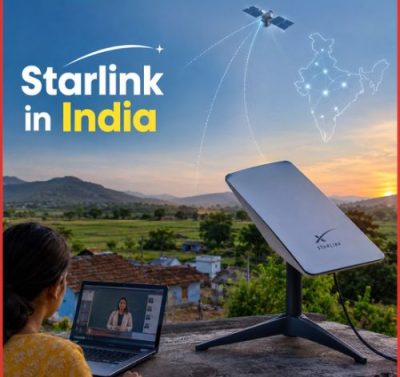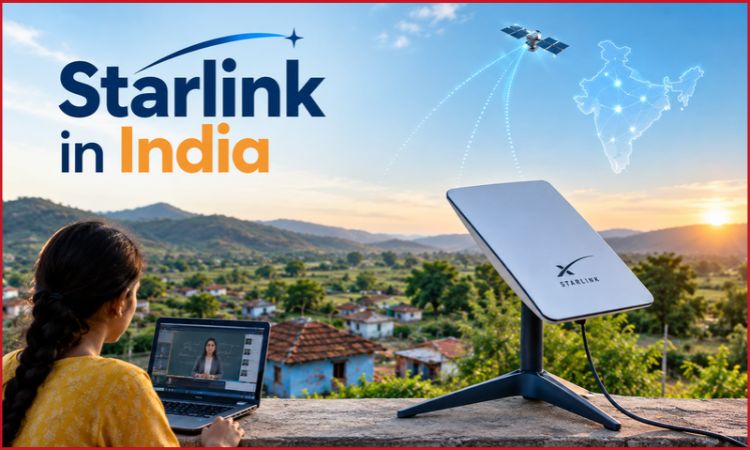
For someone living in a city, poor internet can mean a slow connection for a few minutes. In a remote village, the problem can be much bigger. A weak mobile signal can affect an online class, a digital payment, a work call or even a small shop trying to process an order.
That is where satellite internet enters the picture.
Instead of depending entirely on fibre cables and nearby mobile towers, satellite broadband sends connectivity through satellites orbiting the Earth. SpaceX’s Starlink is one of the best known examples of this approach.
India has already moved Starlink into the country’s formal satellite communication framework. The Department of Telecommunications (DoT) lists Starlink Satellite Communication Private Limited among companies holding GMPCS authorisation, alongside Jio Satellite Communications Limited and OneWeb India Communications Private Limited, as of June 10, 2025. The DoT describes GMPCS connectivity as particularly relevant to rural, remote and underserved areas.
Yet there is an important distinction. Authorisation does not mean that every Indian household can simply order Starlink today. Starlink’s commercial launch in India has faced further regulatory and security requirements. Recent reporting in August 2026 said the service was still awaiting final clearance for commercial operations.
So what could Starlink actually change for India’s rural communities and businesses?
What is Starlink?
Starlink is a satellite internet service developed by SpaceX. It uses a large network of satellites in low Earth orbit to provide broadband connectivity.
The basic idea is easier to understand by comparing it with conventional broadband.
Traditional broadband:
Internet network → fibre or cable → local network → user’s home or business
Starlink:
Internet network → Starlink satellite → user terminal → Wi Fi → devices
The user needs a Starlink terminal, usually installed where it has a clear view of the sky. The terminal communicates with satellites overhead and connects the location to the wider internet.
That changes the last mile problem.
A fibre provider has to physically extend its network to a customer’s location. Satellite broadband does not need the same cable to reach every individual premises.
This does not make satellite internet automatically better. Fibre can deliver excellent performance and serve large numbers of customers efficiently in densely populated areas. Satellite becomes more interesting when reaching the location itself is the difficult part.
Why rural India still has a connectivity problem
India has added internet users at a huge scale, but access is not evenly distributed.
TRAI data cited in August 2026 showed around 1.09 billion internet subscribers in India in March 2026. Rural India accounted for about 441 million of them, compared with nearly 652 million in urban areas. Measured per 100 people, the difference was much larger: 48.3 rural internet subscribers compared with 126.8 urban subscribers.
There is another interesting detail.
Bihar, for example, had mobile coverage in almost all villages, but its rural internet subscriber figure remained only 35.9 per 100 population, according to the same report citing government and TRAI data. Jharkhand stood at 41.4.
That tells us something important: coverage and actual internet usage are not the same thing.
A network may technically reach a village while residents still face problems such as affordability, device access, poor indoor coverage, digital literacy or unreliable high speed connectivity.
And in genuinely difficult locations, there is still the infrastructure problem.
Extending terrestrial broadband can require:
- Fibre cables
- Poles and ducts
- Road crossings
- Local network equipment
- Power supply
- Backhaul infrastructure
- Maintenance teams
The farther a settlement sits from existing infrastructure, the harder that last mile can become.
Satellite internet takes a different route.
How Starlink could help rural India
1. It could give remote locations another broadband option
The most obvious use case is also the simplest.
A village, school, farm or business that cannot get dependable fibre may have another way to connect to the internet.
That could support:
- Video calls
- Online education
- Digital payments
- Cloud software
- Telemedicine
- Government services
- E commerce
- Remote work
- Digital banking
The DoT’s own GMPCS description specifically highlights rural, remote and underserved areas.
For some users, the difference may not be between a 100 Mbps connection and a 200 Mbps connection. It may be between having a usable broadband connection and having none at all.
2. Rural education could become less dependent on location
Consider a student in a village where mobile data works reasonably well outdoors but becomes unreliable inside the school.
A broadband connection could give the school a more dependable way to access online lectures, digital libraries, teacher training platforms and cloud based learning tools.
The same applies to students studying from home.
They could download course material, attend video classes and submit assignments without travelling to the nearest town just to find a stable connection.
Starlink’s own business case studies also highlight rural education and classrooms as a use case for satellite connectivity. That is a company supplied example, so it should be read as an illustration rather than independent proof of outcomes in India.
3. Small businesses could reach customers beyond the village
Internet access has become part of basic business infrastructure.
A rural shop can accept digital payments. A handicraft seller can list products online. A farm business can communicate with suppliers. A homestay can manage bookings without maintaining a separate office in the nearest town.
The chain is fairly simple:
Reliable internet → digital payments → online communication → cloud tools → wider markets
For a business located far from reliable terrestrial infrastructure, that connection can have more value than its speed-test number suggests.
What real Starlink users say about the experience
Real-world experience is useful here because satellite internet has trade-offs that a specification sheet cannot fully explain.
In a 2026 review based on eight months of testing across different locations, EarthSIM reported that video calls generally remained clear in rural and suburban locations with a clear sky. The tester also reported short quality drops during congested evening periods and found that obstructions above 10% made calls less reliable.
A separate business user review published in September 2026 described Starlink as particularly useful for remote jobsites, agricultural operations and locations outside dependable fibre coverage. The reviewer noted that businesses with good fibre should generally view it differently from remote sites where terrestrial connectivity is weak.
These experiences come from outside India, so they should not be treated as a prediction of exactly how Starlink will perform in every Indian location.
Still, they illustrate an important point: location matters enormously.
A clear view of the sky can make the service work very differently from a site surrounded by trees, buildings or other obstructions.
What Starlink could mean for rural businesses
The business opportunity extends beyond households.
Remote offices and project sites
Construction, mining, agriculture, infrastructure and tourism companies often work away from major urban centres.
Imagine a construction company setting up a temporary project office several kilometres from the nearest reliable broadband connection. Fibre may not make economic sense for a temporary site.
A satellite terminal could provide connectivity for:
- Project management software
- Video meetings
- Cloud documents
- Digital payments
- CCTV and monitoring
- Staff communication
Starlink’s international business case studies show similar use cases in agriculture, energy, education, telecommunications and transportation.
Agriculture
Farming is becoming more data driven.
Weather information, connected sensors, irrigation systems, equipment monitoring and cloud platforms can all depend on connectivity.
A remote farm does not necessarily need a fibre connection running directly to every field. It does, however, need a dependable way to connect its systems to the internet.
Satellite connectivity can become one option.
Tourism
Remote hotels, resorts and homestays face a slightly different problem.
Guests now expect Wi Fi, digital payments and online booking systems even when they choose destinations precisely because they are far from cities.
For a resort in a remote hill area, reliable connectivity can support both guests and the business itself.
It can help staff communicate with suppliers, process bookings and payments, manage cloud based hotel software and respond to online reviews.
Starlink is not a replacement for fibre
This is where the discussion often becomes too simplistic.
Satellite internet does not need to replace fibre.
In a dense urban neighbourhood, one fibre network can serve hundreds or thousands of nearby customers. The economics are very different from connecting a handful of homes spread across a difficult terrain.
A useful way to think about the technologies is:
| Connectivity | Typical strength |
|---|---|
| Fibre broadband | Cities, towns and densely populated areas |
| Mobile networks | Everyday mobile connectivity across broad areas |
| Fixed wireless | Locations within suitable wireless coverage |
| Satellite internet | Remote and difficult to connect locations |
The future is therefore more likely to involve multiple technologies working alongside each other.
The biggest challenge may be affordability
Availability is only half of the equation.
A service can technically reach a village and still remain out of reach for many households if the equipment and monthly subscription cost are too high.
This matters particularly in India, where consumers have become accustomed to relatively inexpensive mobile data.
Starlink therefore faces a different question from simply proving that satellite broadband works.
It has to make the service commercially viable for the locations that actually need it.
For an urban household with fibre, switching to satellite may offer little practical reason.
For a remote enterprise that loses business every time its only mobile connection fails, the calculation could be completely different.
Other challenges Starlink will face in India
Weather and obstructions
A Starlink terminal needs a suitable view of the sky.
Tall trees, buildings and other obstructions can interfere with connectivity. User experiences from other markets show that obstruction levels can directly affect reliability.
Weather can also affect satellite communications.
Network capacity
Satellite networks have finite capacity.
Performance can vary depending on local demand, network design and available spectrum. As more customers join, operators need to keep adding capacity to maintain service quality.
This becomes especially important if satellite broadband expands beyond isolated users and starts serving larger clusters of customers.
Regulation and security
Starlink’s Indian journey also shows that satellite internet is not simply a technology deployment exercise.
TRAI released a consultation paper in April 2026 on the framework for satellite communication network authorisation and spectrum assignment. Starlink Satellite Communication Private Limited was among the service providers that participated in the consultation process.
India’s regulatory framework covers authorisation, spectrum and security requirements. That means an operator needs to satisfy several conditions before commercial operations can begin.
Starlink and India’s satellite internet competition
Starlink will not enter India alone.
The DoT’s June 10, 2025 GMPCS list included:
- Jio Satellite Communications Limited
- OneWeb India Communications Private Limited
- Starlink Satellite Communication Private Limited
Other companies, including Hughes and Nelco, have also operated within India’s satellite communication ecosystem through different authorisations and services. The DoT’s Commercial VSAT CUG list, for example, included Hughes, Nelco, Jio Satellite Communications, OneWeb and Starlink as of June 10, 2025.
That means India’s satellite broadband market could eventually offer multiple options.
The eventual differences will likely come down to pricing, coverage, capacity, service quality, enterprise features and regulatory conditions.
The rural internet gap is bigger than Starlink
There is one reason not to treat Starlink as a complete answer to India’s digital divide.
The problem is not only whether a signal can reach a village.
India’s August 2026 connectivity data showed that some states already have very broad mobile village coverage while rural internet usage remains substantially lower than urban usage.
That suggests several barriers can exist after network coverage reaches an area.
A household may not have a suitable smartphone or computer. A data plan may still be expensive relative to income. A user may lack digital skills. A business may not know how to use cloud based tools.
Satellite internet can address an infrastructure gap. It cannot solve all of these problems by itself.
What should businesses consider before using satellite internet?
For a business, the important question is not simply, “How fast is Starlink?”
A better checklist is:
- Is reliable fibre available?
- How much does internet downtime cost the business?
- Is the location difficult to serve with terrestrial infrastructure?
- Does the business operate from temporary or remote sites?
- Would a second internet connection provide useful backup?
- Can the business justify the equipment and recurring service costs?
For a city office with two reliable fibre providers, satellite broadband may have limited value.
For a remote resort, construction site, farm, mining operation or rural enterprise, the calculation can be very different.
What Starlink could mean for India’s digital economy
India’s digital economy has already changed how people pay, shop, study and run businesses.
The next challenge is reaching locations where conventional infrastructure becomes expensive or difficult.
That is where satellite broadband has a specific role.
A rural entrepreneur with reliable connectivity can use the same basic digital tools as a business in a city: cloud accounting, online payments, video meetings, digital marketing and e-commerce platforms.
The location still matters, of course. But poor connectivity becomes less of a hard barrier.
This is also why satellite internet should be viewed as another layer in India’s telecom infrastructure rather than a replacement for everything already in place.
The bigger picture: India’s internet is moving beyond cables
India’s connectivity story has traditionally revolved around mobile towers and fibre.
Satellite broadband adds another route.
Instead of asking only how to extend a cable to every difficult location, operators can also ask whether a satellite network can economically serve that location from above.
That distinction matters in a country with such varied geography.
A dense urban neighbourhood, a Himalayan village, a remote island, a farm and a temporary construction camp do not present the same connectivity problem.
Starlink’s potential role in India lies largely in those difficult cases.
The company has already received GMPCS authorisation, but the path from authorisation to commercial service still involves India’s regulatory and security requirements.
Frequently asked questions
What is Starlink?
Starlink is a satellite broadband service developed by SpaceX. It uses satellites in low Earth orbit to connect users to the internet through a dedicated terminal.
Is Starlink available in India?
Starlink Satellite Communication Private Limited has received GMPCS authorisation from the Department of Telecommunications. However, authorisation alone does not mean that commercial service is universally available. As of August 2026, reports said Starlink was still awaiting final clearance for commercial operations in India.
How does Starlink work?
A Starlink terminal communicates with satellites in low Earth orbit. The terminal then provides internet connectivity to devices through a Wi Fi router or network connection.
Can Starlink help rural India?
It could help locations where reliable terrestrial broadband is difficult or expensive to provide. The DoT specifically identifies rural, remote and underserved areas as relevant use cases for GMPCS connectivity.
Is Starlink better than fibre?
Not necessarily. Fibre and satellite broadband solve different connectivity problems. Fibre is generally well suited to dense areas with established infrastructure, while satellite can be useful in remote locations where terrestrial connectivity is difficult.
Conclusion
Starlink’s significance in India is not simply about bringing another broadband brand to the market.
Its more specific value lies in connecting places where conventional infrastructure struggles to reach.
For a rural school, that could mean another route to online learning. For a remote business, it could mean reliable access to cloud software and digital payments. For a construction company or resort, it could provide connectivity where laying fibre is impractical.
But the service will still have to answer India’s most important practical questions: cost, reliability, capacity, regulatory compliance and commercial availability.
India also does not have a single connectivity problem. Some places need better last mile infrastructure. Others already have mobile coverage but face affordability or adoption barriers. Some remote businesses need a dependable backup rather than a primary connection.
That is why satellite internet is best understood as one part of the country’s broader connectivity network.
The cable will remain important. Mobile networks will remain important. Satellite connectivity adds another option for the places where the existing routes do not work well enough.