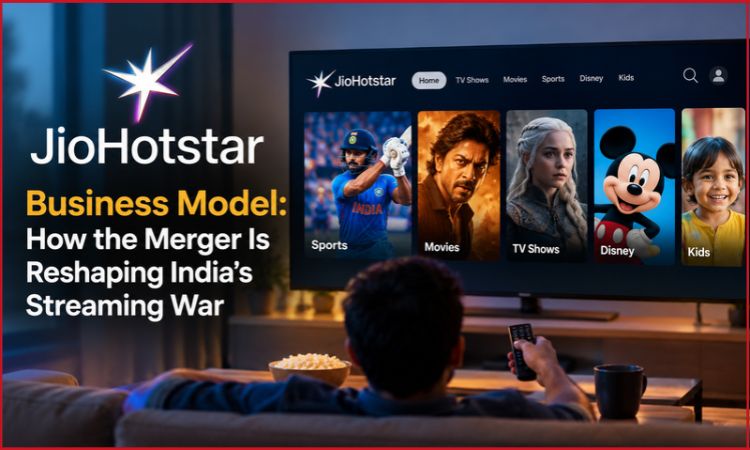
Two Indian streaming apps used to fight each other for the same living room every cricket season. Now they are one app, and the fight has moved to a bigger, messier question. The JioHotstar business model was built by fusing Reliance’s JioCinema with Disney’s India streaming operation, and the resulting platform now carries sports, television, film and international content under a single roof.
Reliance and Disney closed the underlying joint venture in November 2024, with Reliance investing ₹11,500 crore into a venture valued at roughly ₹70,352 crore on a post-money basis, and the merged consumer app, JioHotstar, went live for viewers on 14 February 2025. The strategic question is bigger than combining two apps into one icon on a phone: can JioHotstar turn a genuinely massive audience into a streaming business that actually makes money?
Quick Glance: JioHotstar at a Snapshot
| Parameter | Detail |
| Formed by | Merger of Reliance’s JioCinema and Disney’s India streaming/TV business (JioStar JV) |
| JV completed | November 2024; Reliance invested ₹11,500 crore into a JV valued at ₹70,352 crore post-money |
| App launch | 14 February 2025, combining JioCinema and Disney+ Hotstar into one app |
| Scale (Jan 2026) | 1 billion+ Google Play downloads; 450 million+ monthly active users; 300,000+ hours of content in 19 languages |
| Core model | Hybrid: subscription + advertising + sports monetisation + Connected TV |
| Subscription tiers | Mobile ₹79/₹149/₹499, Super ₹149/₹349/₹1,099, Premium ₹299/₹699/₹2,199 (monthly/quarterly/annual, effective 28 Jan 2026) |
| Regional content push | ₹4,000 crore over 5 years for South Indian content (announced Dec 2025) |
| FY26 financials | JioStar revenue ₹34,917 crore, EBITDA ₹5,842 crore, net profit ₹3,434 crore (RIL AGM, June 2026) |
What Is JioHotstar?
JioHotstar is the streaming platform created by combining JioCinema and Disney+ Hotstar’s India operations under JioStar, the joint venture between Reliance Industries and The Walt Disney Company. The idea was to pair Reliance’s distribution reach and telecom-linked consumer base with Disney’s entertainment library, sports portfolio and streaming know-how.
The resulting catalogue spans Indian television, Bollywood cinema, regional-language shows, international series, Disney titles, live cricket and other sports, kids’ programming, unscripted formats and original productions. By January 2026, JioStar said JioHotstar had crossed 1 billion downloads on Google Play, reached more than 450 million monthly active users across 100 percent of India’s pin codes, and built a library beyond 300,000 hours of content in 19 languages. That scale alone puts it among a handful of streaming platforms operating at this size anywhere in the world.
How the JioHotstar Business Model Works
JioHotstar runs on what is best described as a hybrid streaming model rather than a single revenue engine. Instead of leaning entirely on subscriptions, the platform blends advertising, subscription tiers, sports monetisation, premium content and sheer distribution scale. That mix matters because Indian streaming audiences are famously price-sensitive: a subscription-only approach caps how many people will ever sign up, while an advertising-only approach struggles to fund expensive sports rights and originals.
Subscription Revenue
Subscriptions remain one of the platform’s central revenue sources. Effective 28 January 2026, JioHotstar introduced monthly billing across all three tiers for new subscribers, alongside existing quarterly and annual options.
| Tier | Monthly | Quarterly | Annual | Notes |
| Mobile | ₹79 | ₹149 | ₹499 | 1 mobile device, ad-supported |
| Super | ₹149 | ₹349 | ₹1,099 | 2 devices, ad-supported, Hollywood included |
| Premium | ₹299 | ₹699 | ₹2,199 | 4 devices, ad-free except live sport |
That tiered structure lets JioHotstar price for very different willingness to pay within the same country.
Advertising Revenue
Advertising is the second major pillar. India has hundreds of millions of digital viewers who will never pay for more than one or two subscriptions, and advertising is how JioHotstar monetises everyone else. Advertisers can target audiences by content preference, language, location, device and viewing behaviour, and JioStar has been pushing this further: at Reliance’s 49th AGM in June 2026, the company said JioHotstar was experimenting with a content-commerce feature that lets viewers discover and buy products without leaving what they are watching, folding shoppable commerce directly into advertising inventory.
Sports as the Acquisition Engine
Cricket is the platform’s single biggest audience magnet. JioCinema had streamed IPL matches after Reliance secured the digital rights, while Hotstar carried major international cricket tournaments, and the merger brought both under one platform. Live sport creates something scripted shows rarely can: enormous simultaneous viewership.
JioHotstar said the 2025 IPL alone reached 652 million viewers on the platform, a 28 percent year-on-year increase, with peak concurrency of 55.2 million during the final, making it the most-watched T20 match in digital streaming history at the time. A single tournament like that becomes a customer-acquisition and advertising event as much as a piece of content.
Freemium Into Premium
JioHotstar’s broader strategy mirrors how JioCinema first built scale: give away high-demand live sport for free to build habit, then convert the most engaged viewers into paying subscribers. When the platform initially streamed IPL matches without charge, it proved that free premium sport could pull in audiences fast. The joint venture then shifted toward a hybrid model designed to monetise the most engaged of those viewers over time, layering subscription requirements and tiered access on top of the free base. The pattern is straightforward: attract with cricket, build a viewing habit, then convert into a paying subscription for movies, shows and international content.
Why the Merger Changes the Market
Before the deal, Reliance and Disney were bidding against each other for the same sports rights, the same advertising budgets and the same audiences. Combining them removes that internal competition and lets the merged business consolidate content, cut duplicate technology spend, cross-promote across more than 100 television channels, and negotiate advertising deals from a single, larger inventory pool.
At the time the joint venture was announced, JioCinema and Hotstar together reported an aggregate digital subscription base of more than 50 million, on top of a television business producing more than 30,000 hours of programming a year. That combined footprint gives JioHotstar a different competitive weight than either platform carried alone.
JioHotstar vs Netflix and Amazon Prime Video
JioHotstar’s competitive set includes Netflix and Amazon Prime Video, but the business models diverge. Netflix leans heavily on premium subscription revenue and original programming. Amazon Prime Video benefits from being bundled inside a wider e-commerce membership. JioHotstar instead stacks subscription revenue on top of advertising, television distribution and large-scale sports rights, which makes its pitch closer to sport, television, film and regional entertainment in one place rather than a narrower promise built around premium originals alone. That broader offer can matter in Indian households where several family members want very different things from the same screen.
Regional Content as Growth Strategy
India’s entertainment appetite is not uniform. Language and regional taste vary sharply across states, which makes regional content a genuine growth lever rather than a nice-to-have. In December 2025, at a South Unbound event in Chennai, JioHotstar announced a ₹4,000 crore investment over five years into South Indian content, spanning Tamil, Telugu, Kannada and Malayalam programming, alongside a Letter of Intent with the Tamil Nadu government and a slate of 25 new titles. The company also said it would roll out 1,500 hours of fresh South Indian programming in the following twelve months.
Regional content, on this evidence, functions less like an add-on category and more like a dedicated customer-acquisition channel for audiences outside the Hindi-speaking belt.
Connected TV as a Revenue Layer
Streaming has moved well beyond the smartphone screen. JioStar’s Connected TV Playbook, released in July 2025 in partnership with Ipsos, reported an 85 percent surge in watch time on connected televisions year over year, with 40 percent of total viewing now happening on the big screen, and a 3.1x co-viewing factor compared with user-generated content platforms.
Big-screen, shared viewing is attractive to categories such as automobiles, consumer electronics, financial services, FMCG, travel and e-commerce, all of which pay a premium for attention that is harder to get on a phone. For JioHotstar, that means Connected TV is not just a viewing trend; it is a way to raise the value of its advertising inventory.
Can JioHotstar Reshape India’s Streaming War?
JioHotstar has already reshaped the competitive map simply by combining two of India’s largest streaming ecosystems into one platform. JioStar reported average monthly active users of roughly 451 million across FY26, alongside full-year JioStar revenue of ₹34,917 crore, EBITDA of ₹5,842 crore and a net profit of ₹3,434 crore, according to comments at Reliance’s 49th AGM in June 2026.
Scale of that size does not automatically translate into durable profitability, though. The company’s real test is converting enormous engagement, driven heavily by cricket, into revenue that holds up across the rest of the calendar, without pricing out price-sensitive viewers or overspending on content it cannot fully monetise.
Conclusion
The JioHotstar business model represents one of the more significant shifts in Indian streaming so far. It combines cricket and other live sport, television distribution, regional programming, international entertainment and advertising technology inside a single platform, and it does so using a hybrid model that draws on both subscription and advertising revenue rather than picking one lane.
The company’s next test is not audience size, which it has already proven it can command. It is whether that audience converts into subscriptions, advertising revenue and Connected TV inventory reliably enough, quarter after quarter, to justify what the platform is spending on sports rights, regional content and original programming. The battle among India’s streaming platforms is no longer only about who has the best shows. It is increasingly about who can combine content, sport, technology, pricing and monetisation into the strongest overall ecosystem.
Frequently Asked Questions
1. What is the JioHotstar business model?
JioHotstar runs a hybrid model that combines subscription revenue, advertising, sports rights monetisation and Connected TV inventory rather than depending on subscriptions alone.
2. Why did JioCinema and Hotstar merge?
Reliance and Disney merged their India media assets, bringing JioCinema and Disney+ Hotstar together under JioStar, to combine sports rights, television networks and streaming distribution into one larger business rather than compete against each other.
3. How does JioHotstar make money?
Revenue comes from paid subscriptions across its Mobile, Super and Premium tiers, and from advertising sold against its much larger free and ad-supported user base, with sports and entertainment content driving both.
4. What makes JioHotstar different from Netflix?
JioHotstar combines entertainment with major live sports and television content, and monetises through both advertising and subscriptions, whereas Netflix relies primarily on premium subscription revenue and originals.
5. Is JioHotstar available across all of India?
JioStar said in January 2026 that JioHotstar was available across 100 percent of India’s pin codes, with more than 450 million monthly active users.
6. Why is cricket so important to JioHotstar’s business model?
Cricket, particularly the IPL, generates extremely high simultaneous viewership, which makes it valuable for audience acquisition, advertising sales and converting free viewers into paying subscribers.
7. Is JioHotstar investing in regional content?
Yes. In December 2025, JioHotstar announced a ₹4,000 crore investment over five years in South Indian content, covering Tamil, Telugu, Kannada and Malayalam programming.