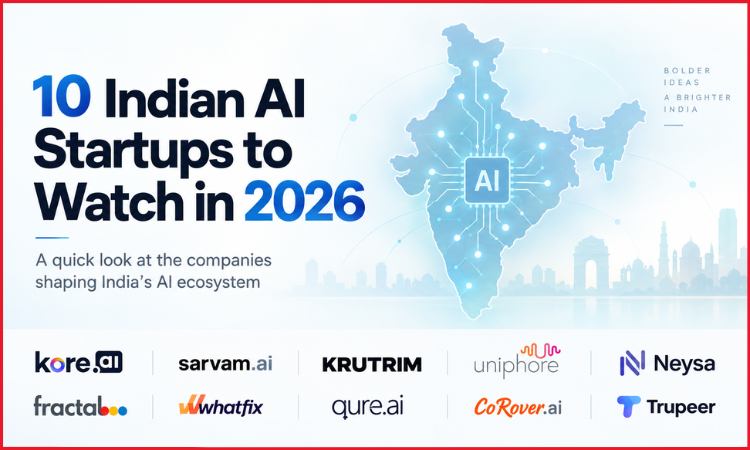
AI isn’t a side bet in India’s startup story anymore; it’s turning into the main engine. Founders who used to build software services for global clients are now building actual AI products: language models trained for Indian tongues, infrastructure to run them at scale, tools for hospitals, and automation that enterprises are genuinely paying for, not just piloting.
2026 has made that shift hard to ignore. Indian startups pulled in $7.4 billion in the first half of the year alone, the best first-half number since 2022, and AI infrastructure did a lot of the heavy lifting. Neysa closed a $1.2 billion round. Sarvam AI raised $234 million in the first close of its Series B. Between Sarvam, Krutrim, and Neysa, India now has three names that get called AI unicorns without much debate.
Part of why this is happening here specifically: 1.4 billion people, dozens of languages, a fast-growing digital backbone, and a real appetite for automation across sectors that still run on manual processes. That’s not a small market to build for. Zoom out further, and the number gets bigger. India’s AI market could hit $126 billion by 2030, with a GDP impact touching $1.7 trillion by 2035.
How We Ranked This List
Ranking isn’t based on funding amount alone. It weighs capital raised, adoption and real-world deployment, technical differentiation, global reach, and growth trajectory across 2026. Because the ten companies span different segments- foundation models, compute infrastructure, enterprise software, healthcare imaging, and public-sector chat- this is a broad comparison of impact across India’s AI startup ecosystem rather than a strict funding ranking.
The goal is to spotlight the Indian artificial intelligence companies with the clearest impact on founders, CXOs, and investors tracking AI startups in India 2026, rather than simply listing whichever company closed the largest round this year.
Quick Glance
| Name | Founded | Sector / Focus | Key Metric (2026) | Best Use Case | Regional Presence |
| Sarvam AI | 2023 | Foundation models (Indic LLMs) | $234M raised at $1.5B valuation | Sovereign LLMs for govt & banking | Bengaluru; national deployment |
| Krutrim (Ola) | 2023 | AI cloud infrastructure | ~Rs 300 crore FY26 revenue, first profit | Enterprise AI cloud | Bengaluru; pan-India |
| Uniphore | 2008 | Conversational & emotion AI | ~$985M total funding | Contact-center AI analytics | India-origin; global |
| Neysa | 2023 | GPU cloud infrastructure | $1.2B Series B (Feb 2026) | GPU compute for AI training | India; enterprise clients |
| Kore.ai | 2014 | Enterprise GenAI deployment | $620.9M total funding | AI agents & self-service automation | Bengaluru/Orlando; global |
| Fractal Analytics | 2000 | Enterprise AI & analytics | Rs 2,833.90 crore IPO (Feb 2026) | Decision-intelligence platforms | Mumbai; global clients |
| Whatfix | 2013 | Digital adoption platform | 1,100+ employees; 2026 IPO talks | Adaptive AI system training | India-origin; global |
| Qure.ai | 2016 | Healthcare imaging AI | $65M Series D | Radiology screening (TB, stroke, lung) | Mumbai; 90+ countries |
| CoRover.ai | 2016 | Government voice/chat AI | ~$4.96M total funding | AskDisha chatbot for Indian Railways | Bengaluru; national govt portals |
| Trupeer | 2023 | Generative content AI | $3M raised (July 2025) | Screen-recording to training video | Bengaluru; early-stage |
1. Sarvam AI
Sarvam AI turned three years old and became a unicorn in the same month. The Bengaluru company closed the first tranche of a $234 million Series B on June 15, 2026, at a $1.5 billion valuation, with HCLTech committing $150 million as lead strategic investor (TechCrunch, 2026). Its Sarvam-105B model already runs in production for banking and government workloads, including Tamil Nadu’s state services. Scale of capital plus proof of real deployment, not a demo, earns it the top spot.
2. Krutrim (Ola)
Ola founder Bhavish Aggarwal’s Krutrim spent late 2025 pulling back from chip design to focus entirely on AI cloud. The bet paid off. The company reported around Rs 300 crore in FY26 revenue, nearly three times the year before, alongside its first annual net profit (Medianama, 2026), while serving more than 25 enterprise customers across telecom, finance, and logistics.
3. Uniphore
Long before emotion AI became a pitch-deck phrase, Uniphore was building it. Originating in Chennai and now operating globally, the company has raised close to $985 million to date and serves large contact centers with real-time conversational analytics. Its age and capital base put it ahead of most emerging AI startups India has produced this cycle, and its decade-long fundraising discipline is one reason it’s still standing as one of the clearer AI unicorns in India.
4. Neysa
Neysa supplies the GPU-accelerated cloud infrastructure that other Indian AI companies quietly depend on. In February 2026, it closed a $1.2 billion Series B, with Blackstone leading a $600 million tranche earmarked for more than 20,000 GPUs (AI Funding Tracker, 2026). Swiggy already routes live compute workloads through Neysa’s platform. Infrastructure rarely makes headlines, but without it, few model-layer names on this list would ship.
5. Kore.ai
Kore.ai builds the deployment layer for enterprise generative AI: conversational agents, self-service automation, AI copilots. The company has raised $620.9 million total, including a $150 million round led by FTV Capital with NVIDIA’s participation (StartupFeed, 2026). That NVIDIA stake matters. It positions Kore.ai as a bridge between chipmakers and enterprise AI buyers, not just another chatbot vendor.
6. Fractal Analytics
Fractal Analytics did something no other company here has: it went public. The Mumbai-founded enterprise AI firm raised Rs 2,833.90 crore through what’s being called India’s first AI-focused IPO, pricing shares at Rs 900 and listing on the BSE and NSE on February 16, 2026 (Business Standard, 2026). Founded in 2000, Fractal spent two decades building toward that listing, and it now offers something private peers can’t: quarterly, audited transparency.
7. Whatfix
Whatfix’s digital adoption platform has quietly become infrastructure for how large enterprises train staff on new software. Its newer Mirror product, which simulates system training with adaptive AI, has pushed headcount past 1,100 globally, and the company is reportedly in talks with advisors about a 2026 listing. It earns its place for growth discipline rather than a single headline round.
8. Qure.ai
Qure.ai treats healthcare access as an infrastructure problem, not a software feature. The Mumbai company completed a $65 million Series D round backed by Lightspeed and 360 ONE Asset, with Merck’s Global Health Innovation Fund also participating (Business Standard, 2024). Its imaging AI now runs across more than 90 countries and 3,000 sites, screening for tuberculosis, lung cancer, and stroke, making it one of the more globally deployed Indian artificial intelligence companies on this list.
9. CoRover.ai
CoRover.ai runs some of the most heavily used AI in the country, even though most people have never heard its name. Its AskDisha chatbot handles booking queries for Indian Railways, alongside government portals and airport helplines in multiple Indian languages. Funding raised to date sits near $4.96 million, tiny next to Neysa or Sarvam. Usage at national scale, not capital raised, is why it makes this year’s list.
10. Trupeer
Trupeer represents the newest wave: small, fast, and already backed by serious names. The Bengaluru startup turns screen recordings into polished training videos and product demos using generative AI, and has raised $3 million from Salesforce Ventures and Exfinity Partners as of July 2025 (Analytics India Magazine, 2025). It’s the smallest company here by funding, and its presence hints at where next year’s list of emerging AI startups in India will likely draw from.
What These Companies Have In Common
These ten companies don’t compete in the same category, and that’s deliberate. Sarvam AI and Krutrim build foundation models; Neysa and Kore.ai sell infrastructure and deployment tools; Uniphore, Whatfix, Qure.ai, and CoRover.ai solve narrow enterprise or public-sector problems; Fractal Analytics and Trupeer sit at opposite ends of company maturity. The common thread is capital efficiency paired with real usage, not vanity metrics.
Krutrim’s own 2025 reset, when it paused chip and foundation-model work to refocus on cloud, is a reminder that even well-funded companies can misjudge which layer of the stack to compete in before finding traction.
Key Takeaways
- India’s AI startup ecosystem attracted close to $1.48 billion in Q1 2026 alone, roughly 38% of all startup funding that quarter.
- Profitability, not just valuation, is starting to separate leaders. Krutrim’s FY26 numbers make that case.
- Infrastructure players like Neysa are becoming as critical as the model builders they support.
- Government deployment, seen at CoRover.ai and Sarvam AI, is now a real growth channel, not a pilot exercise.
- Public listings, led by Fractal Analytics, open a new exit path beyond acquisition for top AI startups in India.
- Watch smaller, VC-backed names like Trupeer. Today’s emerging AI startups India are tomorrow’s unicorns.
Conclusion
Ten companies, five different layers of the stack, one shared signal: capital is following usage, not just ambition. For India’s AI unicorns to keep multiplying at this pace, the next test is exports: whether Sarvam’s models, Neysa’s compute, or CoRover’s vernacular chat can win customers outside the country, not only inside it. Founders, CXOs, and investors watching top AI startups in India should track deployment numbers as closely as funding headlines through the rest of 2026.
Frequently Asked Questions
1. What criteria decided this list of Indian AI Startups to Watch in 2026?
Ranking combined total capital raised, real-world deployment scale, and momentum shown through 2026, not valuation alone. That’s why a smaller player like CoRover.ai sits alongside billion-dollar names like Sarvam AI and Neysa.
2. Which companies count among the newest AI unicorns in India?
Sarvam AI reached unicorn status in June 2026 at a $1.5 billion valuation, and Krutrim has held unicorn status since 2024. Both are frequently cited among the leading AI unicorns in India today.
3. Are these top AI startups in India spread across different sectors?
Yes. The list spans foundation models, GPU cloud infrastructure, enterprise conversational AI, healthcare imaging, and government-facing chat, which is why entries are compared on overall impact within AI startups in India 2026 rather than one financial metric.
4. How big is India’s AI startup ecosystem right now?
India’s AI startup ecosystem attracted close to $1.48 billion in the first quarter of 2026 alone, about 38% of all startup funding in that period. The broader Indian AI market is projected to reach $126 billion by 2030.
5. Is Fractal Analytics still a startup after its IPO?
Technically, Fractal Analytics graduated out of startup status once it listed on the BSE and NSE in February 2026. It’s included here because it remains one of the most influential Indian artificial intelligence companies shaping enterprise AI adoption.
6. Which emerging AI startups India should investors track next?
Early-stage names like Trupeer, still under $5 million in funding, show where next year’s list may draw from. Investors tracking emerging AI startups in India typically look for narrow, deployable use cases rather than broad platform ambitions.