Amazon is reportedly in talks to buy artificial-intelligence startup Decart for around $7 billion, a deal that would push the company deeper into the software layer sitting between AI models and the chips that run them.
Nothing has been signed yet. The discussions could still fall apart or another bidder could emerge. But the reason Amazon might want Decart is fairly clear.
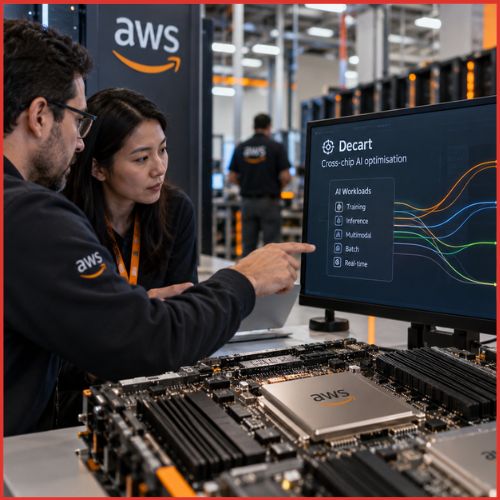
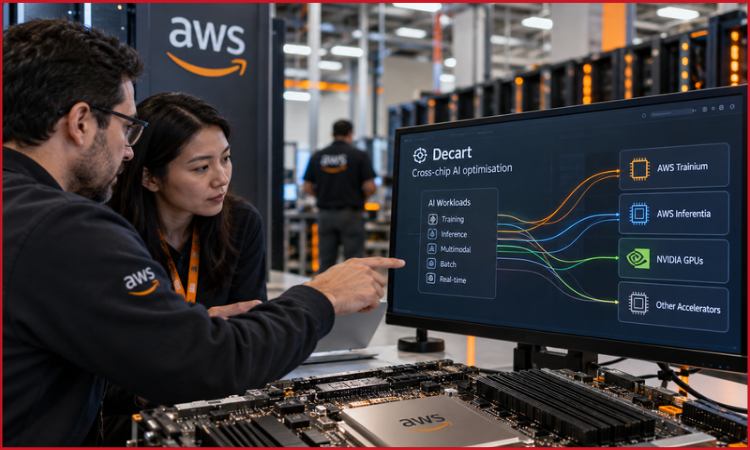
Decart builds software that helps developers move AI workloads between different processors. For Amazon Web Services, which is spending heavily on its own Trainium chips as an alternative to Nvidia hardware, that is a useful capability to own.
A successful Amazon Decart acquisition would therefore be about more than buying another AI model company. It could make Amazon’s own chips easier for customers to use.
Decart Solves an Expensive AI Problem
The AI industry has become heavily dependent on specialised processors.
Nvidia remains the dominant supplier, but cloud companies do not particularly like being dependent on one vendor for some of their most expensive infrastructure.
Amazon has been developing its own answer through Trainium.
The difficulty is that a chip is only as useful as the software surrounding it. Developers build models around particular libraries, tools and hardware assumptions. Moving the same workload elsewhere can involve significant engineering work.
Decart tries to make that process easier.
Its software is designed to optimise models across different processors, reducing some of the friction involved when developers want to switch between AI hardware.
That could make Decart AI software strategically valuable at a time when every major cloud company is looking for ways to reduce the cost of running large models.
Amazon Already Has a Relationship With the Startup
The two companies are not strangers.
AWS gave Decart early access to its Trainium3 processor in 2025, allowing the startup to work with Amazon’s newer AI hardware before wider availability.
That relationship matters because an acquisition would not begin with Amazon trying to understand the company from scratch.
Decart has already demonstrated technology on AWS infrastructure.
Its Lucy model, for example, is designed for real-time visual generation and editing, while Oasis creates simulated environments that can be used in areas such as robotics, gaming and autonomous-system testing.
Those products are interesting in their own right, but the chip-optimisation technology may be the bigger prize for Amazon.
Trainium Is Central to Amazon’s AI Bet
AWS has spent years trying to give customers alternatives to expensive third-party accelerators.
Trainium is built for AI training and inference workloads, and the latest generation is meant to improve both performance and cost efficiency.
The business argument is straightforward.
If more AWS customers use Amazon’s own chips, Amazon keeps more control over the economics of its cloud infrastructure rather than passing a large portion of hardware spending to outside suppliers.
There is one problem: customers need a reason to move.
A company that has already built its AI systems around Nvidia may not switch simply because another processor exists.
Software that simplifies that transition could make AWS Trainium chips more attractive without forcing developers to rebuild everything around a new architecture.
That is where Decart could fit.
A $7 Billion Price Would Be a Big Step Up
Decart was reportedly valued at close to $4 billion in May 2026.
A deal near $7 billion only months later would represent a substantial premium.
The startup has raised more than $400 million from investors including Sequoia Capital, Benchmark and Radical Ventures.
That rapid rise says something about the current AI market.
Companies are no longer paying only for consumer-facing chatbots or foundation models. Infrastructure software, model optimisation and tools that can lower computing costs are becoming equally valuable.
The amount of money being spent on AI hardware is so large that even modest efficiency improvements can have significant financial value.
A startup that helps enterprises use several chip platforms rather than remaining tied to one can therefore become strategically important very quickly.
Anthropic Reportedly Looked at Decart Too
Amazon is not the first major AI company linked with the startup.
Anthropic reportedly explored an acquisition of Decart at around $6 billion before deciding not to proceed after due diligence.
That earlier interest helps explain why Amazon may feel some urgency.
AI infrastructure is becoming one of the areas where large technology companies do not necessarily get multiple chances to buy the same asset.
Once a strategically useful startup is acquired by a rival, its technology can become part of somebody else’s competitive advantage.
The reported $7 billion Decart deal would put Amazon ahead of any future bidder if negotiations are completed.
For now, though, it remains a reported discussion rather than a finished transaction.
Decart Is Also Building World Models
The chip software is only part of Decart’s business.
The startup is developing so-called world models that generate and simulate environments.
Oasis is aimed at creating interactive virtual worlds, while Lucy works on real-time video generation and editing.
Those capabilities could have applications far outside cloud computing.
Robotics developers need simulated environments in which machines can train without damaging real equipment. Autonomous-driving systems can be tested against scenarios that would be expensive or dangerous to reproduce physically. Gaming studios can use generated environments to speed up content creation.
Amazon itself has interests across robotics, logistics, media and cloud services.
That makes Decart’s research potentially useful well beyond AWS.
The Nvidia Question Is Hard to Avoid
Any discussion of alternative AI chips eventually comes back to Nvidia.
Its advantage is not simply that its GPUs are powerful.
CUDA and the wider software ecosystem around Nvidia hardware have given developers years of tools, libraries and experience that are difficult to reproduce quickly.
Amazon cannot challenge that position with silicon alone.
It needs chips, software and a developer experience that makes the switch worthwhile.
Buying Decart would not suddenly turn Trainium into a universal replacement for Nvidia GPUs, but it could remove one practical obstacle.
That is why the reported acquisition looks more strategic than simply adding another startup to Amazon’s AI portfolio.
Amazon Is Buying Into Flexibility
AI computing has become expensive enough that customers increasingly care about where a model runs.
They may want Nvidia for one workload, Trainium for another and some other accelerator elsewhere.
The easier it becomes to move between those options, the less locked-in the customer becomes.
For AWS, that can still be an advantage.
Amazon does not necessarily need every AI workload to run on Trainium. It needs Trainium to be easy enough to consider whenever customers compare costs and performance.
Decart’s technology could help make that comparison less painful.
That is the real logic behind a possible Amazon Decart acquisition.
The headline number is $7 billion. The bigger question is whether Amazon thinks owning the software between AI models and AI chips can make its cloud business harder to leave—and its own processors easier to adopt.