Every large language model, every AI-powered app and every enterprise chatbot ultimately depends on a piece of silicon working overtime inside a data centre. That silicon has become the single biggest constraint, and the single biggest investment bet, in the technology industry today.
Tracking the 10 biggest AI chip companies in 2026 matters well beyond engineering circles now. Investors watch market swings tied to AI chip companies 2026, plan cloud budgets around GPU availability, and students weigh careers in the AI semiconductor industry. Nvidia’s dominance, AMD’s rise and the growing footprint of custom AI chips from Google, Amazon and Microsoft have turned AI infrastructure into the decade’s defining business battleground.
A GPU is a flexible processor built for parallel workloads. An AI accelerator is any chip tuned specifically for AI tasks, whether or not it started life as a GPU. A custom AI chip, or ASIC, is built for one company’s own models, trading flexibility for cost and power savings.
How We Ranked These Companies
This ranking blends several factors rather than one single number, since AI chip companies compete in very different ways. We weighed current revenue and market share in AI chips, the technological depth of each flagship platform, confirmed adoption by hyperscalers and major AI labs, each company’s role in training versus inference, and its broader influence on where AI infrastructure spending is heading in 2026. Companies selling chips commercially and those building custom AI chips purely for internal use, such as Google and Amazon, are both included, since both groups shape the AI semiconductor market.
Quick Glance
| Rank | Company | Key AI Chip / Platform | Major Strength |
| 1 | NVIDIA | Rubin / Blackwell GPU platforms | Market-leading performance plus the CUDA software ecosystem |
| 2 | AMD | Instinct MI400 series (MI455X, MI450) | Strong price-performance and growing hyperscaler adoption |
| 3 | TPU Ironwood (7th generation) | Purpose-built inference efficiency for internal AI workloads | |
| 4 | Broadcom | Custom XPUs for Google, Meta, OpenAI | Dominant custom-chip design plus advanced packaging |
| 5 | Amazon | Trainium 3 / Inferentia | Cost-efficient in-house silicon for AWS |
| 6 | Microsoft | Maia 200 | High-performance inference chip for Azure |
| 7 | Intel | Crescent Island GPU | Large memory capacity at lower cost, air-cooled design |
| 8 | Qualcomm | AI200 / AI250 | Inference-optimised chips with low total cost of ownership |
| 9 | Marvell Technology | Custom XPUs plus optical interconnects | Second-largest custom AI ASIC designer |
| 10 | Huawei | Ascend 950 series (950PR, 950DT) | Domestic Chinese AI chip supply chain |
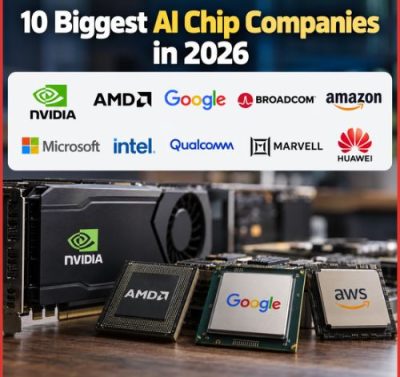
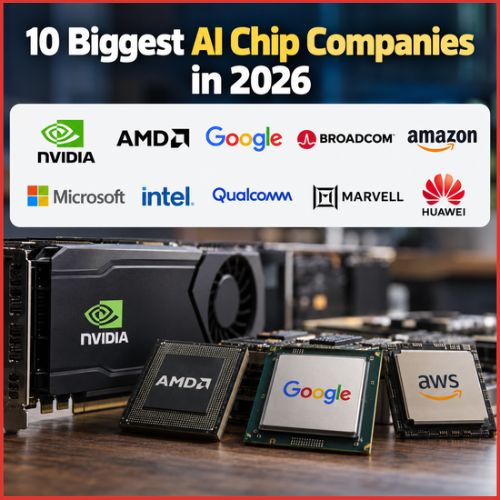
10 Biggest AI Chip Companies in 2026
1. NVIDIA
Nvidia remains the centre of gravity in the AI semiconductor market. Its GPUs train and run the vast majority of large language models worldwide, and its CUDA software ecosystem locks in developers far more tightly than the hardware alone.
The company’s newest platform, Rubin, follows Blackwell and is built around six to seven interconnected chips, including GPU, CPU, networking and memory processors, designed to work as one system rather than as standalone parts. Nvidia says Rubin can train mixture-of-experts models using four times fewer GPUs than Blackwell and can cut inference token costs sharply.
Analysts estimate Nvidia still commands close to 80% of the AI accelerator market. Its main risk is customer concentration, since hyperscalers are building their own custom AI chips specifically to reduce dependence on any single supplier, Nvidia included.
2. AMD
AMD is Nvidia’s most direct GPU rival and the company most often named alongside NVIDIA AI chips whenever buyers weigh their options.
Its Instinct MI400 series, built on the new CDNA 5 architecture, rolled out through 2026, with the flagship MI455X offering 432 GB of HBM4 memory and roughly 40 petaflops of FP4 performance. The MI450 targets high-volume deployments, and AMD’s Helios rack system links dozens of these GPUs together for frontier-scale training.
Meta, OpenAI, Oracle and Microsoft have all signed on as customers, and OpenAI’s multi-gigawatt supply deal with AMD signals real confidence in the roadmap. AMD’s ROCm software has historically trailed CUDA, though the gap has narrowed, and AMD’s AI data-centre revenue is on track to cross $10 billion for 2026.
3. Google
Google is unusual among the biggest AI chip companies because it designs chips purely for internal use rather than selling them commercially.
Its seventh-generation TPU, Ironwood, is the first built specifically for inference rather than training, delivering over 4,600 teraflops per chip and scaling to pods of 9,216 chips. Google is now developing an eighth-generation TPU family with outside design partners, splitting the work between a training-focused chip and a smaller inference-focused chip.
TPUs are available only through Google Cloud, which limits their reach compared with Nvidia’s GPUs but gives Google tighter control over cost and performance for its own Gemini models. Anthropic is among the largest customers renting TPU capacity through Google Cloud.
4. Broadcom
Broadcom rarely puts its own name on a finished AI chip, yet it may be the most important company on this list after Nvidia and AMD.
It designs custom AI accelerators, or XPUs, for hyperscalers including Google, Meta, OpenAI and Anthropic, pairing chip design expertise with advanced packaging technology that stacks multiple compute dies and high-bandwidth memory modules together. Broadcom also supplies the networking silicon, including switches and interconnects, that lets thousands of chips act as a single system.
Broadcom’s AI semiconductor revenue has grown well over 100% year-on-year through 2026, and the company has guided toward AI-chip revenue exceeding $100 billion by 2027.
5. Amazon
Amazon’s AI chip strategy runs through AWS, where Trainium and Inferentia processors, designed by its Annapurna Labs unit, power a growing share of internal and customer workloads.
Trainium 3, built on a 3nm process, is available only through AWS EC2 instances, and Amazon uses it to cut reliance on Nvidia GPUs for both training and inference. Amazon Bedrock, the company’s managed AI service, increasingly runs on this custom silicon.
Because Trainium chips are not sold separately or rented outside AWS, their competitive impact stays confined to Amazon’s own cloud customers rather than the broader AI semiconductor market, a captive model common among custom AI chips built by hyperscalers.
6. Microsoft
Microsoft entered the custom AI chip race later than Google or Amazon, but its Maia accelerators are now central to Azure’s AI infrastructure.
Maia 200, an inference-focused chip built on a 3nm process with 216 GB of HBM3e memory, delivers more than 10 petaflops of FP4 performance, which Microsoft says beats Amazon’s Trainium 3 on that metric. Maia chips currently power Microsoft’s own workloads, including Copilot and part of the OpenAI API traffic running on Azure.
Microsoft has said wider customer access to Maia is coming, though for now the chips remain an internal cost-reduction tool rather than a product competing openly among AI GPU companies.
7. Intel
Intel’s AI chip ambitions have had a rocky run. Its earlier Gaudi accelerators, built on technology from the Habana Labs acquisition, saw weak sales, and a planned successor was shelved.
The company’s current bet is Crescent Island, a data-centre GPU built on the Xe3 architecture and aimed squarely at inference rather than training. It uses air cooling and LPDDR5X memory instead of HBM, offering up to 480 GB of capacity at lower cost than rival designs.
Crescent Island was originally expected to launch in the second half of 2026, though reporting suggests the commercial rollout may slip into 2027, underscoring the execution challenge Intel faces against established AI GPU companies.
8. Qualcomm
Qualcomm built its reputation on smartphone chips, but its AI200 and AI250 accelerators mark a serious push into data-centre inference.
Built on Qualcomm’s Hexagon neural processing architecture, the AI200 supports up to 768 GB of LPDDR memory per card, while the AI250, due in 2027, uses a near-memory computing design that Qualcomm says delivers more than 10 times the effective memory bandwidth. Saudi AI firm Humain has already committed to a 200-megawatt deployment.
Qualcomm is positioning both chips around lower total cost of ownership for inference rather than competing with Nvidia or AMD on training performance, a focused strategy within the wider AI accelerator market.
9. Marvell Technology
Marvell has become the second-largest designer of custom AI chips after Broadcom, building what it calls XPUs for hyperscale customers alongside the optical and networking silicon that connects them.
Marvell’s fiscal 2026 revenue crossed $8 billion, with data-centre revenue up sharply year-on-year. In March 2026, Nvidia invested $2 billion in Marvell as part of a partnership linking Marvell’s designs to Nvidia’s NVLink Fusion ecosystem, a sign of how intertwined the custom-chip and GPU segments have become.
Analysts place Marvell well behind Broadcom in market share, but its acquisitions in optical interconnect technology suggest an attempt to broaden its role across the AI semiconductor supply chain.
10. Huawei
Huawei represents China’s most advanced answer to U.S. export restrictions on AI chips. Its Ascend series, particularly the 950PR and 950DT launched through 2026, is built on domestic manufacturing and includes Huawei’s own high-bandwidth memory to cut reliance on foreign suppliers.
A single Ascend chip still trails Nvidia’s best hardware, so Huawei compensates with SuperPoD and SuperCluster systems that link hundreds of thousands of chips together using proprietary interconnect technology. DeepSeek and other major Chinese AI labs have placed large orders for Ascend hardware.
Export controls mean Huawei’s chips are largely confined to the Chinese market, but that market alone is large enough to make Huawei one of the biggest AI chip companies by volume.
Why AI Chips Matter So Much in 2026
AI model training and AI inference place very different demands on hardware. Training needs thousands of chips working in sync for weeks; inference needs speed and low cost at massive scale, since it happens billions of times a day.
Generative AI has pushed both to new extremes, with every image, video or chatbot reply consuming compute inside a data centre. High-bandwidth memory, or HBM, now matters as much as raw compute, since many AI models are limited by how fast data moves rather than by calculation speed.
AI networking, the switches and interconnects linking thousands of chips, decides whether a data centre behaves like one giant computer. Energy consumption is a boardroom issue too: chip designers compete on performance per watt because power, not chip supply, increasingly caps how much AI infrastructure gets built, keeping cost per AI token in investors’ sights.
Conclusion
The competitive field among the biggest AI chip companies in 2026 has moved from a two-player GPU contest into a much wider one. Nvidia and AMD still lead general-purpose training hardware, but Google, Amazon, Microsoft, Broadcom, Marvell, Qualcomm, Intel and Huawei have each carved out a role through custom silicon, inference-focused chips, or regional supply chains.
AI chips will stay strategically important as generative AI and enterprise adoption keep expanding compute demand, and the next phase of this race will likely hinge as much on power and memory supply as on raw chip design.
Frequently Asked Questions
1. Who are NVIDIA’s biggest competitors in AI chips?
AMD is Nvidia’s closest direct GPU competitor, with its Instinct MI400 series winning customers like Meta, OpenAI and Oracle. Beyond AMD, Google, Amazon and Microsoft compete indirectly through custom AI chips built for their own cloud platforms, while Broadcom and Marvell compete by designing that custom silicon rather than selling finished chips themselves.
2. What are AI chips used for?
AI chips are used to train large language models and to run them once trained, a process called inference. They power generative AI tools, recommendation systems, chatbots, image and video generation, autonomous systems and enterprise applications. Data centres rely on AI chips almost exclusively now, since general-purpose CPUs are too slow for large-scale AI workloads.
3. Why are companies building their own AI chips?
Hyperscalers like Google, Amazon and Microsoft build custom AI chips to reduce dependence on Nvidia, lower long-term costs and optimise performance for their specific AI models. Custom silicon can offer better performance per watt for a known workload than a general-purpose GPU, which matters enormously at the scale these companies run their data centres.
4. Which companies are making custom AI chips?
Google (TPU), Amazon (Trainium), Microsoft (Maia) and Meta (MTIA) all design custom AI chips for their own data centres. Broadcom and Marvell are the two dominant design partners that help build this custom silicon, together enabling the majority of hyperscaler AI accelerator programmes running today.
5. Will NVIDIA remain the leader in AI chips?
Nvidia is expected to remain the leader in AI chips through at least the near term, given its software ecosystem and annual product cadence built around Rubin. However, its share of inference workloads could decline as hyperscalers shift more inference to custom AI chips, even as its training-hardware position stays strong.
6. What is the future of the AI chip industry?
The AI chip industry is likely to move toward a mixed model: Nvidia and AMD GPUs for flexible, general-purpose training, and custom AI chips for the specific, repeatable workloads big cloud providers run at scale. Growth in AI inference, HBM demand and energy-efficient design will shape how this plays out.