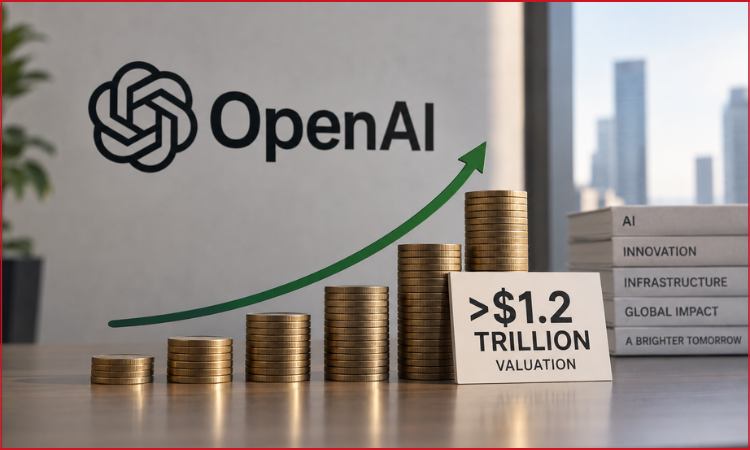
OpenAI is holding early discussions with investors about another funding round that could value the ChatGPT maker at more than $1.2 trillion, potentially giving the company additional financial room before an eventual stock market listing.
The talks are still at an early stage and do not guarantee that a deal will take place. Investors are understood to have initiated the discussions. Any decision on a new OpenAI funding round is likely to depend heavily on when the company chooses to proceed with its long-anticipated initial public offering.
The timing is notable. OpenAI is spending heavily on computing infrastructure, expanding its product portfolio and making acquisitions while competition across the artificial intelligence industry continues to intensify.
Valuation Could Move Above $1.2 Trillion
A successful transaction at the level being discussed would place the OpenAI valuation above $1.2 trillion.
That would put the company among a very small group of private businesses to reach a trillion-dollar valuation before entering public markets.
For OpenAI, however, raising more money is not simply about establishing a higher valuation.
Artificial intelligence development has become extraordinarily expensive. Companies building advanced models need access to large quantities of specialised chips, data-centre capacity, networking infrastructure and electricity.
Those costs continue after a model is released because millions of users and businesses still require computing power every time they interact with AI products.
OpenAI has therefore needed substantial external capital even as ChatGPT and its enterprise products generate growing revenue.
Another large funding round would give the company more flexibility to finance those commitments without rushing into an IPO.
IPO Is Still Coming, but Not This Year
An OpenAI IPO remains part of the company’s longer-term plans, although a listing is not expected in 2026.
Chief executive Sam Altman has indicated that the company still intends to enter public markets eventually.
The exact timing remains uncertain.
A fresh private funding round could allow OpenAI to delay its listing by another quarter or two if management decides that remaining private for longer makes financial or strategic sense.
That flexibility has value.
Going public would give OpenAI access to a much larger pool of capital, but it would also bring quarterly reporting requirements and greater scrutiny of revenue, spending and profitability.
Remaining private gives the company more room to make expensive long-term investments without facing the same short-term expectations from public-market shareholders.
Acquisitions Are Another Reason to Raise Cash
OpenAI’s capital requirements extend beyond building and running AI models.
The company has become increasingly active in acquisitions as it expands into new parts of the technology market.
It has already spent billions of dollars buying businesses that can add talent, software or products to its broader ecosystem.
One of the most significant deals involved IO, the AI hardware startup associated with former Apple design chief Jony Ive.
That acquisition strengthened OpenAI’s ambitions beyond software and gave the company a path towards developing its own AI-focused consumer devices.
OpenAI has also acquired Astral, a developer-tools company known for building software for the Python ecosystem.
More capital could give the company room to pursue additional deals without forcing it to choose between acquisitions and infrastructure spending.
That makes mergers and acquisitions another possible use of money from a new OpenAI funding round.
Anthropic Competition Adds Another Dimension
OpenAI is also operating in a market where competitors are raising enormous sums of their own.
Anthropic, the company behind Claude, raised capital earlier this year at a valuation of about $965 billion, including the new investment.
A funding transaction above $1.2 trillion would again put OpenAI comfortably ahead of its major private-market rival on valuation.
The competition between the two companies is no longer limited to AI model performance.
Both are chasing enterprise customers, recruiting expensive technical talent and investing heavily in infrastructure.
They may also find themselves competing for public-market investors.
Anthropic is preparing for an IPO and has selected Nasdaq as its listing venue. Its flotation could take place as soon as October.
That creates an unusual situation in which two of the most valuable artificial intelligence companies are simultaneously considering how and when to move from private funding markets into public ownership.
Private Investors Still Want More Exposure
The fact that investors initiated the latest discussions is significant.
OpenAI has already raised enormous amounts of money, yet private-market investors still appear interested in increasing their exposure before a possible listing.
An IPO would change how those investors can access the company.
Once shares begin trading publicly, OpenAI’s valuation would be determined continuously by the market rather than through occasional private funding transactions.
Existing backers may therefore see the current period as one of their final opportunities to increase their holdings before that transition.
For OpenAI, strong private investor demand could also reduce the urgency to list.
If the company can continue raising large amounts privately at favourable valuations, it has less reason to enter public markets simply to secure additional capital.
An IPO Creates New Information Challenges
Preparing for a public listing also changes what OpenAI can share with private investors.
The company is considering legal restrictions around the information that may be provided during fundraising discussions ahead of an IPO.
Private companies can normally give potential investors detailed financial and operational information under confidentiality arrangements.
The situation becomes more complicated as an IPO approaches.
Companies preparing to list need to carefully manage disclosures so that certain investors do not receive material information unavailable to others.
For OpenAI, those considerations could influence both the structure and timing of another private round.
AI Capital Race Keeps Getting Bigger
The possible fundraising shows how quickly the economics of artificial intelligence have changed.
Building software companies once required relatively modest physical infrastructure compared with industries such as manufacturing or telecommunications.
Advanced AI has altered that equation.
Companies now need enormous computing systems before they can train new models or serve rapidly growing numbers of customers.
That means the leaders of the AI market are beginning to resemble infrastructure businesses as much as conventional software companies.
The proposed OpenAI valuation above $1.2 trillion reflects investor expectations that the company can eventually turn its technological position and large user base into a business capable of supporting that figure.
But it also highlights how much money is required to stay at the front of the industry.
For now, OpenAI has not committed to another fundraising round. The discussions remain preliminary, and the company’s IPO timeline could still determine what happens next.
If a deal does proceed, however, it would provide OpenAI with another large financial cushion as it weighs acquisitions, infrastructure expansion and the eventual move into public markets.
Source
OpenAI weighs fresh funding at $1.2 trillion valuation ahead of IPO