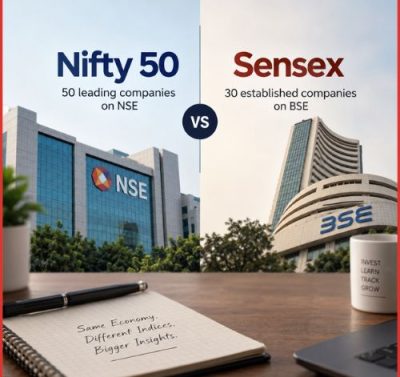
Two numbers open almost every business bulletin in India, and most viewers never ask why there are two. One tracks fifty companies. The other tracks thirty. Both claim to speak for the same economy, yet pricing an IPO or reading a board deck still needs to know which one applies.
The Nifty 50 vs Sensex question sounds academic until that decision arrives. That gap the Nifty 50 and Sensex difference in constitution, calculation, and exchange ownership starts shaping real outcomes right about then.
What Is Nifty 50?
Nifty 50 is the National Stock Exchange’s flagship index, launched on 22 April 1996 with a base value of 1,000. It tracks 50 large, liquid companies spread across roughly 13 to 15 sectors, weighted by free-float market capitalisation. The Nifty 50 index was the most dominant among all the indices on NSE, accounting for approximately 55% of the total free-float market cap (Business Standard, 2025) as of March 2025 and is the benchmark of choice for most equity derivatives and passive funds in India.
What Is Sensex?
Sensex, formally the BSE SENSEX, is the older of the two. BSE launched it on 1 January 1986 with a base value of 100 for the 1978–79 fiscal year. It tracks 30 large, established companies chosen for liquidity and sector balance rather than sheer count, and the Sensex index only switched to free-float weighting in 2003, having used full market capitalisation for its first 17 years.
Nifty 50 Vs Sensex: Key Differences
This Nifty vs Sensex comparison comes down to a handful of structural differences, laid out below.
| Feature | Nifty 50 | Sensex |
| Exchange | National Stock Exchange (NSE) | Bombay Stock Exchange (BSE) |
| Companies Tracked | 50 | 30 |
| Launched | 22 April 1996 | 1 January 1986 |
| Managed By | NSE Indices Limited | BSE Limited |
| Weighting Method | Free-float market capitalisation | Free-float market capitalisation (since 2003) |
| Base Value | 1,000 | 100 |
| Current Standing | About 55% of NSE’s free-float cap (Business Standard, 2025) | Closed near 77,316 on 25 August 2026 (Trading Economics, 2026) |
The gap in constituent count matters less than it looks, since most Sensex companies also sit inside the Nifty 50 basket.
How Are Nifty 50 And Sensex Calculated?
Neither index is an average of share prices. Both use free-float market capitalisation, which counts only shares actually available for public trading, not those locked up with promoters or the government. A company’s weight rises and falls with that free-float value, so one heavily weighted stock can move the whole index even while smaller constituents stay flat true for both the Nifty 50 index and the Sensex index alike.
Why Do Nifty 50 And Sensex Move Differently?
Daily divergence between the two usually comes down to five factors:
● Different rosters – 50 stocks versus 30 means the portfolios rarely match exactly.
● Different weightings – even shared constituents carry different weight in each index.
● Sector exposure – heavier banking or IT weighting can pull one index ahead when that sector rallies.
● Rebalancing – Sensex added Bharat Electronics in its June 2025 review; Nifty 50’s larger roster changes more often.
● Single-stock moves – one heavily weighted company’s earnings or regulatory news can shift one benchmark more than the other.
The real gap between Nifty 50 and Sensex isn’t in the numbers scrolling across a ticker; it’s in which fifty or thirty companies get to define “the market” on any given day.
Which Is Better: Nifty 50 Or Sensex?
This Nifty vs Sensex comparison ultimately turns on use case, not superiority. Nifty 50’s wider roster suits investors wanting broader large-cap exposure and deeper derivatives liquidity, while Sensex’s 30-stock focus and four-decade history make it a simpler reference for boardroom commentary.
The better question isn’t which index wins; it’s which one matches what’s being measured, whether that’s a listed subsidiary’s stock or a fund manager’s returns against a benchmark.
How To Track Nifty 50 And Sensex
Knowing how to track Nifty and Sensex takes minutes once you know where to look.
- NSE and BSE websites – both exchanges publish live levels, constituents, and methodology documents directly.
- Broker apps – Zerodha, Groww, Upstox, and Angel One show both indices on their home screens by default.
- Financial portals – Moneycontrol and the Economic Times markets page carry live charts, percentage change, and market breadth.
- Quick search – searching “Nifty 50 today” or “Sensex today” works for a fast check, though active traders should rely on a real-time feed since search results can lag.
How Investors Can Use Nifty And Sensex
- Gauge sentiment – both indices rising together signals broad optimism, though it doesn’t mean every stock is up.
- Benchmark performance – a portfolio returning 10% against a benchmark’s 14% is underperforming by 4 points, regardless of the absolute gain.
- Access through products – index mutual funds and ETFs offer exposure to either basket without picking individual stocks.
One practical lesson follows: a Nifty 50 fund and a Sensex fund rarely diverge by more than a point or two across a year, so holding both rarely buys extra diversification. A second lesson expense ratio and tracking error decide fund quality far more than which name sits in the title. The common mistake is reading the point-level gap as a valuation signal; Sensex’s lower number reflects its 1978–79 base value of 100, not a cheaper market.
What Makes Nifty And Sensex Rise Or Fall?
Several forces move these Indian stock market indices, sometimes together and sometimes apart:
- Corporate earnings, which move heavily weighted stocks and drag the index with them.
- Changes in interest rates that impact on the cost of borrowing and valuations of equity.
- Inflation, which pressures consumer spending and corporate margins alike.
- Global markets and foreign investor flows, since Indian equities track international sentiment closely.
- Crude oil prices, particularly since India is a big importer.
- Government policy and geopolitical events, from Budget announcements to sudden global shocks.
Conclusion
Nifty 50 and Sensex aren’t rival scoreboards; they’re two lenses calibrated to different exchanges and eras. Understanding the Nifty 50 and Sensex difference matters most when it feeds a real decision: which index a listed entity gets benchmarked against, or which figure gets quoted first in a board meeting.
Indian stock market indices will keep multiplying into sectoral and thematic variants, but these two will likely remain the pair every business leader checks first.
Frequently Asked Questions
1. Is Nifty 50 the same as Sensex?
No. Nifty 50 tracks 50 NSE-listed companies, while Sensex tracks 30 BSE-listed companies. Both use free-float market capitalisation, but different base values mean their point levels aren’t directly comparable.
2. Why does Sensex use a base value of 100 while Nifty 50 uses 1,000?
BSE set Sensex’s base value at 100 for the 1978–79 fiscal year when it launched in 1986. NSE chose 1,000 for Nifty 50 against a reference date of 3 November 1995, a decade later.
3. Which index should a business use for benchmarking?
Most companies benchmark against the exchange where their shares trade, and Nifty 50 tends to be the default for derivatives and passive-fund comparisons. Sensex remains common in general commentary because of its longer history.
4. Do Nifty 50 and Sensex always move in the same direction?
They usually move together, since most Sensex constituents also sit inside the Nifty 50 basket, but daily percentage changes can differ. Divergence widens when sector-specific news affects companies present in one index but not the other.
5. How can I track Nifty 50 and Sensex in real time?
Both update live on the NSE and BSE websites, on broker apps such as Zerodha and Groww, and on portals including Moneycontrol and the Economic Times. Values move continuously during trading hours, 9:15 am to 3:30 pm IST.
6. Is one index a better investment than the other?
Neither is inherently better; each represents a different basket of large, established Indian companies. Choosing between Nifty 50 and Sensex funds usually comes down to expense ratio and tracking error, not the index’s name.