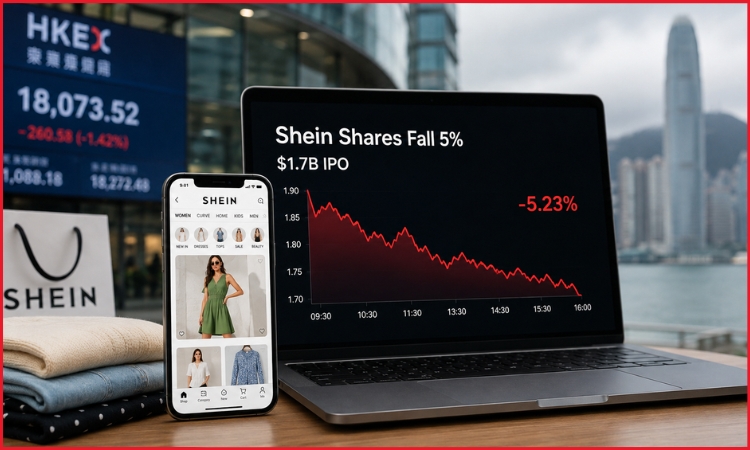
Shein shares fell more than 5% on their second day of trading in Hong Kong, extending the fast-fashion retailer’s difficult start as a publicly listed company.
The stock closed at HK$46 on Wednesday, compared with its initial public offering price of HK$48.56. That left the shares approximately 5.3% below the issue price and reduced Shein’s market value to roughly $25 billion.
The decline was particularly notable because Hong Kong’s Hang Seng Index finished broadly unchanged. It indicated that the weakness was concentrated in Shein shares, rather than being driven entirely by a wider fall in the market.
Shein’s stock had already experienced a volatile debut on Tuesday. It declined as much as 10% before recovering sharply to close at HK$48.50, only six Hong Kong cents below the IPO price.
According to a source and market analysts cited by Reuters, stabilisation measures commonly available for large new listings contributed to that late recovery. Such arrangements allow appointed banks to purchase shares during the period following an IPO to reduce excessive price volatility.
The renewed decline on Wednesday suggested that investors remained concerned about Shein’s slowing growth, weaker profitability and rising operating costs once the immediate support surrounding the listing had faded.
IPO Raises $1.7 Billion at Reduced Valuation
Shein sold approximately 280 million shares through its Hong Kong IPO, raising about HK$13.6 billion, or $1.7 billion.
The offer valued the Singapore-headquartered company at approximately $26.5 billion. This was substantially below its private-market peak of nearly $100 billion in 2022 and its reported $64 billion valuation during later funding rounds.
Only around 6.6% of Shein’s enlarged share capital was offered through the listing. A relatively small float can sometimes support a stock because fewer shares are available for trading, but that scarcity was not sufficient to produce a conventional first-day gain.
Cornerstone investors agreed to buy approximately $383 million of shares. The group included existing investors Boyu Capital, Tiger Global and General Atlantic, alongside Tencent, Greenwoods, Taikang Life and UBS Asset Management.
The company plans to direct most of the money raised towards technology, supply-chain development and international expansion. However, the listing also includes arrangements connected with earlier investors, adding to questions about how much of the wider transaction will directly support future growth.
Shein had spent several years attempting to complete a public offering before choosing Hong Kong. The successful listing provides access to public capital and creates a market price for the company, but the first two sessions show that investors are applying a much more conservative value than private markets did during the e-commerce boom.
Revenue Growth Slows as Profit Declines
Shein’s financial performance helps explain the valuation reset. Revenue rose about 8% to $41.8 billion in 2025, a significant deceleration from growth of about 21% in the prior year. Net profit fell 38.7% to approximately $2.06 billion.
Shein recorded a net loss of about $99 million during the first quarter, compared with a profit of approximately $395 million in the same period a year earlier.
Higher customs duties, logistics expenses and marketing costs have affected profitability. Shein’s rapid expansion was built partly around shipping inexpensive products directly to customers, allowing the company to offer a large selection without maintaining the same store network as traditional fashion retailers.
Changes to import treatment in the United States and Europe have made that model more expensive. Duties and processing fees on lower-value parcels can raise the delivered cost of individual orders, reducing one of Shein’s most important advantages.
US and European markets together account for close to 60% of the company’s revenue, making developments in those regions particularly significant.
Competition has also intensified. Temu, AliExpress and established fashion retailers are competing for price-sensitive online shoppers, while some rivals are expanding local warehousing to shorten delivery times and reduce cross-border exposure.
Shein Seeks Growth Beyond Fast Fashion
Shein is attempting to become a broader retail platform rather than relying entirely on clothing produced through its established supplier network.
Third-party brands can now sell through its marketplace, generating service revenue and expanding the range of goods available. The company has also moved into categories such as home products, beauty and lifestyle accessories.
This strategy could allow Shein to earn money from its logistics, technology and customer base without purchasing every item of inventory itself. It also introduces additional responsibilities involving product quality, merchant oversight and regulatory compliance.
Investors will be watching whether the marketplace business can restore faster revenue growth without requiring a disproportionate increase in advertising and customer-acquisition spending.
The company must also demonstrate that its supply-chain system can remain profitable as customs expenses increase. Its model uses customer data to identify demand and place relatively small initial orders with suppliers, allowing successful products to be replenished quickly while limiting excess inventory.
That operating approach remains an important competitive strength, but investors are questioning whether it can offset rising costs and declining price advantages.
The Shein stock decline does not determine the company’s long-term performance, particularly after only two trading sessions. However, it provides an early measure of public-market confidence.
Shein has completed a long-awaited $1.7 billion listing and remains one of the world’s largest online fashion businesses. Its shares closing at HK$46 nevertheless show that investors want evidence of stronger growth, stable margins and a credible response to the changing economics of low-cost cross-border retail.