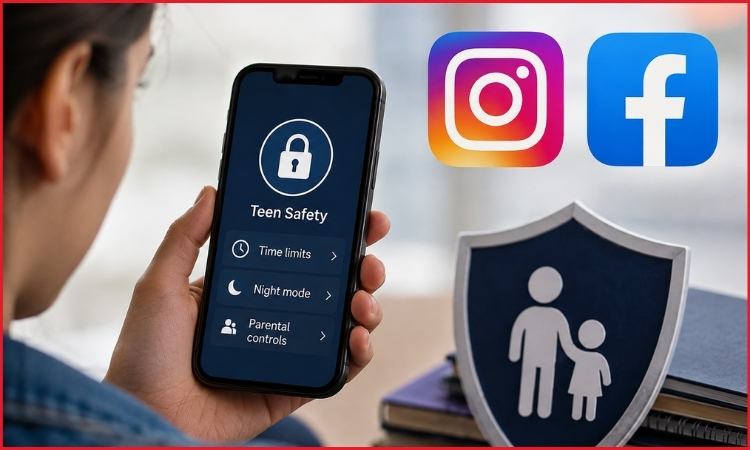
Meta has agreed to pay approximately $18 billion and introduce sweeping safeguards for teenagers on Instagram and Facebook, resolving claims brought by a broad coalition of US attorneys general.
The court-approved agreement will introduce default daily usage limits, overnight restrictions, muted school-hour notifications, stronger parental controls and improved age-detection systems.
It does not represent an immediate worldwide redesign of Instagram and Facebook. The mandatory protections apply to users under 18 in the participating US states and territories. However, the scale of the settlement could influence how Meta and competing platforms design youth accounts in other markets.
Meta reached the agreement with a bipartisan group of 52 attorneys general representing US states, territories and the District of Columbia. The company did not admit wrongdoing.
The legal cases alleged that Facebook and Instagram used addictive design features, exposed young users to harmful experiences and misled the public about platform safety.
Teen Accounts Will Receive Daily Time Limits
The most noticeable change will be a default two-hour daily limit covering Instagram and Facebook together.
Time spent across both platforms will count towards the same allowance. Meta says the system will also attempt to include usage from multiple accounts belonging to the same teenager.
Teenagers will not be able to turn off the limit independently. Removing or modifying the restriction will require permission through Meta’s parental-supervision tools.
The platforms will also introduce regular interruptions intended to discourage continuous scrolling. Teen users will receive prompts after every 15 minutes of uninterrupted activity and further reminders when their combined daily usage reaches 60 and 90 minutes.
Direct messaging will remain available after the daily limit is reached. Meta excluded messages from the restriction so teenagers can continue communicating with friends and family.
The two-hour limit is initially required for five years. It could become stricter if TikTok and YouTube agree to adopt comparable protections under arrangements with the participating states.
If both competitors join, Meta’s limit would fall to one hour per platform and remain in place for 10 years.
Facebook and Instagram Will Be Blocked Overnight
Meta will activate Night Mode by default for users under 18.
Between midnight and 6 am, teenagers will be unable to browse feeds, watch Reels, explore Stories or publish posts. Direct messages and important safety or account-security alerts will remain available.
If TikTok and YouTube adopt the wider settlement framework, the overnight restriction will expand from 10 pm to 7 am.
A separate School Mode will mute most push notifications between 8 am and 3 pm. Direct-message notifications and alerts concerning account security or personal safety will be exempt.
The distinction is important because School Mode does not completely block access. Teenagers can still open the applications, but the platforms will stop sending many of the notifications designed to draw them back during school hours.
Parents Gain Greater Control Over Accounts
Meta will provide parents with more information about how supervised accounts are being used.
Parents can receive notifications when a teenager links a secondary account, interacts with an account considered potentially suspicious or attempts to change a protective setting.
They will also receive periodic usage reports and will be able to require certain settings, including a non-personalised feed.
Teenagers will be offered the option to make a chronological or otherwise non-algorithmic feed their default experience. Meta must remind them of this choice periodically, while parents can make the setting compulsory for a supervised account.
Autoplay can also be disabled, preventing videos from beginning automatically. A teenager would then need to tap or swipe before viewing additional content.
Like and reaction counts will be hidden by default on posts viewed or published by teen accounts. Meta will additionally block cosmetic-surgery and extreme-makeup filters for these users.
These measures target individual features often associated with extended engagement or social comparison. However, the settlement does not eliminate personalised recommendations or advertising from Meta’s wider business.
Meta Must Improve Age Detection
The safeguards depend on Meta correctly identifying which users are children or teenagers.
Instagram and Facebook formally prohibit children under 13 from operating accounts, but younger users can enter a false birth date during registration.
Under the agreement, Meta must strengthen its age-assurance technology to identify likely under-13 accounts and remove them. It must also detect users who appear to be between 13 and 17, even when their profiles contain an adult birth date.
The settlement does not require every user to provide photo identification or submit a video selfie. Instead, Meta can use account activity, friend networks and other contextual signals when estimating whether a declared age is accurate.
An independent auditor will examine Meta’s compliance annually for five years. The company will also help establish an independent social-media research foundation and provide consented user data for research into teenage wellbeing.
Only Part of the Payment Is Guaranteed
The approximately $18 billion settlement will be paid in annual instalments over 10 years.
Participating jurisdictions are expected to receive roughly $12.7 billion, representing about 70% of the allocated amount. The remaining $5.3 billion is conditional.
That money will be released only if TikTok and YouTube introduce one-hour daily limits, Night Mode and age-assurance measures while also reaching matching financial agreements with the states.
Meta expects to record a legal expense of approximately $10 billion during the third quarter of 2026. It said the charge was not included in the expense range issued with its previous quarterly results, although its other financial guidance remains unchanged.
Most of the settlement’s operational requirements must remain active for 10 years. While the changes initially apply within participating US jurisdictions, they establish one of the most detailed legal frameworks yet for managing teenagers’ use of large social-media platforms.