Artificial intelligence stopped being a side tool a while ago. In 2026, AI tools replacing jobs is no longer a distant warning – it is a live pattern showing up in hiring freezes, leaner teams, and quiet restructuring across writing, coding, design, support, and research. Companies are not always cutting people outright. Often they simply stop backfilling roles once AI automation tools absorb enough of the workload.
Microsoft’s 2026 Work Trend Index found that 66% of AI users say AI frees up time for high-value work. That single number captures the whole shift. AI job displacement rarely announces itself. It shows up as one experienced employee doing what a small team used to do, with AI tools for automation quietly filling the gap.
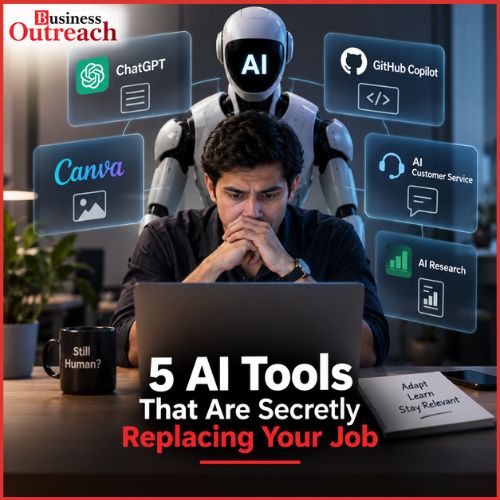
The Five Tools Driving AI Replacing Human Jobs Right Now
Business Outreach’s own tracking of India’s AI Companies of 2026 shows the same five categories showing up across enterprise budgets, and the jobs most exposed sit inside them.
| Tool | Roles Under Pressure |
| ChatGPT and general AI assistants | Content writers, copywriters, research assistants, virtual assistants, social media executives |
| GitHub Copilot and coding agents | Junior developers, QA testers, basic web developers, technical documentation writers |
| Canva AI and generative design tools | Junior graphic designers, presentation designers, freelance banner designers |
| AI customer-service agents | Call-centre executives, chat-support agents, tier-one technical support |
| AI research and data-analysis tools | Junior business analysts, market researchers, data-entry workers |
None of this reads as “AI replaces the writer” or “AI replaces the developer.” It reads closer to: one experienced professional with AI now does the work that used to need three or four people around them.
1. ChatGPT and General AI Assistants
ChatGPT and similar AI assistants have moved far past answering questions or writing short paragraphs. They can research a topic, summarise long documents, draft full reports, brainstorm campaigns, and support entire workflows in a single session.
Jobs most affected by this category of AI automation tools include:
- Content writers
- Copywriters
- Customer-support executives
- Research assistants
- Administrative staff
- Social media executives
- Junior analysts
- Virtual assistants
Picture a marketing team that once needed a writer, a researcher, and a junior social media executive to produce one week’s content. Today, an AI assistant often lets one experienced marketer handle most of that output alone.
This is the real shape of AI tools replacing jobs. It is rarely “AI replaces the writer.” It is closer to “one writer with AI now produces what three people used to produce.” Strategy, brand voice, and judgment about a specific audience still need a human. The bigger risk isn’t the tool itself it’s the colleague who has learned to use AI automation tools faster than you have.
2. GitHub Copilot and AI Coding Tools
Software development was long seen as one of the safest careers from automation. AI coding assistants have changed that story faster than almost any other field.
Tools like GitHub Copilot, along with newer agentic coding systems, can generate code, explain existing code, catch bugs, and build a working first draft of an application in minutes rather than hours.
Jobs most affected here include:
- Junior software developers
- Entry-level programmers
- QA testers
- Basic web developers
- Coding support roles
- Technical documentation writers
A junior developer once spent a full day on a simple landing page, a database query, or an API integration. An AI coding agent can produce a usable first version of that same work in minutes. This does not remove developers from the picture; someone still has to understand the architecture, review the output, and test it properly. But it does change hiring math: a project that needed five developers may now run on three, working alongside AI agents.
This is where AI job displacement gets tricky for beginners. Junior developers traditionally learn through small, repetitive assignments. When AI automation tools absorb those assignments, companies hire fewer juniors and expect the ones they do hire to arrive with stronger skills already. The fix isn’t avoiding coding altogether; it’s pairing coding skill with an understanding of AI tools, system architecture, and product thinking.
3. Canva AI and Generative Design Tools
Graphic design is another field facing rapid automation. Traditional design work picking layouts, resizing images, building social posts, generating presentations, producing variations of the same creative is exactly the kind of repetitive, rules-based task that AI automation tools are built to absorb.
Canva’s AI features let anyone type a plain-language brief and get a starting design instead of a blank canvas.
Jobs most affected include:
- Junior graphic designers
- Social media designers
- Presentation designers
- Banner designers
- Basic video editors
- Freelance design professionals
A small business that once hired a designer for ten Instagram posts may now generate first drafts internally through an AI-enabled design platform. The same applies to presentations, where a manager can describe the goal and get a structured starting point instantly.
Is design disappearing because of jobs replaced by AI? Not really. The gap is between execution and creative direction. AI is good at producing visual variations quickly. It is far less reliable at understanding why a brand’s visual identity should look a certain way, or how a design should feel to a specific audience. Designers who move from simply “making graphics” toward creative strategy, brand positioning, and audience psychology are the ones holding their ground.
4. AI Customer-Service Agents
Customer service is one of the clearest examples of AI replacing human jobs in repetitive, high-volume work. Chatbots have existed for years, but the newer generation of AI agents can hold real conversations, search knowledge bases, and complete actions across systems not just answer “What are your business hours?”
Jobs most affected include:
- Call-centre executives
- Chat-support agents
- Customer-service representatives
- Help-desk employees
- Tier-one technical support
Because customer service runs on enormous volumes of repetitive interactions, this is exactly the kind of environment where AI automation tools scale fastest. If an AI agent can resolve thousands of routine queries a day, companies need fewer people for first-level support.
Humans are not vanishing from customer service altogether. Complex complaints, emotionally sensitive situations, and unusual problems still need a person. The likely split going forward: AI handles volume, humans handle complexity. Professionals who build skills in escalation management, retention, and complex problem-solving are more insulated from this wave of AI job displacement than those handling routine tickets.
5. AI Research and Data-Analysis Tools
Research and analysis used to eat entire days searching websites, reading documents, organising spreadsheets, pulling out the relevant numbers, and writing it all up. AI tools for automation have compressed much of that timeline dramatically.
Modern AI research tools can summarise long documents, spot patterns across datasets, generate charts, compare sources, and produce a first-draft report almost instantly.
Jobs most affected include:
- Market researchers
- Junior business analysts
- Research assistants
- Data-entry workers
- Financial analysts doing routine work
- Operations executives
- Administrative researchers
An analyst who once spent a morning gathering market data and an afternoon writing it up can now compress both into a fraction of the time. That shifts the job itself: less time gathering information, more time interpreting it and deciding what it means for the business. As AI generates more raw information, that raw information becomes less valuable on its own. What stays valuable is judgment knowing which information actually matters and what a company should do about it.
Are These AI Tools Actually Replacing Jobs?
The honest answer sits between the two extreme headlines. AI job displacement is real, but a full “jobs apocalypse” is not what the evidence shows either. What is happening is narrower and, in some ways, harder to notice: AI is reducing specific tasks inside roles, and when enough tasks disappear from a role, companies simply need fewer people to fill it.
The future of work AI is shaping doesn’t look like humans against machines. It looks more like AI-powered workers pulling ahead of workers who never adopted AI tools for automation at all.
The Jobs Most At Risk Share One Pattern
Across writing, coding, design, support, and research, the roles facing the most pressure from AI tools replacing jobs share a few traits. They tend to be repetitive, digital, rules-based, high-volume, and easy to measure, with predictable inputs and outputs.
Jobs built on negotiation, leadership, emotional intelligence, physical work, or deep judgment are harder to automate completely. That doesn’t make them immune to AI job displacement; it just means AI is more likely to reshape how the work gets done than erase the role outright.
Final Takeaway
None of the five tools covered here – ChatGPT, AI coding assistants, AI design platforms, AI customer-service agents, and AI research tools – are likely to erase an entire profession overnight. What they are doing is changing, quietly and continuously, what companies expect one employee to be able to do.
The real risk isn’t that AI replacing human jobs happens all at once. It’s that your role changes shape gradually while someone else learns to do the new version of that job faster, with AI already built into how they work. The same shift that creates disruption also creates room to grow: AI can strip out repetitive work, boost individual output, and let smaller teams accomplish more. Microsoft’s 2026 research puts a number on that upside too – 66% of AI users say it gives them more time for high-value work, and 58% say it lets them produce work they could not have produced a year earlier.
Frequently Asked Questions
1. Is AI actually replacing jobs, or just changing them?
Mostly the latter. Evidence points to AI reducing specific tasks within roles rather than eliminating entire professions, though enough task loss in one role can eventually reduce headcount.
2. Which jobs are most at risk from AI tools replacing jobs in 2026?
Roles built around repetitive, high-volume, rules-based work face the most pressure: junior content writers, entry-level developers, basic graphic designers, tier-one support agents, and data-entry roles.
3. Can AI job displacement be reversed by learning new skills?
It can be managed, not reversed. Workers who build AI fluency into judgement-heavy or relationship-based parts of their job tend to stay valuable as routine tasks around them get automated.
4. Do AI automation tools eliminate the need for junior employees entirely?
Not entirely, but they shrink the stepping-stone assignments juniors traditionally learned on, pushing some companies to expect more advanced skills even at entry level.
5. What should professionals do first to prepare for AI replacing human jobs?
Identify which parts of your role are repetitive and digital, since AI tools for automation target those first, then invest in the judgement and communication skills around them.
6. Is India’s job market affected differently than other countries?
India’s scale of IT and services employment means automation shows up fast in outsourcing and entry-level tech roles, even as the country’s own AI sector adds new jobs in research and deployment.