For most of the past three years, the AI race looked like a contest between language models. GPT, Gemini, Claude and Llama slugged it out over benchmarks, while the world watched to see who could write better code or hold a longer conversation. That contest hasn’t ended, but a quieter one has opened up beneath it, inside the chips that actually run these systems.
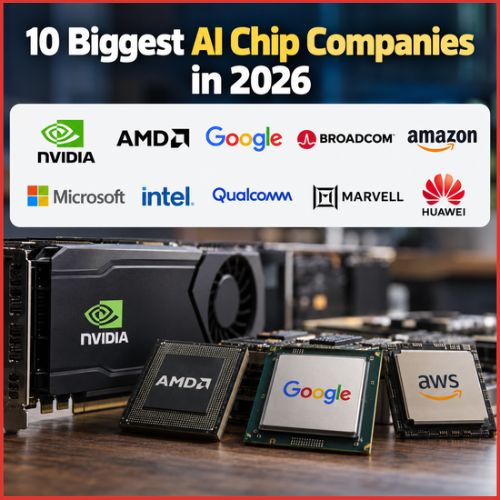
The list of tech companies building AI chips now stretches from Google and Amazon to Microsoft, Meta and even OpenAI, all pouring billions into designing their own AI silicon rather than buying it entirely off the shelf from Nvidia. Qualcomm and Broadcom have joined the AI hardware competition from the supplier side, building custom accelerators for whoever will pay for them. AI chip development has quietly become one of the most consequential items on the technology industry’s balance sheet.
Why would companies that already spend fortunes on Nvidia GPUs also spend billions on AI chip design of their own? The short answer comes down to a handful of business drivers that recur across every hyperscaler:
- Lower AI computing costs at massive, repetitive scale
- Better performance for specific, well-understood workloads
- Tighter energy efficiency as power becomes the real bottleneck
- Steadier, more predictable chip supply and delivery timelines
- Greater control over the AI infrastructure roadmap
- Reduced, though not eliminated, dependence on Nvidia
Quick Glance
| Company | Custom Chip | Primary Use | 2026 Status |
| TPU (Ironwood / TPU7x) | Training + inference | Generally available; 8th-gen previewed for 2027 | |
| Amazon Web Services | Trainium3 / Inferentia | Training + inference | Trainium3 UltraServers generally available |
| Microsoft | Maia 200 | Inference | In mass production; powers Copilot, Foundry |
| Meta | MTIA (100–500 series) | Inference + recommendation | New generations rolling out through 2027 |
| OpenAI | Jalapeño (with Broadcom) | Inference | Unveiled June 2026; deployment by end of 2026 |
| Qualcomm | AI200 / AI250 | Inference | AI200 commercial 2026, AI250 in 2027 |
The Nvidia Problem: Why AI Computing Got So Expensive
Nvidia didn’t plan the AI boom, but it was ready for it. Its GPUs, built originally for video games, turned out to be excellent at the matrix math behind deep learning. By the time ChatGPT made generative AI mainstream, Nvidia’s chips and its CUDA software were already the industry default.
That dominance carries a price tag. IDC estimates Nvidia still controls roughly four-fifths of AI data center chip revenue in 2026, down from over 90 percent a few years earlier but still an overwhelming lead. Every major AI company depends on a supplier whose chips are in permanent short supply and whose pricing power is close to absolute.
Running billions of AI queries a day, across search, chatbots, recommendation feeds and coding assistants, turns that dependence into a recurring, ballooning bill. That is where application-specific integrated circuits, or ASICs, enter the picture: chips built to do one job extremely well instead of everything reasonably well, the way a GPU does.
1. Custom Chips Can Cut the Cost of AI at Scale
Training a frontier AI model still tends to favor Nvidia’s flexible, general-purpose GPUs. Inference, the everyday work of actually answering a prompt or ranking a feed, is a different story. Inference workloads repeat themselves millions of times a day in fairly predictable patterns, which makes them strong candidates for chips designed around one specific job.
Meta’s MTIA accelerators, for instance, were built primarily to handle the ranking and recommendation inference behind Facebook, Instagram and WhatsApp, work so repetitive and high-volume that shaving a fraction of a cent off each computation adds up quickly. Amazon says the majority of inference running through Amazon Bedrock already runs on its own Trainium chips rather than Nvidia hardware. At the scale these companies operate, even modest efficiency gains from custom AI chips can mean hundreds of millions of dollars in avoided spend, and a small but real shift in the wider AI chip market.
2. Companies Want Control Over Their Own AI Infrastructure
There is a second motive that has less to do with price and more to do with leverage. Depending entirely on one external supplier for the most important component in your business is a strategic risk, not only a cost line. When Nvidia allocates limited supply, some customers wait longer than others.
Designing an in-house chip does not remove a company from the semiconductor supply chain. Google, Amazon, Microsoft and Meta still rely on TSMC to manufacture their designs, and increasingly on Broadcom or MediaTek to help with AI chip design itself. What custom silicon does provide is a voice in the roadmap: what the next chip prioritizes, when it ships, and how closely it fits a company’s own workloads. Amazon has made this point directly around Trainium, framing the goal as broadening customer choice rather than replacing Nvidia purchases altogether.
3. AI Chips Are Becoming Part of the Product Strategy
The most ambitious argument for custom silicon is not about saving money at all. It is about owning the entire stack, from the chip up through the AI model, the software layer and the cloud platform customers actually pay for:
- Chip: the custom accelerator itself
- AI model: trained and tuned with that chip in mind
- Software: frameworks and developer tools built around the hardware
- Cloud: the platform customers actually rent and pay for
- Data center: power, cooling and networking wrapped around all of it
Google’s TPUs make the point clearly. They began as an internal project and have since become a selling point for Google Cloud itself, a way to run Gemini, and now Anthropic’s Claude, on hardware nobody else can match. When a company controls chip, model and cloud together, it can tune each layer around the others in ways a business simply buying off-the-shelf GPUs cannot.
Inside the Big Five’s Custom Silicon Bets
Google’s TPU Playbook
Google’s Tensor Processing Units have been in development for roughly a decade, and Ironwood, the seventh generation, reached general availability on Google Cloud in April 2026. Google calls it its first TPU built for “the age of inference.”
- About 4.6 petaflops of compute per chip
- Scales up to 9,216 chips in a single pod
- Anthropic has committed to deploying up to a million Ironwood chips for Claude
- Eighth-generation chips already previewed for 2027: a Broadcom-designed training chip and a MediaTek-designed inference chip
Amazon’s Trainium and Inferentia
AWS has taken a two-track approach: Trainium for training, and increasingly for inference too, alongside its earlier Inferentia line.
- Trainium3 UltraServers, AWS’s first 3-nanometer chip, generally available since late 2025
- Roughly four times the compute performance and about 40 percent better energy efficiency than Trainium2
- More than a million Trainium chips reportedly running across AWS data centers
- Most of Amazon Bedrock’s inference traffic already runs on Trainium rather than Nvidia GPUs
Microsoft’s Maia Chips
Microsoft’s Maia 200, unveiled in January 2026, is built specifically for inference rather than training.
- Made on TSMC’s 3-nanometer process with more than 140 billion transistors
- Powers parts of Microsoft 365 Copilot and Azure AI Foundry
- Entered mass production by mid-2026, according to Microsoft
- A successor, Maia 300, was reportedly being prepared for a September 2026 unveiling
Meta’s MTIA and the Inference-First Bet
Meta runs some of the largest recommendation and advertising systems in the world, and its MTIA chips were purpose-built for that inference-heavy, repetitive workload rather than for training frontier models. In an expanded partnership announced in April 2026, Meta committed to work with Broadcom through 2029 on multiple future MTIA generations, deploying at gigawatt scale from 2027 onward. Meta has been candid that this is a portfolio strategy: Nvidia GPUs for flexibility and frontier training, MTIA for cost-optimized inference at massive scale.
OpenAI, Broadcom and Qualcomm Join the Race
OpenAI unveiled its first custom chip, codenamed Jalapeño, in June 2026, co-developed with Broadcom specifically for the inference workloads behind ChatGPT and its coding tools, with deployment planned by the end of 2026. Qualcomm, meanwhile, has moved from smartphones into data centers with its AI200 and AI250 accelerators, due commercially in 2026 and 2027, aimed squarely at inference economics rather than training. Broadcom itself has emerged as the industry’s most important AI chip design partner, working with Google, Meta, OpenAI and others at the same time.
Why Inference Is Rewriting the AI Chip Market
The AI industry spent its first few years obsessed with training bigger models. It is now just as focused on inference, the cost of actually running AI assistants, coding agents, search features and enterprise tools for hundreds of millions of users every day. TrendForce estimates custom ASIC shipments are growing at roughly 44.6 percent a year, nearly triple the growth rate of general-purpose GPUs, with ASIC-based servers on track to account for close to 28 percent of accelerator server shipments in 2026. Billions of daily inference requests, multiplied across products most people use for free, is exactly the kind of recurring bill that makes AI chip development worth the expense.
Energy Efficiency Has Become a Boardroom Issue
AI data centers consume enormous amounts of electricity, and power availability, not chip supply, is increasingly the binding constraint on how fast companies can expand. Cooling systems, grid capacity and local power agreements now shape where new AI infrastructure gets built almost as much as chip orders do. That has pushed performance-per-watt to sit alongside raw computing speed as a core goal of AI chip design; both Microsoft’s Maia 200 and Amazon’s Trainium3 were marketed on efficiency gains as prominently as on speed.
Custom Silicon Doesn’t Mean Nvidia Is Finished
None of this spells trouble for Nvidia in the near term. Its GPUs remain the default for frontier model training, where flexibility across constantly changing model architectures matters more than pure cost efficiency. The CUDA software ecosystem, built over nearly two decades and used by millions of developers, remains a genuine barrier that no custom AI chip has matched.
Nvidia’s own numbers back this up:
- 75.2 billion dollars in data center revenue in a single quarter of 2026
- AI accelerator revenue share down from a 2024 peak near 87 percent, but still an estimated 75 to 81 percent
- GPUs still preferred for unpredictable or fast-evolving workloads
- Custom ASICs preferred once a workload is stable, high-volume and well understood
The realistic outlook is a mixed one, with GPUs and specialized AI chips running side by side inside the same data centers for years to come.
The Real Battle Is the Full Stack, Not Just the Chip
Competition in AI hardware no longer stops at the processor. It now runs through several layers at once:
- Memory bandwidth and chip architecture
- Networking between thousands of chips in a pod
- Data center design, power procurement and cooling
- The software and frameworks that tie hardware to models
- The cloud platform that ultimately reaches the customer
A company that controls more of that stack, chip, network, cooling, model and cloud, can squeeze out efficiencies that a company simply buying components cannot. That is the logic behind Google pairing TPUs with its own AI models, or Microsoft pairing Maia with Azure and Copilot.
Conclusion
The competition among the world’s biggest technology companies has quietly shifted. It is no longer only about who can build the smartest model; it is about who can run that model efficiently, affordably and at a scale of billions of daily requests. That shift explains why AI chip development has become a boardroom priority at Google, Amazon, Microsoft, Meta and OpenAI, all at roughly the same time.
Custom AI chips will not replace Nvidia’s GPUs, and none of these companies are pretending otherwise. What they are betting on is a mixed future: GPUs for the unpredictable work of training frontier models, and purpose-built AI accelerators for the predictable, repetitive work of serving those models to the world. As inference costs keep climbing, that bet looks harder to ignore every quarter.
Frequently Asked Questions
What is a custom AI chip, and how is it different from a GPU?
A custom AI chip, often called an ASIC, is designed for one specific workload, such as AI inference, rather than general-purpose computing. GPUs, including Nvidia’s, are more flexible and better suited to varied or evolving workloads like training.
Why are Google, Amazon, Microsoft and Meta building their own AI chips instead of just buying Nvidia GPUs?
These companies run AI workloads at a scale where even small efficiency gains translate into large savings. Custom AI chips also give them more control over supply, cost and long-term infrastructure planning.
Does building a custom AI chip mean a company stops buying from Nvidia?
No. Every major hyperscaler pursuing AI chip development, including Google and Amazon, continues to buy Nvidia GPUs for training and for workloads where flexibility matters more than raw cost efficiency.
What is the difference between AI training and AI inference, and why does it matter for chip design?
Training builds an AI model from data and tends to need flexible, general-purpose hardware. Inference runs the finished model for users, is far more repetitive, and is where most custom AI chips today are focused.
Is Nvidia losing the AI chip market to custom silicon?
Nvidia’s share of AI accelerator revenue has declined from a 2024 peak near 87 percent to an estimated 75 to 81 percent in 2026, but it remains the dominant supplier, especially for AI model training.
What role do Broadcom and Qualcomm play in the AI chip market?
Broadcom co-designs custom silicon for Google, Meta and OpenAI and is one of the AI semiconductor industry’s largest beneficiaries. Qualcomm has entered the market directly with its own AI200 and AI250 inference chips for data centers.