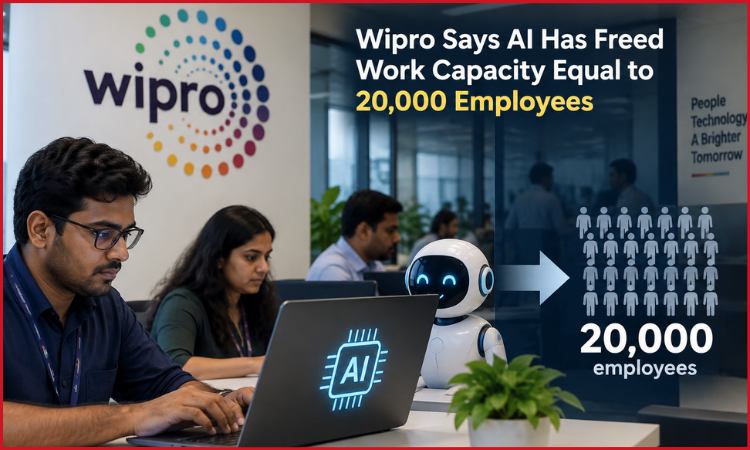
Wipro’s use of artificial intelligence has generated productivity gains equivalent to the output of approximately 20,000 employees, according to chief technology officer Sandhya Arun, offering one of the clearest indications yet of how AI is changing India’s software-services workforce.
The figure does not mean that Wipro eliminated 20,000 positions. Arun said employees whose capacity was released through automation and AI-assisted work had been reassigned to other projects, placed in different roles or given additional training.
Wipro employed approximately 243,000 people at the end of June. The productivity estimate therefore represents capacity equivalent to slightly more than 8% of its workforce, although it should not be interpreted as a direct headcount reduction.
The Bengaluru-based company is moving towards what it describes as a human-AI operating model, in which employees work with AI agents capable of handling parts of software development, testing, documentation, data analysis and other business processes.
More than 100,000 Wipro employees have received advanced AI-related training or certifications. The company is now seeking to convert those investments into client projects, new revenue and stronger margins.
Employees Are Being Redeployed, Not Directly Replaced
Arun said AI-driven productivity gains do not necessarily result in one agent replacing one employee. In practice, an engineer could supervise several AI agents, move to another customer assignment or train for a role requiring different skills.
That distinction is important because the 20,000-employee capacity figure measures estimated output rather than job losses. Wipro did not provide a detailed calculation showing the number of hours saved, the projects involved or the period over which the improvement was measured.
Productivity benefits can emerge in several ways. An AI coding assistant may generate routine software, explain existing code or identify errors. Other systems can create test cases, summarise documents, process support requests or help employees search large collections of company information.
These tools can shorten some tasks, but their output still requires supervision. Companies must check code for security problems, review generated information for accuracy and ensure that confidential customer data is handled correctly.
The effect on employment will consequently vary by assignment. Some projects may require fewer people, while others may use the released capacity to deliver additional work without a proportionate rise in headcount.
Wipro’s approach reflects a wider change across India’s $315 billion software-services industry. The sector traditionally expanded by recruiting large numbers of engineers and billing clients partly according to the employees assigned to a project. AI could weaken that connection by allowing smaller teams to produce the same amount of work.
That shift may also change customer contracts. Clients are increasingly interested in paying for a completed outcome, cost reduction or improvement in service rather than only the number of employees and hours involved.
AI Changes the Skills Required From Engineers
Wipro is expanding its group of forward-deployed engineers, who work closely with customers to identify business problems and implement AI systems directly within their operations.
Arun did not provide a numerical hiring target but said Wipro’s forward-deployed workforce would probably be comparable with those planned by its larger competitors.
Tata Consultancy Services intends to build a team of as many as 8,900 forward-deployed engineers, while Infosys is targeting approximately 6,000 over the next several years.
These roles combine software engineering with industry knowledge and customer interaction. An engineer working with a bank, for example, needs to understand both AI tools and the operational, security and regulatory requirements surrounding financial services.
Arun cautioned against placing too much emphasis on a single job title. She said the broader priority was ensuring that engineers throughout the organisation could work effectively with AI.
Wipro’s challenge is moving beyond internal efficiency. The company’s technology chief said the focus must shift from productivity alone to measurable outcomes, including improved customer experience, new sources of revenue and the achievement of wider business goals.
An organisation can complete an existing task faster without necessarily creating additional commercial value. The larger opportunity comes when AI allows it to launch a service, increase customer retention or solve a problem that was previously too costly or complicated.
Commercial Returns Remain the Next Test
Wipro is the only company among India’s four largest IT-services providers that does not separately disclose its AI-related revenue. This makes it difficult to determine how much customer spending the company has generated from its AI investments.
Manoj Chandra Jha, principal analyst at Nord-IQ Research, said Wipro’s spending on employee training and AI partnerships was comparable with investments made by TCS, Infosys and HCLTech.
However, he said Wipro remained at an earlier, cost-absorbing stage of AI commercialisation and trailed its peers in converting that investment into mature business.
Training more than 100,000 employees requires expenditure on courses, certifications, software access and time away from billable assignments. Wipro will need enough client demand to recover those costs while protecting profitability.
The productivity gains could help the company complete projects with fewer labour hours, but customers may also expect part of those savings through lower prices. Competition among IT providers could therefore limit the amount of efficiency improvement retained as profit.
AI adoption is also likely to slow traditional hiring across the industry. TCS said in June that recruitment would moderate as it works towards an operating model containing an equal number of employees and AI agents.
For Wipro, the immediate task is balancing that efficiency with workforce development. Redeployment avoids treating automation as an automatic job-cutting exercise, but employees must be able to move into roles for which customer demand exists.
The company’s estimate shows that AI is already affecting work at a meaningful scale. The decisive measure will now be whether capacity equal to 20,000 employees can be redirected into stronger revenue, better delivery and sustainable margins.