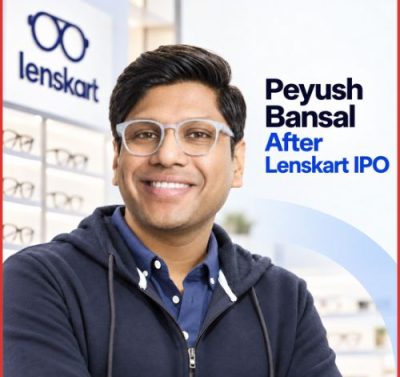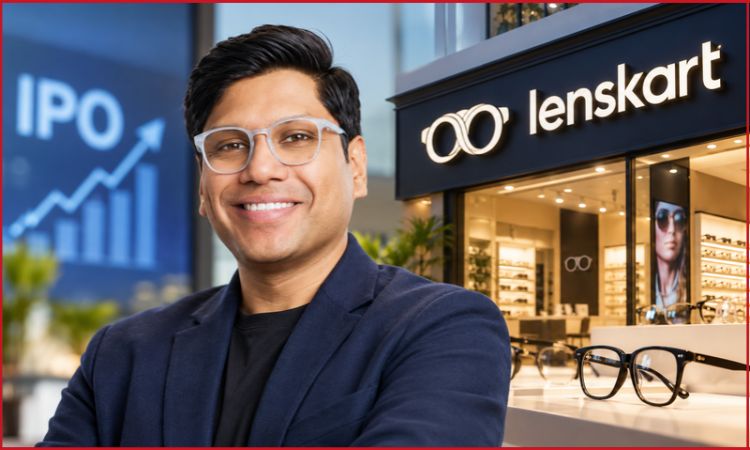
Peyush Bansal’s story has moved into a new chapter. For years, the Lenskart founder was known for building one of India’s most recognisable eyewear companies, and equally for his chair at the panel of Shark Tank India. His job today looks different. He is no longer simply pitching a growth story to private investors he is running Lenskart, now a public company, answerable every quarter to public shareholders.
This shift is really what the phrase Peyush Bansal post Lenskart IPO is pointing at. Running a startup and running a listed company are not the same job, and the Lenskart IPO changed the rules of the game for its Lenskart founder. Investors now track the company’s financial performance, its expansion plans, profitability, technology spending and long-term strategy line by line, quarter by quarter, a direct consequence of the Lenskart IPO 2025.
Lenskart’s own corporate disclosures name Peyush Bansal, CEO of Lenskart, as Chairman and Managing Director as well.
So what does life actually look like for him after the Lenskart IPO, and where does the next stretch of his career go from here?
Quick Glance
| Full Name | Peyush Bansal |
| Current Role | Co-founder, Chairman, Managing Director & CEO, Lenskart |
| Also Known For | Judge/Investor, Shark Tank India |
| Lenskart IPO | Listed in 2025 (fresh issue + offer for sale) |
| Term as MD & CEO | Five years, effective June 1, 2025 (shareholder-approved) |
| Approx. Promoter Stake | Roughly 8–9% of Lenskart, per corporate/insider filings |
| Reported Net Worth (2026) | Estimates vary widely, from the high hundreds of millions to over a billion dollars |
| International Presence | Japan, Southeast Asia, Middle East (besides India) |
| Market Cap (Sept 2026) | Reported to be approaching the $15 billion mark |
From Microsoft to Building Lenskart
Before he became one of India’s best-known startup founders, Peyush Bansal worked at Microsoft in the United States. He holds an engineering degree from McGill University in Canada a detail that regularly turns up in any account of the Peyush Bansal career arc.
The idea behind his entrepreneurial bet was fairly simple: eyewear in India needed to be easier to access, more affordable, and far more convenient than it was.
Lenskart’s own corporate history traces the company back to 2008, when it was incorporated as Valyoo Technologies by Peyush Bansal, Neha Bansal, Amit Chaudhary and Sumeet Kapahi, the same group later named as promoters in the Lenskart founder ranks. It began operating as an online eyewear business in 2010 and opened its first physical store in New Delhi in 2013.
That blend of online retail, physical stores, manufacturing and technology eventually became the backbone of the Lenskart business model and a central plank of the wider Peyush Bansal success story that would, years later, culminate in the Lenskart IPO.
Rather than treat eyewear as a plain retail category, Lenskart built an ecosystem around it: eye testing, prescription glasses, sunglasses, contact lenses, manufacturing and distribution, all under one roof.
The Shark Tank India Effect
Bansal became a household name after joining the panel of Shark Tank India.
The show put him in front of millions of viewers who had, until then, known Lenskart only as an eyewear brand and had little sense of the person behind it.
His blunt questions to founders, his running commentary on business models, and his willingness to back select startups on-air all fed into the Peyush Bansal Shark Tank India persona that audiences came to recognise, long before he became known for the Lenskart IPO itself.
There was an odd contrast sitting underneath all of it, though. On television, Bansal was the one judging entrepreneurs and deciding whether their businesses deserved a cheque. At Lenskart, he was the entrepreneur whose own company would eventually be judged by public-market investors the flip side of every Peyush Bansal Shark Tank India appearance.
That shift became very real with the Lenskart IPO 2025.
Lenskart IPO 2025: A Major Turning Point
The Lenskart IPO 2025 was a milestone in the company’s move from startup to public company, and arguably the single biggest turning point in the wider Peyush Bansal post Lenskart IPO narrative.
The IPO documents named Peyush Bansal, Neha Bansal, Amit Chaudhary and Sumeet Kapahi as promoters. The red herring prospectus also listed Bansal, CEO of Lenskart, as Chairman and Managing Director.
Structurally, the Lenskart IPO combined a fresh issue with an offer for sale, and the draft prospectus disclosed Bansal as one of the promoter shareholders participating in that offer for sale.
For Bansal, then, the Lenskart IPO was never just a fundraising event. It marked the move from running a privately held startup to leading a business whose every decision would now be watched by shareholders, analysts and the wider market a defining line in the Peyush Bansal career story, and the clearest marker yet of Lenskart as a public company.
From Startup Founder to Public Company CEO
The biggest change in Peyush Bansal’s career since the Lenskart IPO is arguably the sheer weight of accountability now attached to his calls.
A startup founder can chase long-term expansion and run experiments without much outside scrutiny. A listed-company CEO which is exactly what Peyush Bansal, CEO of Lenskart, is now has to weigh that same ambition against financial discipline, shareholder expectations, governance norms and regulatory obligations.
Bansal’s formal appointment as Chairman, Managing Director and CEO was approved for a five-year term starting June 1, 2025, subject to shareholder approval. Lenskart’s corporate filings note that his mandate covers the company’s strategic direction, innovation and growth.
Put simply: he is no longer just the founder people associate with Lenskart. He is the person steering Lenskart, now a public company, through its next stage of growth, with a scoreboard that updates every quarter arguably the clearest single measure of Lenskart IPO performance to date.
What Is Driving Lenskart’s Growth?
An Omnichannel Playbook
A large part of the post-IPO strategy rests on how Lenskart, as a public company, blends technology with physical retail.
The company runs both online and offline channels and has expanded beyond India into Japan, Southeast Asia and the Middle East.
Customers discover products online, walk into stores for eye tests and fittings, and lean on technology at nearly every step of the buying journey in between.
Heavy Bets on Technology
Lenskart is also pouring money into its tech stack. In its FY26 investor presentation, the company said it employed more than 500 engineers and was using technology to decide store locations, run eye tests and manage its supply chain. It also said its AI platform, GeoIQ, analyses more than 3,000 variables to identify optical retail locations.
That detail says a lot about where Peyush Bansal, CEO of Lenskart, is trying to take the company. The strategy is not just about opening more stores it is about using data to make a very large retail network run more efficiently, which is now a core part of the Peyush Bansal career story post-IPO.
The Vision Beyond India
International expansion is another major thread in the Lenskart post-IPO story, and one more piece of the Peyush Bansal success story still being written.
India is still Lenskart’s biggest market by far, but the company, now a public company with public-market obligations, talks increasingly about opportunities abroad. Its corporate website lists Japan, Southeast Asia and the Middle East among the markets it has already entered.
That creates a much bigger canvas for the Lenskart founder to work with taking a model built and refined in India into markets with different consumer habits, different competitors and different retail structures altogether.
Brand recognition alone will not get the job done there. It will take local market knowledge, efficient supply chains, the right product mix and disciplined execution.
Lenskart Share Price and the Public-Market Test
The Lenskart share price has become the most visible scoreboard for how investors read the company’s performance since the Lenskart IPO.
After listing, Lenskart drew heavy market attention. By September 2026, reports noted that its market capitalisation had climbed sharply from IPO-time levels, with the company’s valuation reportedly nearing the $15 billion mark a strong signal of Lenskart IPO performance by any measure.
That market reaction says something about the Lenskart IPO performance more broadly. The issue was priced at a valuation that sparked real debate among market watchers at the time. Share-price movement since then has shifted that conversation, as the company kept reporting growth and kept building out its retail and technology infrastructure.
Share prices, of course, can turn quickly, and short-term moves rarely settle the long-term question of whether a business is built to last. For Bansal, the harder task is holding onto operational growth while building value that shareholders can actually count on over time.
What Changes for Peyush Bansal After the IPO?
The gap between the old and new versions of the Peyush Bansal career comes down to three broad areas.
1. Greater Financial Accountability
As a private company founder, Bansal’s main job was building Lenskart. As the head of a listed company Lenskart, now firmly a public company his financial results draw far more scrutiny. Revenue growth, margins, cash generation, store-level economics and capital allocation are all part of the public conversation now, not internal boardroom detail.
2. Bigger Expansion Decisions
Lenskart already has a large physical and digital footprint. The next stage is about deciding where, and how fast, to expand further and international markets add a whole extra layer of complexity to that call.
3. Balancing Innovation With Discipline
Technology has always been part of the Peyush Bansal success story, but public companies cannot experiment endlessly without an eye on returns. The real challenge for Peyush Bansal, CEO of Lenskart, is keeping the innovation engine running while staying financially disciplined enough to satisfy public-market investors.
Final Takeaway
The Peyush Bansal post Lenskart IPO journey marks a real turning point in his career.
He started out as a technology professional, moved into entrepreneurship, built Lenskart from a small online eyewear business into a large omnichannel company, became one of India’s most recognisable startup investors through Shark Tank India, and eventually took his company through the Lenskart IPO and into the public markets.
The spotlight on him is different now. As Peyush Bansal, CEO of Lenskart, he is operating in a world where investors track the company’s numbers every quarter and where his strategic calls are tied directly to shareholder expectations.
The next chapter of the Peyush Bansal success story will likely be less about proving Lenskart can grow as a startup, and more about showing whether a founder-led business can keep growing once it belongs to the public markets, as Lenskart IPO performance continues to be judged quarter after quarter.
For Bansal, the Lenskart IPO was never the finish line. It was the start of a much bigger test of leadership, and the next stage of the Peyush Bansal career is only just getting underway.
Frequently Asked Questions
1. Who is Peyush Bansal?
Peyush Bansal is the co-founder, Chairman, Managing Director and CEO of Lenskart, and the Lenskart founder most associated with the company’s growth. He is also widely known for his role as an investor on Shark Tank India. Lenskart’s corporate profile confirms his current leadership position.
2. When did Lenskart go public?
Lenskart completed its transition to a publicly listed company following the Lenskart IPO 2025. The company’s official investor-relations website carries its IPO disclosures and offer documents.
3. What is Peyush Bansal’s role at Lenskart after the IPO?
He serves as Chairman, Managing Director and CEO of Lenskart, with responsibility for the company’s strategic direction, innovation and growth the core of the Peyush Bansal post Lenskart IPO mandate.
4. What is the Lenskart business model?
Lenskart combines online and offline retail with eye testing, eyewear manufacturing, technology and supply-chain infrastructure. The company, now a public company, operates across India and in select international markets, including Japan, Southeast Asia and the Middle East.
5. Why is Peyush Bansal famous?
Beyond building Lenskart as its founder, Bansal became widely recognised through Peyush Bansal Shark Tank India appearances, where he evaluated and backed startups on-air a platform that turned him into one of India’s most familiar entrepreneur-investors, well before the Lenskart IPO brought him a different kind of public attention.