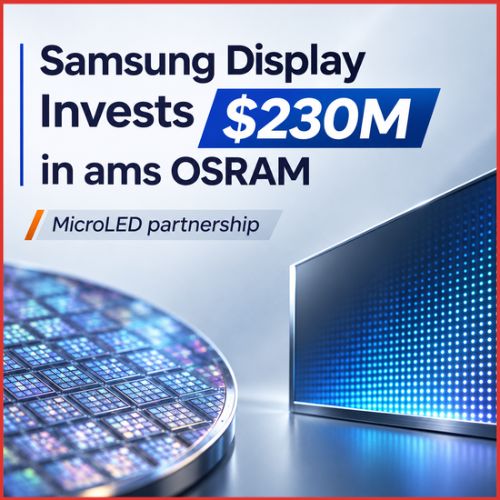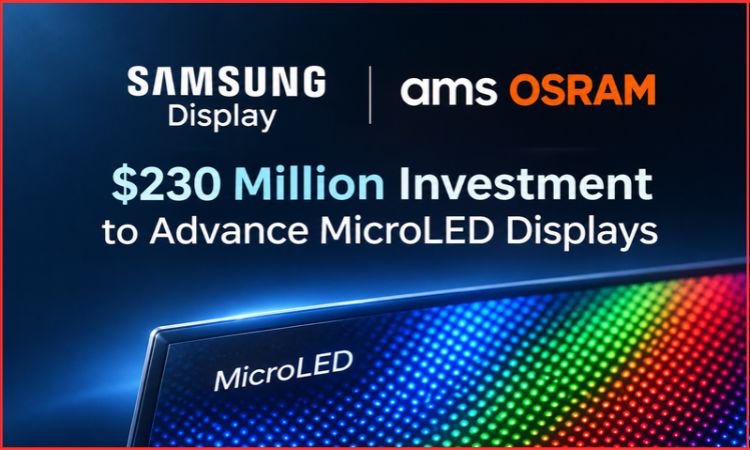
Samsung Display has agreed to invest approximately €210 million, or $230 million, in ams OSRAM, linking a substantial equity purchase with a partnership to develop next-generation display technology.
Under the agreement announced on November 25, Samsung Display will acquire 9,984,439 newly issued shares at €21 each. The transaction would give it a 9.1% stake in ams OSRAM and make it the company’s largest shareholder upon closing.
The investment accompanies a separate development programme focused on ultra-small microLEDs. For both companies, the commercial challenge goes beyond producing smaller light-emitting components: the technology must also become efficient and economical enough for manufacturing at scale.
Equity Investment Supports A Wider Partnership
The agreement brings together two connected commitments: ownership in the semiconductor supplier and funding for joint technology development.
Because Samsung Display is subscribing to newly issued shares, the investment provides capital to ams OSRAM. It also ties Samsung Display’s financial interest more closely to the supplier’s progress.
The development programme gives the relationship a practical purpose beyond the shareholding. The companies intend to combine their manufacturing and display expertise to create a route towards potential commercial production.
For ams OSRAM, that combination offers both financial support and a customer relationship built around an emerging technology. For Samsung Display, it creates a closer working arrangement with a specialist in light emission and optical sensing.
The announcement concerns an agreed investment and development partnership. Samsung Display’s position as the largest shareholder takes effect upon completion of the equity transaction.
Why Ultra-Small MicroLEDs Matter
MicroLED technology uses microscopic light-emitting diodes to produce images. Samsung Display describes the next generation under development as an inorganic, self-emissive technology with potential advantages in brightness, operating life and design flexibility.
Those characteristics explain its appeal. Display makers want screens that can deliver strong visual performance while fitting different shapes and demanding product requirements.
Yet promising characteristics alone do not establish a viable product. A display technology also needs repeatable production, acceptable costs and consistent performance across large numbers of components.
The partnership therefore includes work on efficiency and cost competitiveness. These are central commercial questions rather than finishing touches.
A component that performs well in a development setting must eventually be manufactured, handled and incorporated into a complete display reliably. Progress at each stage affects whether the resulting product can find a market.
The Companies Bring Complementary Skills
Ams OSRAM contributes expertise in advanced epitaxy, LED miniaturisation and high-volume manufacturing using eight-inch wafers.
Samsung Display brings its proprietary transfer technology, along with experience developing display manufacturing processes and commercialisation methods.
In practical terms, making tiny emitters and assembling them into useful displays are connected but distinct tasks. The partnership attempts to address both within one development programme.
Smaller components can introduce tougher requirements for handling, placement and quality control. A successful design must remain workable when production moves beyond individual demonstrations.
This helps explain why the companies have paired technical cooperation with a longer-term financial commitment. The work involves several stages, with manufacturing decisions influencing performance and cost throughout development.
Also Read: Samsung Life Q3 2026 Results: Profit Beats Forecasts
Kulim 2 Receives A Funded Development Role
The agreement also creates a clearer role for ams OSRAM’s Kulim 2 facility.
Samsung Display will provide significant funding over multiple years, while ams OSRAM reserves an agreed portion of manufacturing capacity for the programme.
Ams OSRAM expects annual development funding in the high double-digit millions of euros. That funding is intended to cover programme-related operating expenses and an appropriate share of the facility’s fixed costs.
For a semiconductor manufacturer, this matters before large commercial orders arrive. Facilities incur costs while technologies are being developed and qualified, and customer funding can help support that period.
The reserved capacity also gives the partners a framework for future production planning. It connects laboratory and engineering work with a potential manufacturing route.
Capacity Remains For Other Opportunities
The arrangement does not allocate the whole facility to Samsung Display. Ams OSRAM says substantial capacity remains available for other digital photonics opportunities.
That leaves room for additional programmes while the microLED partnership develops.
For the supplier, preserving that flexibility is commercially useful. A factory’s prospects can depend on several customers and applications reaching different stages at different times.
The partnership improves visibility around one programme without removing the need to develop other business. Its contribution should therefore be assessed alongside the facility’s wider utilisation and customer pipeline.
A funded development project can improve the economics of available capacity, but future revenue still depends on the work progressing and customers adopting the resulting technology.
Revenue Potential Depends On Execution
Ams OSRAM has identified a potential annual revenue opportunity in the triple-digit millions of euros over the medium to long term.
That figure describes an opportunity conditional on successful development and market adoption. It is not a statement that equivalent commercial sales have already been secured.
The distinction is especially important in emerging display technologies. Development milestones, qualification, production economics and customer decisions all affect how quickly an opportunity becomes revenue.
The equity proceeds are also expected to improve ams OSRAM’s financial flexibility. Its presentation estimates an approximately 0.7-turn improvement in pro-forma leverage, incorporating the effects described in the company’s transaction materials.
Together, the funding and investment give the programme firmer financial backing. They do not eliminate the technical work needed to reach competitive production.
A Long-Term Bet On Display Manufacturing
The agreement places Samsung Display more deeply inside the development of a potential future display platform, while giving ams OSRAM capital and a funded role in that effort.
Its significance lies in the combination: an equity stake, shared engineering work and reserved manufacturing capacity.
The next measure of progress will be whether those commitments produce technology that meets performance and cost requirements consistently. Until then, the $230 million investment represents a substantial commitment to development, with commercial returns depending on what the partners can manufacture and sell.
Sources: Samsung Display’s Official Announcement, Ams OSRAM’s Regulatory Announcement and Ams OSRAM’s Partnership Presentation. global.samsungdisplay.com