LG Electronics India shares and Siemens Energy India shares moved in opposite directions in morning trading on November 26, as a large share transaction weighed on the consumer electronics company while strong quarterly earnings lifted the energy equipment manufacturer.
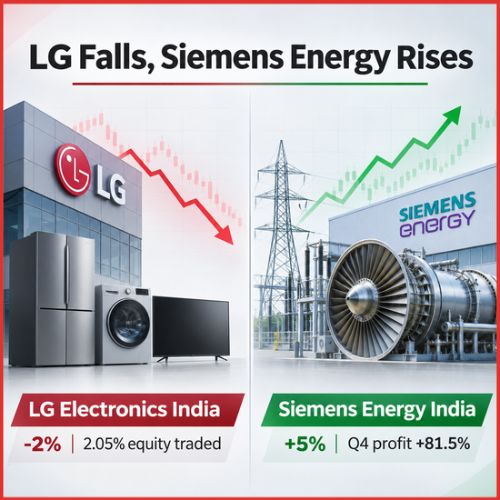
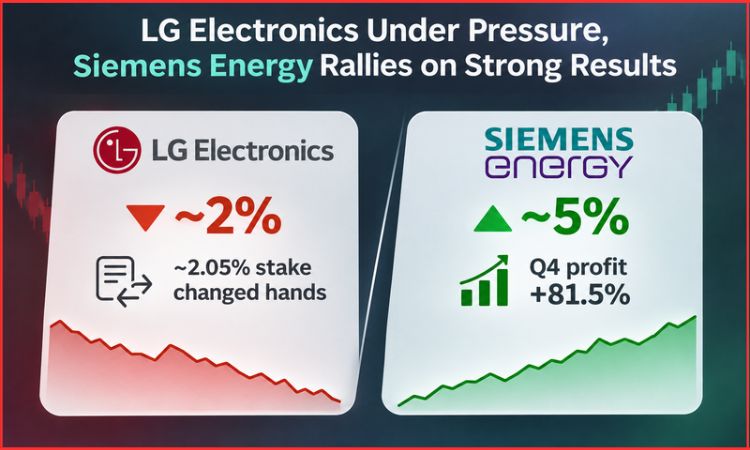
The morning report put LG Electronics around 2% lower as approximately 2.05% of its equity changed hands. Siemens Energy, meanwhile, gained about 5% after reporting an 81.5% increase in September-quarter profit.
Those figures describe movements during the session rather than closing prices. They also reflect different immediate triggers: a substantial change in share ownership at LG and an earnings announcement at Siemens Energy.
For investors following the two companies, the distinction matters. Trading pressure around a large transaction and a response to operating results require different explanations.
LG Shares React To A Large Transaction
The reported LG Electronics block deal involved approximately 1.39 crore shares, equivalent to about 2.05% of the company’s equity.
The immediate reaction may reflect the price needed to complete the transaction, the available demand and expectations about further supply.
The development followed an announcement that parent company LG Electronics Inc. intended to sell up to 2% of its Indian subsidiary to help meet minimum public shareholding requirements.
The parent’s proposed sale covered up to 13,575,447 shares.
However, the proposed transaction and the reported market turnover should not automatically be treated as identical. The quantities differ, and confirmation of individual buyers and sellers requires transaction disclosures.
The useful conclusion from the morning activity is narrower: a sizeable quantity of LG shares changed hands while the stock faced selling pressure.
Why The Promoter Sale Matters
LG Electronics Inc. held an 85% stake in the Indian business before the proposed sale. Selling two percentage points would reduce that holding to 83%.
The announced purpose was compliance with minimum public shareholding requirements.
A sale of existing shares changes ownership between the seller and buyers. It does not, by itself, issue new shares or provide fresh operating capital to the listed company.
That distinction helps explain why a stock can decline around a transaction without a new deterioration in the underlying business. More shares offered for sale can affect the trading balance even when the immediate announcement concerns ownership compliance.
At the same time, the promoter’s stated reason does not determine how the market must respond. Investors still assess transaction pricing, the amount of supply and the company’s valuation.
Siemens Energy Delivers A Strong September Quarter
Siemens Energy’s Q4 results provided a clearer operating catalyst.
For the quarter ended September 2026, the company reported profit after tax of ₹653 crore, up 81.5% from ₹360 crore a year earlier.
Revenue from operations increased 30.4% to ₹3,453 crore from ₹2,646 crore.
Profit growth therefore substantially outpaced revenue growth. That indicates the earnings improvement involved more than a larger volume of business.
The company attributed its performance to operational execution, a higher contribution from exports and improved profitability.
It suggested that the additional business translated into a proportionately larger increase in earnings.
Operating Margin Expands Sharply
Siemens Energy’s profit from operations rose to ₹781 crore from ₹448 crore, an increase of 74.4%.
Its operating margin improved to 22.6% from 16.9%, a gain of 570 basis points.
In simple terms, the company retained more operating profit from each rupee of revenue than it had a year earlier. That helps explain the scale of the increase in net profit.
Margin expansion can have a powerful effect when revenue is also growing. The larger sales base generates more business, while the improved margin increases the profit earned on that business.
Whether the latest margin can be sustained will depend on future execution, costs and the mix of orders delivered. One strong quarter establishes the recent performance; subsequent results will show how durable it is.
Orders Strengthen The Business Pipeline
New orders increased 92.1% to ₹4,514 crore during the quarter. The Siemens Energy order backlog rose 25.6% to ₹20,362 crore.
These figures add another dimension to the earnings report. Revenue describes work recognised during the period, while orders provide an indication of business secured for future execution.
However, a backlog is not the same as revenue already earned or cash already collected. Orders must progress through manufacturing, delivery and contractual milestones before their full contribution appears in financial results.
The commercial value therefore depends on both the size of the pipeline and the company’s ability to execute it profitably.
Annual Results Reinforce The Quarterly Performance
For the full financial year, Siemens Energy reported revenue of ₹10,243 crore, up 30.9%.
Annual profit after tax increased 61.9% to ₹1,781 crore. The board also recommended a dividend of ₹12 per share, subject to approval.
The full-year figures give the September-quarter performance a broader context. Growth extended across the financial year, rather than appearing only in the final reporting period.
The company identified opportunities associated with rising electricity demand, industrial expansion and renewable energy integration. Its business includes equipment and services used across power generation and transmission.
Turning those opportunities into earnings still requires timely delivery, manufacturing capacity and disciplined execution.
Two Stocks, Two Different Market Questions
The morning divergence left investors assessing separate issues.
For LG Electronics, attention centred on the share sale, transaction disclosures and the market’s ability to absorb the additional supply.
For Siemens Energy, the focus was on stronger profitability, the expanding order book and whether future execution could support the latest operating performance.
Neither morning move establishes what the shares will do next. What the session did show was how different corporate developments can drive opposite price reactions on the same day: a large ownership transaction pressing one stock lower, and a substantial earnings improvement lifting another.