India pulled in roughly $72 billion in energy-transition investment in 2025, according to BloombergNEF’s India Transition Factbook 2026. That single number says a lot about where corporate India is heading. The fastest-growing business sectors in India 2026 are no longer limited to IT services and consumer goods. Capital is moving into chips, clean power, data centres, electric mobility and defence, and the money is coming from Indian conglomerates, startups, private equity funds and foreign investors alike.
The reasons are fairly easy to see. A large middle class keeps spending more. Digital infrastructure now reaches small towns. The workforce is skilled and cheap relative to most rivals, and global companies want a second manufacturing base outside China. Together, these factors have made several of the fastest-growing industries in India attractive at the same time, something that rarely happens.
For a founder, a CXO or an investor, knowing which emerging business sectors in India deserve attention is practical, not academic. It shapes where you place capital, which markets you enter and which partnerships you chase. Below is a sector-by-sector look at the high-growth industries of 2026, the companies already active in them and the business investment opportunities India offers within each.
Quick Glance
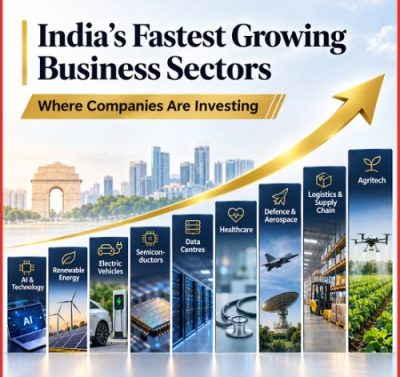
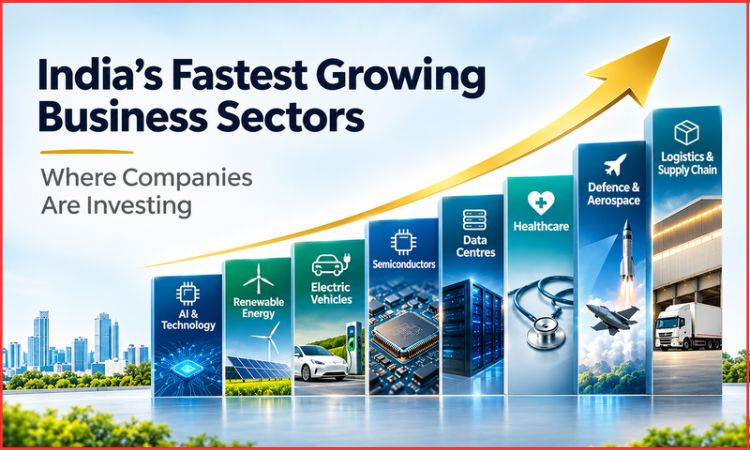
This table sums up the emerging sectors for investment in India covered above.
| Business Sector | Major Investment Areas | Growth Driver |
|---|---|---|
| Artificial Intelligence | AI software, automation, cloud | Enterprise digitalisation |
| Renewable Energy | Solar, wind, green hydrogen | Clean energy transition |
| Electric Vehicles | Batteries, charging stations | Electric mobility |
| Semiconductors | Chip manufacturing, testing | Electronics demand |
| Data Centres | Cloud and digital infrastructure | AI and data consumption |
| Healthcare | Hospitals, pharma, diagnostics | Rising healthcare demand |
| Defence and Aerospace | Drones, aircraft, satellites | Domestic manufacturing |
| Fintech | Digital payments, lending | Digital financial services |
| Advanced Manufacturing | Robotics, chemicals, textiles | Industrial expansion |
| Logistics and Warehousing | Storage, transportation, 3PL | E-commerce and trade |
| Agritech and Food Processing | Farm technology, food production | Modernisation and consumption |
1. Artificial Intelligence and Technology
AI is probably one of India’s most talked-about fastest-growing sectors, and for once the talk has money behind it. Companies are using AI to automate back-office work, answer customer queries, read business data and trim operating costs. Demand for generative AI, machine learning, cloud services, cybersecurity and enterprise automation is rising together.
The big Indian IT names, including Tata Consultancy Services, Infosys, Wipro and HCLTech, are building out AI practices for overseas clients. Smaller startups are going narrower, building products for healthcare, education, financial services and retail. On the policy side, the IndiaAI Mission has an approved outlay of ₹10,371.92 crore to support the country’s AI ecosystem.
Where companies are investing:
- Generative AI and enterprise automation
- AI-powered software and business intelligence
- Cloud computing and cybersecurity
- Machine learning and data analytics
- AI infrastructure and GPU computing
Business opportunity: AI consulting, automation services, SaaS platforms, AI-led marketing tools and specialised software development are strong entry points for both entrepreneurs and established technology firms.
2. Renewable Energy and Clean Technology
Energy security and the push to cut fossil fuel dependence have made renewables one of the most important emerging sectors for investment in India. Solar, wind, green hydrogen, battery storage and energy management systems are all drawing fresh capital, helped along by rising power demand from factories, offices and data centres.
BloombergNEF’s India Transition Factbook 2026 also points to heavy future funding needs for solar and wind capacity. Adani Green Energy, Tata Power, NTPC Green Energy and ReNew Energy Global are among the companies expanding capacity.
Where companies are investing:
- Utility-scale and rooftop solar
- Wind energy projects
- Green hydrogen production
- Battery energy storage systems
- Transmission and distribution for renewable power
- Commercial and industrial energy solutions
Business opportunity: Smaller players can look at solar installation, energy audits, rooftop solar maintenance, battery storage solutions and renewable energy consulting.
3. Electric Vehicles and Battery Manufacturing
Electric mobility in India is building speed, though unevenly. Two-wheelers and three-wheelers lead the way because they suit crowded cities and last-mile delivery fleets. Carmakers, battery producers, charging companies and startups are all putting money in, and some are looking at battery recycling, battery management systems and vehicle financing too.
The main names include Tata Motors, Mahindra & Mahindra, TVS Motor, Bajaj Auto, Ather Energy and Ola Electric. Government support for electric mobility and local manufacturing is helping firms build domestic supply chains. Battery costs, patchy charging networks and buyer affordability are still real hurdles, though.
Where companies are investing:
- Electric two-wheelers and four-wheelers
- Lithium-ion battery manufacturing
- EV charging infrastructure
- Battery swapping technology
- Battery recycling and material recovery
- Fleet electrification and mobility services
Business opportunity: EV dealerships, charging stations, battery maintenance, recycling units and electric fleet management are workable options for small and mid-sized businesses.
4. Semiconductor and Electronics Manufacturing
Chips go into phones, laptops, cars, telecom gear, factory machines and defence systems, and India still imports most of what it needs. That dependence is why semiconductor manufacturing has become a strategic priority and one of the high-growth industries to watch in 2026.
An EY-IESA report released in September 2026 projects that India’s semiconductor market will grow from about $64 billion in 2026 to $200 billion by 2035. The Semicon India Programme and its second phase, Semicon 2.0, are backing fabrication and supply chain development. Tata Electronics, Micron Technology, CG Power and Kaynes Technology are among the firms involved.
Where companies are investing:
- Semiconductor fabrication facilities
- Chip packaging and testing
- Electronic components manufacturing
- Printed circuit boards (PCBs)
- Semiconductor design and research
- Industrial electronics and equipment
Business opportunity: Component manufacturing, electronics assembly, testing services, industrial equipment supply and specialised engineering work all stand to gain as the sector expands.
5. Data Centres and Cloud Infrastructure
Every AI model, UPI payment and online order needs somewhere to run. That is pushing data centres to the front of the list of business investment opportunities in India. Mumbai, Chennai, Hyderabad, Pune and Delhi-NCR are the main hubs, mostly because of connectivity, power access and existing business clusters.
JLL’s India Data Centre 2026 Mid-Year Report puts national capacity at around 1.6 GW in mid-2026 and expects it to reach 6 GW by 2029. It estimates that about $110 billion will be needed by then. Global tech firms, cloud providers and infrastructure developers are all lining up to expand.
Where companies are investing:
- Hyperscale and colocation data centres
- Cloud computing infrastructure
- Server and networking equipment
- Data centre cooling systems
- Power backup and energy management
- Cybersecurity and data management
Business opportunity: Construction, electrical equipment supply, cooling technology, network infrastructure and specialised maintenance offer room for B2B businesses.
6. Healthcare, Pharmaceuticals and Health Technology
Healthcare stays on the list of growing industries in India because the demand base keeps widening. Incomes are rising, cities are expanding and people expect better medical care than their parents did. Money is flowing into hospitals, drug manufacturing, medical devices, diagnostics, health insurance and digital health platforms.
India also supplies generic medicines and vaccines to many countries, which gives the pharmaceutical side a global footprint. Meanwhile, healthtech startups are working on access, particularly outside the metros. Apollo Hospitals, Max Healthcare, Sun Pharmaceutical Industries, Cipla and Dr. Reddy’s Laboratories cover different parts of this ecosystem.
Where companies are investing:
- Hospitals and specialised healthcare facilities
- Diagnostic laboratories
- Pharmaceutical research and manufacturing
- Medical devices and equipment
- Telemedicine and digital health platforms
- Health insurance and patient management software
Business opportunity: Diagnostic centres, medical equipment distribution, healthcare software, specialised clinics and pharma supply-chain services can work for new entrants.
7. Defence, Aerospace and Space Technology
Defence production and aerospace now sit inside India’s wider industrial growth plan. The push for domestic manufacturing and self-reliance has opened the door for private companies, which were largely shut out of this space for decades. The same is happening in space, where private firms now work on satellites, launch vehicles, earth imaging, navigation and communication systems.
Skyroot Aerospace, Agnikul Cosmos, Pixxel and Digantara are among the startups building in different corners of the space ecosystem. A September 2026 Business Standard report, citing Jefferies research, says India’s space economy could reach roughly $40 to 45 billion by 2030.
Where companies are investing:
- Defence equipment and components
- Aircraft and aerospace manufacturing
- Drones and unmanned aerial vehicles
- Satellite technology
- Rocket and launch vehicle development
- Space-based data and communication services
Business opportunity: Precision engineering, component manufacturing, drone services, electronics, specialised software and defence supply-chain partnerships suit Indian businesses with technical depth.
8. Financial Technology and Digital Payments
UPI changed how Indians pay, and it changed how small businesses collect money. Corner shops, service providers and local merchants now take digital payments as a matter of routine. Fintech companies are using that base to move into lending, wealth management, insurance technology and financial automation.
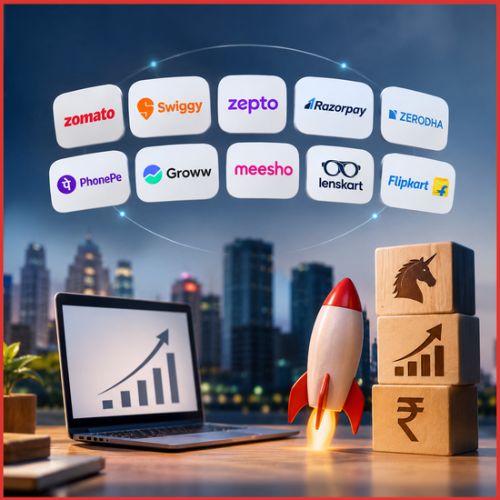
PhonePe, Razorpay, Paytm, CRED and Groww each work in a different slice of India’s digital finance market, which is why fintech remains among India’s fastest-growing sectors.
Where companies are investing:
- Digital payment platforms
- Lending and credit technology
- Insurtech and wealth management
- Financial automation software
- Fraud detection and cybersecurity
- Financial services for MSMEs
Business opportunity: Payment integration, financial software, merchant solutions, accounting automation and fintech consulting benefit from rising digital adoption.
9. Advanced Manufacturing, Chemicals and Industrial Automation
Companies want to produce more at home, spread their supply chain risk and sell abroad. Make in India and production-linked incentive (PLI) schemes are encouraging exactly that. On factory floors, firms are bringing in robotics, smart sensors, industrial IoT and automated production lines to raise output and cut waste.
NITI Aayog’s August 2026 report on making India a global manufacturing hub identifies chemicals, textiles, telecom equipment and solar photovoltaic manufacturing as high-potential industries.
Where companies are investing:
- Industrial robotics and automation
- Specialty chemicals
- Textile and technical textile manufacturing
- Telecom and networking equipment
- Solar panel and component manufacturing
- Industrial packaging and machinery
Business opportunity: Industrial packaging, machinery distribution, automation consulting, specialty chemical production and component manufacturing serve steady B2B demand.
10. Logistics, Warehousing and Supply Chain Management
E-commerce, organised retail, manufacturing and trade all need goods to move faster and cost less. That has made logistics one of the quieter but more dependable growing industries in India. Firms are building modern warehouses, adopting automated inventory systems, adding cold storage and linking transport networks. Quick commerce has added pressure for fulfilment centres in the right locations.
Delhivery, Blue Dart, Mahindra Logistics, TCI Express and Allcargo Logistics are among the major operators.
Where companies are investing:
- Industrial and commercial warehousing
- Cold storage and temperature-controlled logistics
- Automated inventory management
- E-commerce fulfilment centres
- Freight forwarding and transportation
- Supply-chain technology platforms
Business opportunity: Regional warehousing, packaging, cold-chain logistics, third-party logistics (3PL) and last-mile delivery are open to smaller businesses.
11. Agritech and Food Processing
Agriculture still carries a large share of the Indian economy, but it is slowly picking up technology. Agritech and food processing aim to raise yields, cut wastage and connect farmers to bigger markets. Companies are putting money into precision farming, agricultural drones, farm management software, preservation, packaging and organised food supply chains.
Demand for packaged food, ready-to-eat products and processed farm goods is also encouraging investment in processing infrastructure. DeHaat, Ninjacart and BigHaat are some of the names in India’s agritech ecosystem.
Where companies are investing:
- Precision agriculture and farm automation
- Agricultural drones and monitoring technology
- Food processing facilities
- Cold storage and preservation
- Agri-supply chain platforms
- Packaged and ready-to-eat food products
Business opportunity: Food processing units, farm equipment rental, farm-to-business supply chains, packaging and storage facilities look promising, especially for firms serving regional markets.
What Is Driving Business Investment in India in 2026?
No single factor explains why these high-growth industries are expanding together. Five forces keep showing up.
Government policy and incentives. Make in India, PLI schemes, the IndiaAI Mission and semiconductor programmes are backing local manufacturing, technology development and infrastructure.
Consumer demand. Higher incomes, urbanisation and changing habits are lifting demand for healthcare, digital services, electric vehicles, packaged goods and organised retail.
Digital adoption. Businesses of every size are moving to AI, cloud tools, automation and digital payments to work faster and serve customers better.
Supply-chain diversification. Global companies are looking at India as a place to manufacture and source, which opens doors for domestic suppliers and industrial firms.
Infrastructure spending. Roads, railways, ports, power networks, logistics hubs and industrial corridors are making it easier to do business across the country.
Conclusion
India’s economic shift is opening up opportunities across technology, manufacturing, infrastructure, healthcare and consumer industries. The fastest-growing business sectors in India 2026 are drawing money because of real shifts in demand, government backing, technology adoption and rising domestic consumption.
AI, renewable energy, electric vehicles, semiconductors and data centres deserve the closest watch, since each one feeds growth in several other industries. Healthcare, logistics, fintech, food processing and industrial automation, meanwhile, give businesses a way to serve India’s expanding domestic market.
For entrepreneurs and established companies, the real opportunity is not simply being present in a hot sector. It lies in finding a specific customer problem, building a better answer to it and running the business in a way that lasts. As manufacturing capacity and digital infrastructure keep growing, these are India’s fastest-growing sectors and should stay central to business activity and investment for years to come.