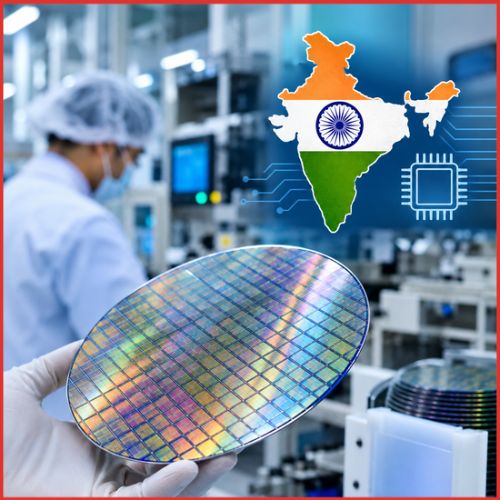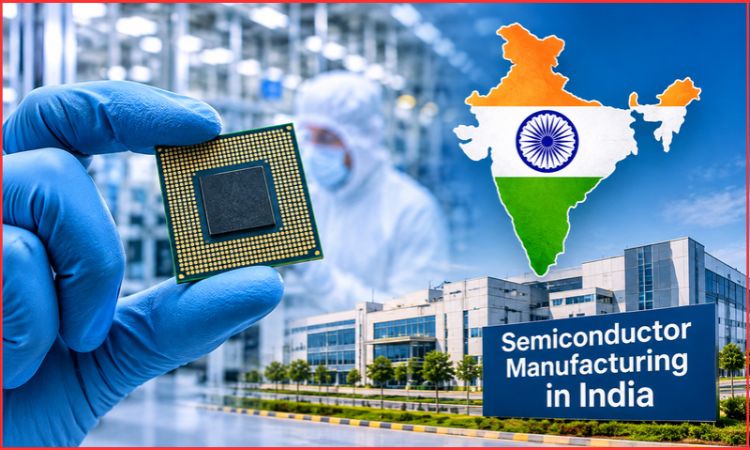
Every phone in your pocket, every car on the road and every data centre humming in the background runs on chips. For years, India designed a good share of them but manufactured almost none. That is starting to change. India’s semiconductor manufacturing ecosystem is taking shape through government backing, large corporate bets and a growing group of smaller specialists.
This article looks at India’s semiconductor ecosystem 2026 as it stands today: which semiconductor companies in India are building what, how the India semiconductor supply chain fits together, and where the real hurdles sit. One caution first. Much of what follows is announced or under construction, and announced capacity is not the same as chips coming off a production line.
Quick Glance
| Category | Key Details |
| Industry | Semiconductor manufacturing and chip design |
| Main government initiative | India Semiconductor Mission (ISM) |
| Key segments | Design, fabrication, assembly, testing and packaging |
| Major participants | Tata Electronics, Micron, CG Power, Kaynes Technology, HCL-Foxconn |
| Demand drivers | Smartphones, electric vehicles, AI, data centres, telecom |
| Main challenges | Capital cost, technology access, water and power, talent |
What Makes Up India’s Semiconductor Ecosystem
A semiconductor is a material whose electrical conductivity can be controlled, and silicon is the one most chips are built on. Those chips process data, store information and control everything from washing machines to missile guidance.
India has long been a strong base for chip design. Engineers in Bengaluru, Hyderabad and Noida have worked on processors for global brands for decades. Designing a chip, though, is a very different job from making one. Semiconductor chip manufacturing India-style, at scale, needs ultra-clean facilities, expensive machinery and years of process know-how.
The ecosystem has five connected parts:
- Design: the architecture and circuitry of a chip.
- Wafer fabrication: building circuits on silicon wafers.
- Assembly and packaging: protecting the chip and connecting it to other components.
- Testing: checking that each chip performs and lasts.
- Materials and equipment: wafers, gases, chemicals and the machines themselves.
The strategy is to build these up step by step rather than leap straight to the most advanced chips.
Semiconductor Companies in India to Watch
The list of semiconductor companies in India now includes home-grown conglomerates, global chipmakers and a handful of niche players. The figures below reflect developments reported through October 2026, and most are announced investments rather than operating output.
Tata Electronics
Tata Electronics is behind the most ambitious project. Its proposed fab in Dholera, Gujarat, is being developed with Taiwan’s Powerchip Semiconductor Manufacturing Corporation (PSMC). The announced investment is about ₹91,526 crore, with planned capacity of roughly 50,000 wafer starts a month. Chips from the plant are meant for automotive, consumer and industrial uses.
Tata has also partnered with ASML on lithography technology and talent development, and it is building a separate assembly and testing facility in Morigaon, Assam. Taken together, these projects are the clearest attempt at semiconductor fabs in India that span more than one stage of production.
Micron Technology
US-based Micron is setting up an assembly and test facility in Sanand, Gujarat, with an announced investment of ₹22,516 crore. It will handle memory products such as DRAM and NAND. This is not a wafer fab. The plant packages and tests memory components rather than making the silicon wafers themselves.
Still, memory sits inside nearly every smartphone, laptop and server, so having a large memory packaging site at home matters for semiconductor manufacturing in India.
CG Power and Renesas
CG Power and Industrial Solutions has teamed up with Japan’s Renesas Electronics and Thailand’s Stars Microelectronics for a packaging and testing unit in Sanand. The announced investment is around ₹7,584 crore. Renesas brings the chip expertise, and CG Power brings industrial manufacturing experience. The focus is on automotive electronics, industrial automation and power management.
Kaynes Technology
Kaynes began as an electronics manufacturing services company and is now moving into chip packaging through Kaynes Semicon. Its Sanand facility handles assembly and testing, with an announced investment of about ₹3,307 crore. The company’s existing relationships with industrial and automotive customers could help it link chip packaging directly to product makers.
HCL and Foxconn
The HCL-Foxconn project near Jewar in Uttar Pradesh is designed around display-driver chips, the components that control the pixels on phone, laptop and monitor screens. The announced investment is roughly ₹3,706 crore.
Smaller specialists
Not every project is huge. Several smaller firms are carving out niches:
- SiCSem is developing silicon carbide chips in Odisha for power electronics.
- 3D Glass Solutions is working on glass substrates and advanced packaging.
- Continental Device India (CDIL) is expanding discrete semiconductor production in Punjab.
- ASIP is building packaging capability in Andhra Pradesh.
These firms show that the semiconductor industry growth India is hoping for will not come only from giant fabs.
How the India Semiconductor Supply Chain Works
The India semiconductor supply chain runs in a loop of dependent stages, and a weak link anywhere slows everything else. In simple terms: design, then materials and equipment, then wafer fabrication, then assembly, packaging and testing, and finally electronics manufacturing.
Design and intellectual property
Design teams use electronic design automation software to lay out and verify circuits. India already has a large design workforce, and companies such as Qualcomm, Intel, AMD, Texas Instruments and MediaTek run engineering centres here. Local startups are building specialised chips for telecom, industrial and connected devices. But a finished design still needs a fab willing and able to build it, which is the gap new projects are trying to close.
Wafer fabrication
Fabs turn silicon wafers into working circuits through lithography, deposition, etching and doping. It is the most capital-hungry stage in the chain. A fab needs stable power, ultra-pure water, tight contamination control and experienced engineers. This is why technology partners matter so much to semiconductor fabs in India. Money alone does not buy process knowledge.
Assembly, testing and packaging
After fabrication, wafers are cut into individual chips, packaged and tested. Assembly, testing, marking and packaging (ATMP) and outsourced semiconductor assembly and test (OSAT) are common entry points for countries building a chip industry. Micron, CG Power, Kaynes and Tata are all active here, and it is where India is likely to see output first.
Equipment and materials
Factories depend on specialised machines, high-purity chemicals, gases and wafers, most of them imported from firms like ASML, Applied Materials, Lam Research and KLA. Building local suppliers, maintenance services and materials expertise will reduce that exposure over time. It is probably the least glamorous part of the story, and one of the most important.
Government Support: ISM and Semicon 2.0
Policy has been a major reason investors showed up. The India Semiconductor Mission was set up to build a domestic semiconductor and display manufacturing base, and the original programme carried an approved outlay of ₹76,000 crore. In 2026 the government introduced India Semiconductor Mission 2.0, with more weight on equipment, materials, chip design and indigenous intellectual property.
The approach rests on a few pillars: financial incentives for eligible projects, partnerships with experienced foreign manufacturers, help for design startups, workforce training and support for local suppliers. Investors in this industry think in decades, so policy consistency matters as much as the incentives themselves.
Where the Projects Are Located
| Location | Companies or projects | Main focus |
| Dholera, Gujarat | Tata Electronics and PSMC | Wafer fabrication |
| Sanand, Gujarat | Micron, CG Power, Kaynes | Assembly, testing and packaging |
| Morigaon, Assam | Tata Electronics | Assembly and testing |
| Jewar, Uttar Pradesh | HCL-Foxconn | Display-driver chips |
| Odisha | SiCSem, 3D Glass Solutions | Power chips, advanced packaging |
| Mohali, Punjab | CDIL | Discrete devices |
| Andhra Pradesh | ASIP | Packaging |
Gujarat leads on scale, while other states are building specialised strengths. Over time, these clusters could attract suppliers, test labs, logistics firms and training institutes.
Opportunities Behind the Growth
Several forces are pushing semiconductor industry growth India is counting on.
Rising electronics demand. Phones, laptops and smart appliances need more chips each year, and local packaging and production can serve both Indian and export customers.
Electric vehicles and power electronics. EVs rely on chips in battery management, motor control and charging. Silicon carbide devices are especially useful in high-efficiency power systems.
AI and data centres. AI infrastructure needs processors, memory and power-management chips. Still, advanced AI accelerators demand technology far beyond what mature-node or specialised plants can produce, so expectations should stay realistic.
Jobs and local suppliers. Plants need engineers and technicians, but they also create demand for industrial gases, precision parts, cleanroom equipment and maintenance services.
Challenges Facing India’s Semiconductor Ecosystem
Progress is real, but so are the obstacles.
- Capital cost: a fab costs enormous sums to build and run, and returns depend on steady demand and good yields.
- Technology dependence: key equipment, software and materials still come from abroad.
- Infrastructure: power cuts or water shortages can wreck yields and raise costs.
- Talent: fab work needs hands-on training that few Indian institutions currently offer at scale.
- Global competition: Taiwan, South Korea, China, Japan, the US and Europe have decades of experience and deep supplier networks.
- Commercial viability: an announced investment guarantees nothing. Plants must win customers and keep costs down.
Future Outlook
India is moving from a design-led presence toward a broader manufacturing base. The realistic path is not copying every segment of the global industry at once. It is building depth in mature-node chips, automotive semiconductors, power devices, memory packaging, display drivers and advanced packaging.
Three things will decide how far this goes: how fast plants reach commercial production, whether they lock in long-term customers, and how well local suppliers plug into global chains. If ISM 2.0 delivers on equipment, materials and indigenous IP, India’s semiconductor ecosystem 2026 could be remembered as the point where the country stopped only assembling imported parts.
Conclusion
India’s semiconductor manufacturing ecosystem is being built by Tata Electronics, Micron, CG Power, Kaynes and a set of specialist manufacturers, covering fabrication, packaging, testing and power chips. The bigger opportunity lies beyond the factory walls: design strength, local equipment and materials suppliers, trained people and plants that make money.
India is not yet a replacement for established hubs. But with a large electronics market and a widening manufacturing base, it has a credible foundation. Execution will decide the rest.