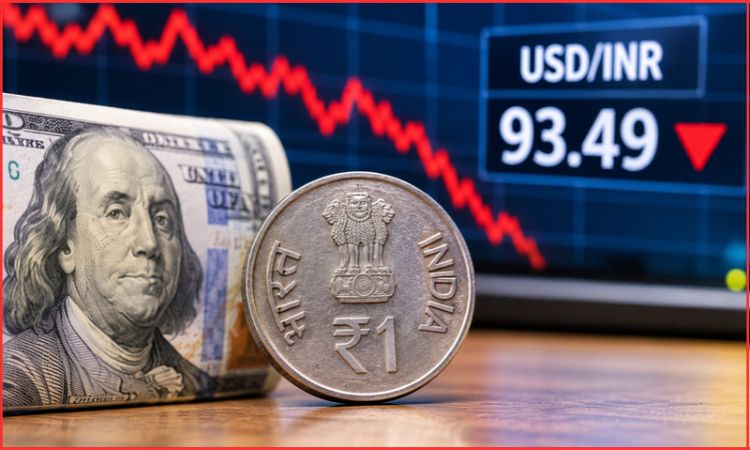
The Indian rupee weakened in early trade on November 19, giving back a small part of its recent recovery as the US dollar strengthened.
The currency opened at 93.40 against the dollar before slipping to 93.49, eight paise weaker than Wednesday’s close of 93.41.
Lower crude oil prices and foreign investment inflows helped limit the decline, according to currency traders cited in the morning report.
The movement followed three sessions of appreciation. The rupee had gained 10 paise on Wednesday after strengthening by a combined 68 paise in the preceding two sessions.
Thursday’s early loss therefore represented a modest retreat from that advance, rather than a complete reversal of it.
The quotation was an intraday observation, not the final exchange rate for the session.
The Rupee Opened Stronger Before Losing Ground
The opening level of 93.40 was one paisa stronger than the previous close.
The subsequent move to 93.49 showed that the initial improvement did not hold.
In the USD/INR exchange rate, a higher number means more rupees are required to buy one dollar. The move from 93.41 to 93.49 therefore represents rupee depreciation.
That can be confusing when the currency is described as “falling” while the quoted number rises.
The eight-paise change is ₹0.08 per dollar. Its percentage size was approximately 0.09%, calculated against the previous close.
That is a relatively small movement, although even modest changes can matter when applied to large commercial payments.
A Stronger Dollar Applied Pressure
The dollar index was up 0.11% at 103.90 in the reported snapshot.
The index measures the US currency against a basket of six major currencies. It provides context for dollar strength, but it does not determine the rupee’s exchange rate mechanically.
USD/INR also reflects demand and supply in the domestic currency market.
Import payments, export receipts, investment flows and hedging transactions can all influence that balance.
The morning report identified a stronger dollar and weak domestic equities as pressures on the rupee. It also identified factors working in the opposite direction.
That combination explains why the currency could soften without experiencing a much sharper decline.
Lower Crude Prices Help Limit The Retreat
Brent crude traded 0.26% lower at $91.71 a barrel in the same report.
For India, lower oil prices can reduce pressure on the cost of imported energy.
The effect on currency demand depends on the value and timing of payments, rather than the commodity quotation alone. Purchase arrangements and hedging can also influence when a price change reaches an importer.
Still, lower crude oil prices supplied a supportive part of the morning backdrop.
That support was not strong enough to prevent the rupee weakening, but traders said it helped contain the fall.
The distinction is useful: a favourable influence does not have to produce a stronger currency by itself. It can instead offset part of the pressure created elsewhere.
Foreign Equity Buying Provides Another Support
Foreign institutional investors bought Indian equities worth ₹5,866.78 crore on Wednesday, according to exchange data cited in the report.
Overseas investment can support demand for domestic assets and influence currency transactions associated with those purchases.
However, a daily equity-flow figure does not reveal every foreign-exchange transaction made during the period.
Investors may hedge their exposure, retain existing currency balances or conduct transactions at different times.
The reported inflow should therefore be treated as part of the explanation, rather than a direct formula for calculating the rupee’s next move.
The important observation is that foreign fund inflows remained supportive even as the dollar strengthened and local shares encountered early weakness.
The Recent Recovery Remains Relevant
Before Thursday’s retreat, the rupee had appreciated by 78 paise across three sessions.
Measured against that combined improvement, an eight-paise early decline gave back only part of the gain.
This does not establish that the recovery will continue. It simply places the latest movement in proportion.
Currency reports can become misleading when each day is described without reference to the preceding sessions. A small decline after a strong recovery has a different context from the same decline during a prolonged slide.
For businesses monitoring payments, both the current rate and the path taken to reach it can matter.
A company that arranged a transaction several days earlier may still face a more favourable rate despite Thursday’s modest weakening.
An Eight-Paise Move Has A Clear Payment Effect
Consider a hypothetical payment of $10,000.
At ₹93.41 per dollar, its rupee value would be ₹9,34,100. At ₹93.49, it would be ₹9,34,900.
The difference is ₹800, before bank charges, conversion spreads or any other applicable costs.
For a $100,000 payment, the same eight-paise movement would change the rupee amount by ₹8,000.
These examples illustrate the arithmetic rather than quote a bank’s customer rate.
They also explain why a movement that appears small on a market screen can attract attention from businesses handling larger transactions.
The effect depends on which side of the payment the business occupies and whether the exchange rate has already been fixed.
Market Quotes Differ From Customer Conversion Rates
The reported interbank rate should not be treated as the exact price available to every individual or business.
Banks and other providers apply their own conversion quotations and charges.
A traveller buying dollars, a family paying overseas tuition and a company settling an invoice may therefore face different effective rates.
The market number provides a reference for the direction of movement. The actual transaction requires a current quote for the relevant service.
This distinction matters particularly when calculating whether a small daily change has produced a meaningful saving.
A narrow market improvement can be outweighed by differences in provider charges.
The Morning Balance Remains Mixed
Thursday’s early trade brought together opposing influences.
Dollar strength and weaker equities pressured the rupee, while softer crude and foreign investment provided support.
The confirmed result was a move to 93.49 against the dollar, eight paise below the previous close in currency-value terms.
That left most of the preceding three-session recovery intact at the time of the report. Whether the retreat would deepen or reverse depended on trading later in the day, making the early quotation a dated observation rather than a forecast.
Source: Business Standard’s PTI Currency Report. Finance News – Business Standard