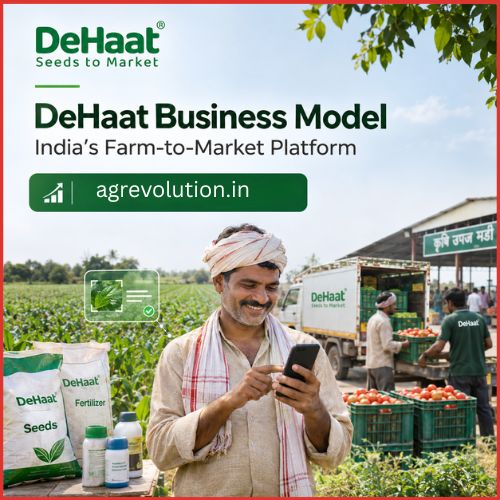
A farmer in Bihar buys seed from one shop, asks a neighbour what to do about a pest outbreak, and sells the harvest to whichever trader turns up at the field gate. Three transactions, three middlemen, and almost no price transparency.
That patchwork is what the DeHaat business model tries to stitch together. Started in Patna in 2012, DeHaat sells farm inputs, gives crop advice and buys produce back, all through a single relationship. Among agritech startups in India, it is one of the few that has grown into a business of real scale.
This article looks at how the DeHaat agritech business works, where its money comes from, how the DeHaat farmer network operates on the ground, and what the DeHaat business model India has built says about the wider Indian agritech industry.
Quick Glance
| Factor | Details |
| Company | DeHaat (legal entity: Green Agrevolution Pvt. Ltd.) |
| Founded | 2012, Patna, Bihar |
| Founders | Shashank Kumar, Amrendra Singh, Shyam Sundar Singh, Adarsh Srivastava |
| Sector | Agritech, full-stack farm services |
| Operating model | Phygital: mobile app plus local DeHaat Centres run by micro-entrepreneurs |
| Revenue sources | Produce (output) linkage, input sales, agri services, platform fees from brands |
| FY25 revenue | ₹3,041 crore, up 11% from ₹2,720 crore in FY24 |
| Farmers reached | Over 12 million (company-reported) |
| Funding | Over $200 million raised; backers include Temasek, Sofina, Lightrock, Prosus and Peak XV |
What Is DeHaat and Who Started It?
DeHaat means “village” in Hindi, which tells you where the company’s head is. Shashank Kumar, Amrendra Singh, Shyam Sundar Singh and Adarsh Srivastava founded it in 2012, and today it works out of Patna and Gurugram.
The early pitch was plain. Smallholder farmers in eastern India couldn’t easily get genuine inputs, timely advice or a fair buyer, so DeHaat set out to cover all three. When it raised its Series A, led by Sequoia Capital India (now Peak XV), it served about 210,000 farmers across 20 regional hubs, according to TechCrunch. The company now says it reaches more than 12 million, helped along by acquisitions such as the data platform FarmGuide in 2021.
How the DeHaat Business Model Works
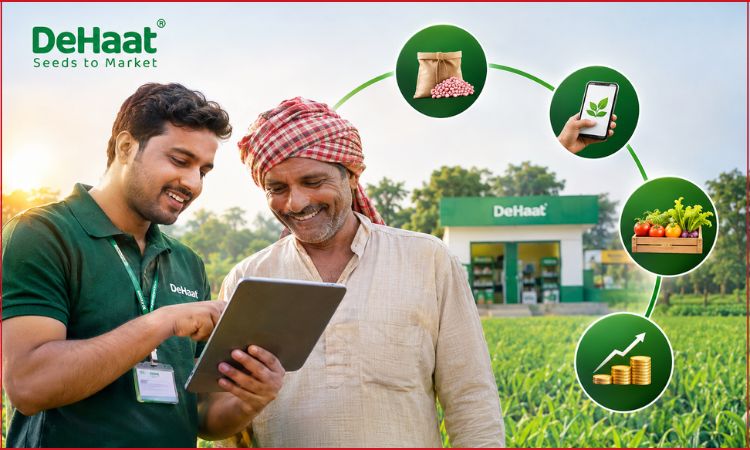
The easiest way to read the DeHaat business model is as a loop that follows the crop calendar. It is not a shop that happens to have an app. A farmer can join at any point, and the idea is that he or she stays for the next stage too.
Inputs: seed, fertiliser and crop protection
Before sowing, a farmer needs seed, fertiliser and pesticides, and needs them to be genuine. DeHaat supplies these through its centres and app, which gives brands a cleaner route into villages they could never reach on their own. Farmers get a nearby source. Companies get a ready-made distribution line.
Advisory: free guidance, paid for indirectly
This is the part most people get wrong. DeHaat does not charge farmers for advice. As TechCrunch reported, it takes a cut when a farmer buys inputs through the platform or sells a crop through it. So the advice on sowing time, irrigation, pests and weather works as the hook, and the commercial value shows up later in purchases and sales.
Output linkage: buying the harvest
Growing a crop is half the job. Selling it at a fair price is the other half. DeHaat aggregates produce from farmers and sells it to institutional buyers, which cuts down the chain of traders in between. For a small farmer with no bargaining power, a reliable buyer can matter more than a discount on fertiliser.
Credit and other services
Over time, DeHaat has added farm credit and other services on top of the core loop. The more of the crop cycle it touches, the harder it becomes for a farmer to go back to the old, scattered way of doing things.
The DeHaat Farmer Network on the Ground
Apps are easy to copy. A trusted face in the village isn’t. The DeHaat farmer network is built around DeHaat Centres, each run by a local micro-entrepreneur who knows the farmers by name.
According to Preqin, the same micro-entrepreneur sells inputs, makes crop reminder calls in the local language, helps monitor the crop and finally helps move the produce to institutional buyers. One person, one relationship, the whole season. That continuity is why the DeHaat farmer network is considered the real asset of the company, more than the software on top of it.
At one stage, the company also planned to open around 2,000 rural retail centres to improve last-mile delivery, per the same source. The direction is clear: more local points of contact, not fewer.
Why DeHaat Runs a Phygital Model
Rural India doesn’t run on apps alone. Plenty of farmers own smartphones, but seeds still have to be physically delivered, and harvested crops still have to be physically collected. So the DeHaat agritech business splits the work between a digital layer and a physical one.
The digital side handles:
- Farmer registration and records
- Advisory messages and crop reminders
- Ordering and payments
- Data collection and crop monitoring
The physical side handles:
- Delivery of inputs to villages
- Face-to-face support and trust
- Collection and aggregation of produce
- Handover to buyers
Neither half works well without the other. That is the core of the DeHaat business model India has been testing for over a decade.
DeHaat Revenue Model: How the Company Earns
The DeHaat revenue model rests on transactions rather than subscriptions from farmers. Three streams matter most, and one smaller one sits alongside them.
| Revenue stream | How DeHaat earns | Why it matters |
| Output linkage | Margin on produce sold to institutional buyers | Largest share of revenue; high volume, thin margin |
| Input sales | Margin on seed, fertiliser and crop protection sold | Repeats every crop cycle |
| Agri services | Fees and margins on advisory-linked and credit services | Deepens the farmer relationship |
| Platform fees | Charges to input and output companies using the network | Smaller, but not dependent on farm prices |
Now the numbers. DeHaat reported revenue of ₹3,041 crore in FY25, up about 11% from ₹2,720 crore in FY24, according to filings reported by StartupFeed. A revenue split published by Multiples.vc puts roughly ₹2,393 crore under output linkages and about ₹607 crore under inputs and services. In other words, around four-fifths of the DeHaat revenue model comes from trading farm produce, not from selling seed.
That tilt explains a lot. Produce trading brings in a large top line, but margins are slim, and a bad price swing can wipe out a quarter’s gains. The company has reportedly reached EBITDA breakeven in the first quarter of FY26, though readers should check the latest filings before treating that as settled.
Where DeHaat Has an Edge
Its advantage is not one feature. It is the combination. A pure input marketplace such as BigHaat, which leans on online sales, can’t easily offer buy-back. A produce trader can’t easily offer advice. The DeHaat agritech business sits across both, and its local centres keep farmers close. Add the data that builds up as the DeHaat farmer network grows, and its recommendations can get sharper each season. Responsible handling of that farmer data is still something the company has to earn trust on.
Challenges Facing the DeHaat Business Model
Agritech is hard, and the DeHaat agritech business carries its own risks. So does the DeHaat business model India has bet on.
- Thin margins. Commodity trading pays little per rupee of turnover. Scale helps, but only if costs stay under control.
- Rural logistics. Collection, storage and transport eat into profit, particularly for perishable crops.
- Seasonality. Input demand spikes before sowing and then drops. Cash flow has to survive the quiet months.
- Farmer adoption. Trust takes years to build and one bad season to damage. A farmer who loses money on advice may not come back.
- Fragmentation. India has millions of small farms growing different crops under different conditions. One playbook rarely fits two states.
What DeHaat Tells Us About the Indian Agritech Industry
DeHaat is not the only name in the Indian agritech industry. Peers such as BigHaat and WayCool work on inputs and food distribution respectively, and many other agritech startups in India are chasing farm advisory, marketplaces, credit or supply-chain technology. What sets DeHaat apart is that it tries to cover the full crop cycle, which is the core of the DeHaat business model India now offers as a template.
For the Indian agritech industry, the lesson is that a digital-only play is a hard fit for the village. The more convincing models so far pair technology with people on the ground. If that holds, the next wave of agritech startups in India will probably look less like pure apps and more like DeHaat: part software, part logistics, part local trust.
Conclusion
The DeHaat business model works because it treats farming as a cycle, not a single sale. Inputs, advice, credit and buy-back are tied to one local relationship, and that makes the farmer harder to lose. The numbers back up the scale, even if margins are still the open question.
For anyone tracking agritech startups in India, the DeHaat business model India has built is worth watching less for its app and more for its ground game. It shows that in Indian agriculture, trust and technology have to travel together.