The buying behavior of consumers in India has evolved over time, but there is one thing that has not changed – people love to shop from multiple brands within one place. The only difference now is that their expectations have increased. Consumers expect more variety, better pricing and a shopping experience that is worth it.
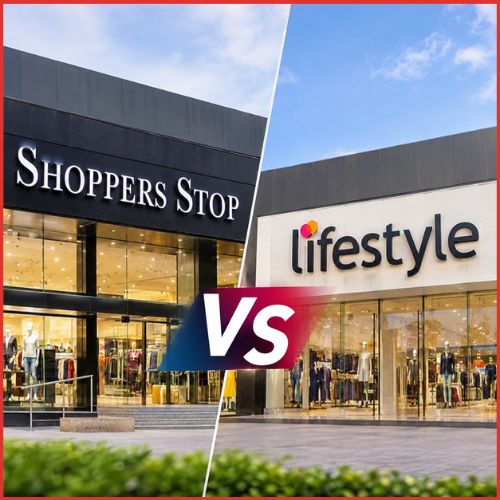
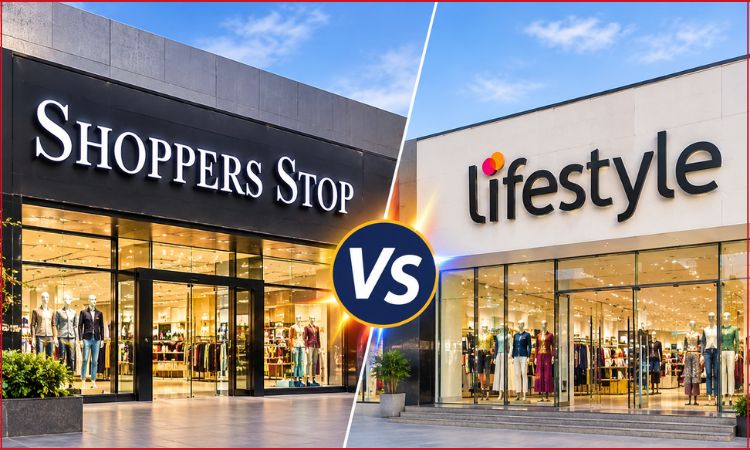
This change has brought a unique kind of competition between the two well-known players in the Indian retail sector – Shoppers Stop and Lifestyle.
Though both provide fashion, footwear, accessories, and beauty products, each retailer has a different strategy. While Shoppers Stop is focusing on premium brands, beauty and personalized shopping, Lifestyle is positioning itself on trendy fashion for the whole family.
Recent developments in the businesses of both these companies are also a reflection of their different problems. While Shoppers Stop has made a consolidated net loss in FY2025-26 even though the revenues have increased, Lifestyle is planning to expand outside metropolitan areas despite the lack of suitable retail spaces.
So, which retailer has the stronger business model? Let’s compare them across the factors that matter most.
Shoppers Stop vs Lifestyle: Company Profile at a Glance
| Parameter | Shoppers Stop | Lifestyle |
|---|---|---|
| Started | 1991 | 1999 (India) |
| Headquarters | Mumbai | Bengaluru |
| Parent / ownership | Promoted by K Raheja Corp; publicly listed | Part of Dubai-based Landmark Group; privately held |
| Founders | Promoted by K Raheja Corp (Chandru L. Raheja); B S Nagesh was the founding employee who later served as Managing Director and Chairman | Landmark Group was founded by the late Micky Jagtiani; Lifestyle is its Indian fashion retail chain |
| Current CEO | Kavindra Mishra, MD and CEO | Devarajan Iyer, CEO, Lifestyle India |
| Retail formats | Department stores, INTUNE, HomeStop and Global SS Beauty Brands | Lifestyle department stores, Max and Home Centre |
| Core positioning | Premium retail destination | Accessible, trend-led fashion for the whole family |
Company Background: Two Different Retail Journeys
Shoppers Stop started out in 1991 and went on to become one of the early modern department store chains of India. It has grown to expand its reach in fashion, beauty, footwear, accessories and home.
Today, it positions itself as an upscale retailing destination. Its portfolio includes department stores, value fashion stores called INTUNE, HomeStop and beauty retailing through Global SS Beauty Brands.
Lifestyle came into India in 1999 as a part of the Dubai based Landmark Group. It sells fashion, footwear, handbags, accessories and beauty products for men, women and children.
It also has Max, a value fashion chain, and Home Centre, which is all about home furnishings in its larger retailing system.
This distinction is important when it comes to analyzing their business models. Shoppers Stop’s business model is all about premiumisation while that of Lifestyle is about fashionable yet affordable clothing.
Shoppers Stop wants to give customers a more premium shopping experience. Lifestyle aims to make fashion discovery convenient for a wider range of shoppers.
Product Range and Brand Positioning
The process of product selection plays a pivotal role for the department stores industry. Customers would like there to be enough choice in brands to make the comparison while being inside just one establishment.
Shoppers Stop addressed this need by building up their premium fashion and beauty offering. Their stores house a blend of international and Indian brands in the segments of apparel, fragrance, watch, cosmetics and accessories.
For Shoppers Stop beauty turned out to be a strategic segment as well. Beauty accounted for ₹1,281 crores in FY2025-26 in non-GAAP metrics and the portfolio of their premium brands provided for 69% of revenues and 10% LFL growth.
This demonstrates that premium products are becoming more relevant for Shoppers Stop business. Such a strategy will help to attract customers that come to the store to shop specifically for beauty products or international brands.
On the other hand, Lifestyle has developed a more broad-based fashion driven strategy. The retailer offers such segments as everyday wear, occasion wear, footwear, handbags, accessories and beauty products. Besides, their assortment includes a wide range of price points, which makes them relevant for different family members.
According to Lifestyle’s official website, the retailer offers more than 300 international brands.
The benefit of Lifestyle lies in the wide range of fashion products whereas Shoppers Stop is trying to differentiate itself with high-end brands and specific categories.
The conclusion: Shoppers Stop has a more defined premiumisation strategy; Lifestyle has a wider range of fashion products. The best option depends on what the customer prefers: premium brands or fashion diversity.
Customer Experience: What Makes People Return?
Shoppers Stop is developing personalised offerings to improve customer loyalty. The Personal Shopper programme contributed over ₹1,200 crore of revenue annually in FY2025-26, which accounted for around 26% of sales, according to the annual report by the retailer.
Premium positioning of Shoppers Stop allows to offer additional services like beauty consultations and personal product recommendations. The idea is to create more individualised shopping experience.
Lifestyle is using much simpler approach. Customers get an access to several fashion categories at once, whereas its online store gives them an opportunity to buy from outside physical retail.
Moreover, Lifestyle is trying to improve its performance in e-commerce segment. Thus, in October 2025, Lifestyle India’s CEO Devarajan Iyer said in his conversation with ETRetail that online sales channels constituted about 6% of total sales with an ambitious goal of reaching 10% share within two years.
It still gives many opportunities to Lifestyle. Having strong online business would allow the retailer to attract customers in those places where there are no Lifestyle’s physical stores.
Financial Performance: Which Business Is Growing Stronger?
Shoppers Stop is listed on the stock exchange and makes public their audited consolidated financial statements. Lifestyle belongs to a private group, the Landmark Group, and the financial statements of its Indian parent company represent a more extensive range than that of Lifestyle alone..
The following figures provide context for their business performance.
| Financial indicator | Shoppers Stop | Lifestyle International |
|---|---|---|
| FY2024-25 reported revenue/sales | ₹4,628 crore | ₹12,031 crore |
| FY2024-25 net profit | ₹10.89 crore | ₹415 crore |
| Latest reported full-year revenue/sales | ₹5,043 crore (FY2025-26) | ₹12,031 crore (FY2024-25) |
| Latest reported full-year profit/(loss) | -₹36.09 crore (FY2025-26) | ₹415 crore (FY2024-25) |
Sources: Shoppers Stop’s audited annual report and The Economic Times’ report on Lifestyle International’s FY2024-25 financials. Lifestyle International’s figures include its broader business, including Max and Home Centre; they should not be treated as standalone Lifestyle-store figures.
The figures reveal an important difference.
Shoppers Stop’s consolidated revenue from operations increased from ₹4,628 crore in FY2024-25 to ₹5,043 crore in FY2025-26. However, the company moved from a consolidated net profit of ₹10.89 crore to a net loss of ₹36.09 crore.
This suggests that revenue growth alone has not been enough for the company. Retailers must manage inventory, employee expenses, store rentals and other operating costs alongside sales.
Lifestyle International reported revenue of ₹12,031 crore and net profit of ₹415 crore in FY2024-25, with revenue increasing by approximately 6% and profit rising by 42%.
On the other hand, even though it has performed better financially than Shoppers Stop, it cannot automatically conclude that each of its stores beats that of Shoppers Stop.
Verdict: When it comes to annual financial analysis for Shoppers Stop, it is more straightforward since it can be derived from its listing disclosures. Although Lifestyle International looks like a profitable entity in its FY2024-25 analysis, it cannot be considered a clear winner based on the numbers alone.
Expansion Strategy: Premium Retail vs Wider Fashion Reach
Growth in retail depends on more than opening new stores. Locations, rental costs, merchandise selection and sales productivity all influence whether a new outlet becomes profitable.
Shoppers Stop has continued investing across its retail formats. During FY2025-26, it added 27 stores across department stores, INTUNE, beauty and HomeStop.
However, the company is also working to improve the economics of its existing business. Its annual report identifies improving INTUNE’s unit economics as a priority for FY2026-27. In other words, building a larger network matters less if individual stores struggle to generate sustainable returns.
Lifestyle is looking beyond established metropolitan markets for further expansion.
In October 2025, its CEO identified Tier-II cities as important growth opportunities, naming markets such as Lucknow, Kanpur and Trichy. The company planned to open 10–14 stores during that financial year.
There is, however, a practical limitation. In November 2025, Iyer told The Economic Times that the availability of suitable premium mall space could constrain future expansion.
This highlights a challenge shared by department store operators. Prime retail locations are expensive, and retailers cannot assume that every new store will deliver the same performance.
The verdict: Shoppers Stop is balancing expansion with operational improvement. Lifestyle is looking to grow beyond saturated metropolitan markets, but access to suitable retail space could affect its plans.
Recent Developments and Consumer Concerns
One notable development for Shoppers Stop came in September 2026, when reports emerged of a Hyderabad consumer commission dismissing a complaint over the retailer’s ₹10 paper carry-bag charge.
The customer had challenged the charge on grounds relating to the information provided on the invoice and applicable labelling requirements. The commission dismissed the complaint and imposed ₹10,000 in costs on the complainant, describing the case as false and frivolous.
The decision was specific to the dispute. It should not be interpreted as a blanket ruling on every retailer’s carry-bag practices.
For Shoppers Stop, however, the case illustrates how everyday retail decisions can attract consumer scrutiny and legal attention.
For Lifestyle, the more prominent recent business development is its planned expansion into smaller cities and its push to increase online sales. The challenges identified by its management suggest that finding suitable locations and building digital sales will be important to sustaining growth.
I found no similarly well-substantiated recent controversy involving Lifestyle in the sources reviewed, so drawing a direct controversy-based comparison would not be justified.
Shoppers Stop vs Lifestyle: Who Has the Edge?
The competition between Shoppers Stop and Lifestyle reflects two different approaches to India’s department store market.
Shoppers Stop is building a more premium identity through beauty, established brands and personalised shopping. Its recent financial results, however, show that stronger sales and premiumisation do not automatically translate into higher profits.
Lifestyle has a broad fashion proposition, a presence across multiple customer segments and the backing of Landmark Group. Its future growth will depend partly on how successfully it enters smaller cities and increases digital sales.
For shoppers, the choice is relatively simple. Shoppers Stop may appeal more to those seeking premium brands, beauty products and personalised service. Lifestyle is an attractive option for customers who prefer a wide selection of fashion categories under one roof.
For the businesses, the question is more complicated. Both must attract repeat customers while managing the costs of running large physical stores.
Ultimately, Shoppers Stop is betting on premiumisation, while Lifestyle is building on broad fashion appeal. The retailer that balances customer loyalty, store productivity and sustainable profitability will be better placed to compete in India’s evolving department store market.
Frequently Asked Questions
1. Which is better, Shoppers Stop or Lifestyle?
Shoppers Stop is better suited to shoppers looking for premium brands, beauty products and personalised shopping services, while Lifestyle appeals to customers seeking trendy fashion, footwear and accessories across multiple price points. The better choice depends on your budget, preferred brands and shopping needs.
2. What is the difference between Shoppers Stop and Lifestyle?
The main difference between Shoppers Stop and Lifestyle lies in their retail positioning. Shoppers Stop focuses on premium brands, beauty retail and personalised customer experiences, whereas Lifestyle offers a broader, trend-led fashion range for men, women and children. Both operate department stores that bring multiple brands and product categories under one roof.
3. Is Shoppers Stop more profitable than Lifestyle?
Lifestyle International reported a net profit of ₹415 crore in FY2024-25, while Shoppers Stop reported a consolidated net profit of ₹10.89 crore in the same financial year. Shoppers Stop subsequently reported a consolidated net loss of ₹36.09 crore in FY2025-26. However, these figures are not directly comparable because Lifestyle International’s financials cover a broader business, including Max and Home Centre.
4. What are the business models of Shoppers Stop and Lifestyle?
Shoppers Stop follows a premium-oriented retail model supported by established fashion brands, beauty products, personalised shopping and multiple retail formats. Lifestyle follows a broad-based fashion retail model focused on trendy and accessible products for the entire family. Both businesses depend on attracting repeat customers, maintaining efficient inventory management and generating sufficient sales from their physical stores.