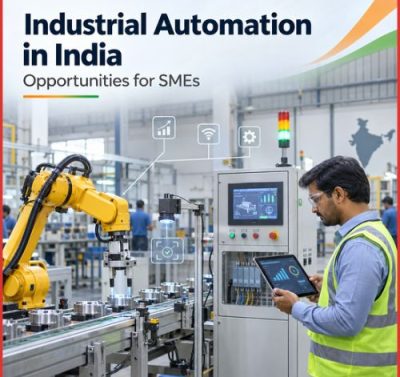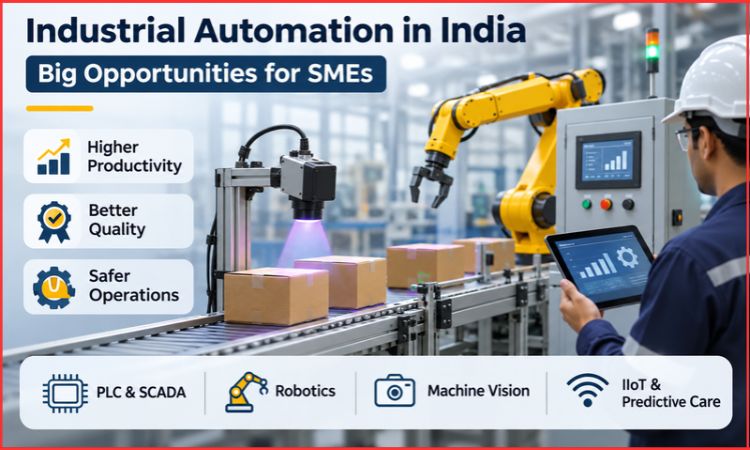
Picture a packaging unit that swaps its manual counting station for a camera and a small controller. Across town, a pump maker starts tracking motor vibration on a tablet instead of waiting for the next breakdown. Neither bought a giant robot. Both took a first step into the industrial automation business in India, and both show where demand is actually growing right now.
Indian factories are changing how they work. Labour is harder to find in some clusters, buyers expect tighter quality, and every hour of downtime costs more than it used to. That has opened up industrial automation opportunities India’s smaller firms can reach, not just the auto and pharma giants that have been automating for years.
The numbers back this up, with a caveat. Ken Research puts the Indian industrial automation market at about USD 17.28 billion in 2025, heading towards roughly USD 28.73 billion by 2031. Other research houses slice the sector differently and publish different totals, so treat any single figure as a rough guide. Read any industrial automation market India 2026 report, though, and the direction is the same: up.
This guide covers what the work involves, seven automation business ideas that suit modest capital, the industries worth chasing, how to think about money, and the steps to land a first customer.
Quick Glance
| Factor | Overview |
| Business sector | Industrial automation and smart manufacturing |
| Target customers | MSMEs, factories, warehouses and industrial plants |
| Key services | PLC programming, robotics, machine vision and other factory automation solutions |
| Industrial automation investment | Varies with the business model, equipment and technical team |
| Revenue sources | Equipment sales, installation, consulting, maintenance and software |
| Major industries | Automotive, pharmaceuticals, food processing, electronics and logistics |
| Growth areas | Industry 4.0, predictive maintenance and factory digitisation |
What Is Industrial Automation, and Why Does It Matter?
Industrial automation means using machines, sensors, controllers and software to run production with less hand-holding from people. A basic line might have a sensor that spots a product, a PLC that decides what the conveyor does next, and a motor that carries it on. Bigger plants add robots, machine vision and software that watches the whole shop floor.
Four pressures push Indian manufacturers this way. Productivity comes first: output has to rise without payroll rising at the same pace. Quality is second, since pharma, auto-component, electronics and food buyers want inspection records they can trace. Safety is third, because machines can take over heavy, repetitive or risky jobs. And then there is data. Plant teams can now spot a failing motor before it stops the line.
For a small firm, the point is not to sell the fanciest kit. It is to make factory automation solutions affordable and practical for a customer who counts every rupee.
Why India Offers Room for an Industrial Automation Business
India’s manufacturing base runs from giant assembly plants to thousands of small component makers, packers and processors. Plenty of the smaller ones still lean on manual checks and stand-alone machines that never talk to each other. That gap is where industrial automation companies India-wide are finding work: upgrading what a factory already owns instead of asking it to start from zero.
Policy adds some tailwind. According to the Press Information Bureau, PLI schemes across 14 sectors had drawn more than ₹2.16 lakh crore in cumulative investment by December 2025. That points to manufacturing growth, though it does not guarantee orders for every supplier. On robots, Ken Research notes India installed roughly 9,100 industrial robots in 2024, up 7% on the year and sixth in the world.
Cheaper sensors, controllers, collaborative robots and vision systems also mean a plant can automate one process at a time. Newcomers who do well pick an industry with a recurring, expensive problem and show a measurable fix.
7 Automation Business Ideas for Small and Mid-Sized Companies
There is no single way in. Which of these automation business ideas suits you depends on your technical skills, your cash and who you already know in industry. Founders hunting for industrial automation opportunities India has in plenty should match the idea to the skills they already have.
1. PLC and SCADA System Integration
PLCs run the logic on most machines, while SCADA lets people watch and control them from a screen. A small firm can write PLC programs, build control panels, link machines together and configure SCADA. Packaging makers, chemical plants, food processors and engineering workshops are the usual buyers. Old control systems can be upgraded and stand-alone machines wired into one monitoring view, so the owner sees more without replacing the line. Of all the factory automation solutions on this list, it is probably the easiest to begin with.
2. Industrial Robotics and Robot Integration
Robots weld, paint, move parts, assemble and palletise. Yet the robot is the smaller part of the job. Someone has to program it, build the safety cell, make the fixtures, install it and keep it running. Small firms can buy from established robot makers and sell the application work.
Say a component manufacturer needs an arm to shift metal parts between two machines. An integrator designs the work cell, sets up the robot and trains the operators. It is also the most capital-hungry automation business for SMEs on this list, so go in with a confirmed customer.
3. Machine Vision and Automated Quality Inspection
Cameras, lighting and image software check products without tired eyes. They catch surface flaws, verify labels, measure dimensions and flag missing parts, which matters in electronics, pharma, auto parts and packaged food. You do not have to build camera hardware; installation and inspection software is a business on its own. The pitch lands best when you can show shorter inspection time, fewer rejects and lower quality costs.
4. Industrial IoT and Predictive Maintenance
IIoT ties machines, sensors and software together. Fit vibration, temperature, pressure and energy sensors and a plant can see how its equipment behaves, then service it before it fails. A small engineering factory, for instance, could track motor temperature and vibration to catch trouble early. Income comes from installation, dashboards, software subscriptions and support.
5. Automation Equipment Distribution
If your strength is sales and supply chain rather than engineering, distribute sensors, PLCs, drives, motors, switches and controllers. It needs less engineering than custom systems, but product knowledge and technical backup still matter. Partner with established makers or authorised distributors, serve one regional cluster and stock what people ask for most. Smaller industrial automation companies India-wide can compete here simply by being the one factories call first when a drive fails.
6. Retrofitting Existing Machines
Plenty of factories own machines that still work well and cannot justify replacing them. Retrofitting adds modern controllers, sensors, drives, HMIs and safety features. You inspect the old equipment, spot its limits and recommend upgrades. It suits mid-sized and small manufacturers who want tighter control while keeping spending in check, and it can be done in stages, depending on the machine’s condition, compatibility and safety needs.
7. Industrial Automation Software and Data Analytics
Manufacturers want software that links machines with planning, inventory, quality and maintenance. If you can code, think production dashboards, downtime trackers, energy monitoring and MES integrations. Skip the fight with big industrial software vendors and pick one industry or one recurring problem instead, such as production monitoring for textile processing units or small packaging factories.
Which Industries Should Automation Businesses Target?
| Industry | Where the work is |
| Automotive and auto components | Assembly automation, robotic welding, component inspection, machine tending |
| Pharmaceuticals and healthcare manufacturing | Packaging, filling, labelling, inspection, batch traceability |
| Food processing and packaging | Sorting, weighing, filling, sealing, automated handling |
| Electronics manufacturing | Precision assembly, machine vision, testing, component handling |
Textile mills, metal fabrication units, plastics processors, warehouses and renewable energy equipment makers are worth a look too.
Who Are the Big Names You Will Compete With?
The large industrial automation companies India buyers already know include Siemens, ABB India, Schneider Electric India, Rockwell Automation India, Honeywell Automation India and FANUC India, based on Ken Research listings. They chase the big turnkey projects. A small firm wins elsewhere: with a narrow specialty, quicker response and service that shows up the same day.
Industrial Automation Investment: What It Takes to Start
Industrial automation investment depends on what you sell. A programming and consulting shop needs laptops, software licences and a couple of capable engineers. A distributor ties money up in stock. A robotics integrator needs test equipment, a demo cell and people who have commissioned real machines.
| Business model | Capital needed | Main cost drivers |
| Consulting and PLC programming | Low | Engineers, software licences, laptops |
| Small-scale system integration | Low to medium | Panel building, tools, project staff |
| Equipment distribution | Low to medium | Inventory, credit given to customers |
| Machine vision and IIoT services | Medium | Cameras, sensors, demo kits, software |
| Robotics integration | High | Robots, safety systems, work cells, skilled staff |
These tiers are directional only. Get supplier quotes before committing any money.
What Catches New Founders Out
Salaries, travel, software licences, testing gear, insurance and working capital all need a line in the budget. Customers also pay late. Industrial projects can swallow cash for months before the final payment lands. A service-led model is easier on the wallet, since fabrication can be outsourced and project parts bought only after an order arrives.
How to Start an Industrial Automation Business in India
- Pick one specialty. PLC programming, machine retrofits or machine vision. Not all three at once.
- Choose a customer segment. Study nearby industrial estates and clusters, and note the problems that keep coming back.
- Build the skills. Hire qualified engineers or partner with experienced integrators. Industrial electrical work, machine safety, commissioning and programming need real competence.
- Make a pilot. A working prototype that shows better output, inspection, energy use or downtime sells harder than a brochure.
- Line up suppliers. Component makers, panel builders, software providers and distributors.
- Register and comply. Pick a business structure, sort out GST, and check local, electrical, factory-safety and contract requirements.
- Sell maintenance contracts. Troubleshooting, periodic inspections, spares, software backups and upgrades bring in recurring revenue.
Government support exists too. According to the Ministry of Heavy Industries, its SAMARTH Udyog Bharat 4.0 initiative promotes Industry 4.0 awareness and technology evaluation, mainly for MSMEs. Its demonstration facilities are worth a visit before you finalise what you will offer.
How Automation Businesses Make Money
- Project fees: design, programming, installation and commissioning.
- Equipment margins: controllers, sensors, robots and related parts.
- Annual maintenance contracts: recurring fees for servicing and troubleshooting.
- Software subscriptions: monthly or yearly charges for dashboards and monitoring.
- Consulting fees: automation audits, feasibility studies and ROI analysis.
Profit hangs on project pricing, engineering productivity, buying costs, warranty obligations and payment terms. Cost every project in full, including travel, testing, commissioning and support after handover. Customers judge your pitch by the return on their industrial automation investment, so work it out from their own production data, not guesses. A steady automation business for SMEs usually leans on service contracts, not one-off sales.
Challenges to Plan For
Even with the industrial automation market India 2026 forecasts looking healthy, this is a hard business to run.
- Technical expectations. A badly configured system can halt production. You need competent engineers, proper testing and written commissioning procedures.
- Long sales cycles. Buyers ask for several demos, technical sign-offs and budget approvals before an order shows up.
- Working capital pressure. Parts and project costs arrive long before the customer pays.
- After-sales duty. When a critical system fails, the factory wants an answer fast. Clear service agreements, spares and backups matter.
- Competition. Established brands and experienced integrators fight for larger projects, so smaller firms need a specialty, flexibility and local support.
Where the Industry Is Heading
Control systems are merging with robotics, machine vision, connectivity and analytics. IMARC Group estimates India’s smart factory automation market at USD 3.6 billion in 2025, growing to USD 8.6 billion by 2034. For SMEs, the most reachable industrial automation opportunities India will see in the next few years sit in software-led services, brownfield upgrades and predictive maintenance. Founders who understand both factory processes and digital tools can build long customer relationships.
Still, chase applications that earn their keep rather than technology for its own sake. A well-done retrofit that fixes a costly production problem can be worth more to a customer than a gleaming, fully automated cell.
Conclusion
The industrial automation business in India rewards founders who connect a real production problem with a practical fix. Rising interest in productivity, quality control and equipment monitoring is creating demand for factory automation solutions across several industries, and the best industrial automation opportunities India offers right now are modest in size and specific in purpose.
For small and mid-sized companies, the sensible route is simple: begin with one specialised service, prove it saves a customer money, then grow as skills and relationships deepen. Skip the heavy equipment spending at the start. Targeted solutions, dependable maintenance and a close understanding of what the customer’s plant actually needs will carry a young business further.