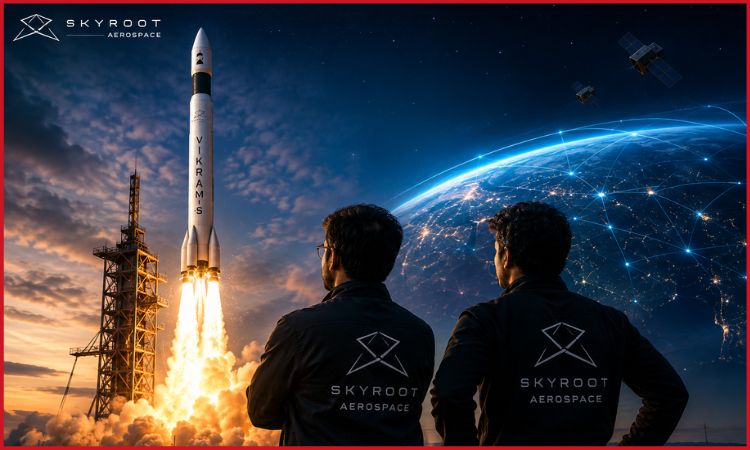
In 2018, two engineers took a risk by leaving their cozy positions at India’s space agency to launch a rocket firm from the ground up. Private companies were essentially nonexistent in India’s space industry at the time. The majority of people thought their proposal was absurd because everything belonged to the government. After six years, Skyroot Aerospace has emerged as the first space-tech unicorn in India. They raised around $160 million and launched India’s first privately constructed rocket, garnering international interest in addition to headlines.
Skyroot’s narrative, however, is more than just a startup. It reflects a larger transformation in India’s commercial landscape. Aerospace, AI, chip manufacturing, and defense—all these tech-heavy businesses are thriving, and investors aren’t missing a beat.
Why now? India’s got its sights set on building a world-class commercial space sector, right when satellite launches everywhere are becoming hotly competitive. The numbers are impressive, too.
Skyroot estimates the satellite launch market is worth somewhere between $15 and $20 billion right now, and they believe it’ll hit $50 billion soon, thanks to skyrocketing demand.
So it’s not just rockets for India, it’s a launch hub that’s global and affordable. Just like India made a splash in software services years ago.
How Two Former ISRO Engineers Built India’s First Space Unicorn
Pawan Kumar Chandana and Naga Bharath Daka founded Skyroot shortly after their time at ISRO. Chandana previously worked on the GSLV Mk III rocket and claims he was driven to rockets because they are “the most complex machines humans have ever created.” It’s that difficulty that got him hooked and finally prompted him to create his own business.
Honestly, nobody believed a private rocket startup could make it in India. There was zero support from investors, the government kept a tight grip on launch sites, and there were no clear rules for commercial missions.
Still, Chandana and Daka noticed small satellites were getting popular worldwide. Turns out, they were ahead of the curve. The game has totally changed.
Why Small Satellite Launches Are Taking Off
Governments were the only ones allowed to experiment with space technology for decades, launching massive, costly satellites. However, those times have passed.
These days, fleets of smaller satellites perform a wide range of tasks, including military, mapping, internet, and climate monitoring. According to Skyroot, almost 90% of the current generation of satellites weigh less than 500 kg.
This shift has flipped the launching process. Small satellites need speed, lower costs, and more flexibility. Waiting for a giant rocket slot just isn’t practical anymore. Skyroot saw the opening.
Their Vikram rocket series is built for exactly this purpose. Instead of fighting the big guys over massive payloads, Skyroot offers quick, efficient launches for smaller loads.
Chandana described it as “Uber for space”. Like calling your own ride, satellite operators pick their schedule and destination.
And, honestly, that flexibility is huge in a business where timing is everything.
Vikram-S: India’s First Private Rocket Launch
Vikram-S, the first private rocket ever launched in India, made news in November 2022. The incident, which took place in Sriharikota, made Skyroot famous across the country.
Vikram-S wasn’t just a technical win. For decades, ISRO ran every major space mission. Now, a private company proved they could build and launch rockets too.
But launching a rocket is just the beginning. Now, Skyroot has to keep building reliable rockets, scale up, and turn this momentum into a lasting business.
Next on their list: orbital missions.
- Vikram-1 will carry about 300kg into orbit.
- Vikram-2, using advanced engines, will go up to a full ton.
- Both are designed for frequent, dedicated launches—the kind of demand that’s exploding right now.
India’s Space Sector Opens Up
Skyroot owes much of its rise to policy changes. For years, ISRO called all the shots and ran everything from launch pads to clearances.
That changed in 2020. India opened up its space sector to private enterprises by launching IN-SPACe, which provides startups with launch locations, testing, and simplified rules.
Prior to this relocation, the founders claimed there was no significant environment for space entrepreneurs. There is no backup, no infrastructure, nothing.
These reforms drew investors in fast. India knows it can’t dominate the global space market by relying on ISRO alone. Private companies are now the new engine for growth.
It’s the same playbook the US followed with companies like SpaceX. Private innovation totally transformed the industry.
Why Investors Are Betting on Skyroot
Skyroot raised about $160 million and became the first private space unicorn in India. Investors see serious potential. They think India could soon rival other global launch destinations, both on price and reliability.
The country brings some clear advantages. Manufacturing and launching tech is way cheaper here than in the West. Plus, India has a huge pool of talented engineers and scientists, and startups get to take advantage of ISRO’s decades of experience.”
With government reforms making it easier to enter the sector, India is quickly becoming a major player on the global stage.
But Skyroot’s playing on a global field from day one. More than 90% of its market is outside India. Unlike traditional tech startups that start local, launch providers serve customers everywhere—telecom, defense, Earth observation—across the globe.
If Skyroot proves itself as a reliable, affordable launch provider, India stands to gain big. That’s why investors from places like Singapore are betting on Indian space startups.
India’s Expanding Space Ambitions
Skyroot’s story develops as India’s space ambitions grow. The country’s Mars Orbiter Mission was a first-time success; no one had done it before. Chandrayaan-3 arrived near the Moon’s south pole, which was another significant accomplishment.
ISRO is preparing for human spaceflight (Gaganyaan) and planning other lunar missions.
However, India’s spending still trails China’s—about $1.6 billion vs $11 billion each year. China possesses several heavy-lift rockets, a space station, and a vast satellite network..
India’s always favored cost-effective innovation, not outspending rivals. That resourceful spirit is now driving the private space sector.
Skyroot’s Challenges
Skyroot’s path isn’t guaranteed. Rocket development is tough—costly, risky, and complicated. A single failure can crash both confidence and contracts. Investors get nervous fast.
And the competition’s fierce. SpaceX, Rocket Lab, and others have strong records and big infrastructure.
Launch Cost Comparison of Global Rocket Companies
| Rocket | Country | Payload to LEO | Launch Cost | Approx Cost per kg |
|---|---|---|---|---|
| SpaceX Falcon 9 | USA | 22,800 kg | ~$67 million | ~$2,700/kg |
| Rocket Lab Electron | USA | 300 kg | ~$7.5 million | ~$25,000/kg |
| SSLV | India | 500 kg | ~$3.5 – 5 million | ~$7,000–10,000/kg |
| Ariane 6 | Europe | 21,650 kg | ~$77 – 100 million | ~$3,500–5,200/kg |
| Skyroot Vikram-I | India | 350 – 480 kg | Est. $2 – 4 million | ~$6,000–10,000/kg |
Source: Skyroot Aerospace, Rocket Lab, SpaceX launch data, Economic Times reporting, and industry launch estimates.
Note: Skyroot Aerospace has not officially published Vikram-I launch pricing. Estimates are based on payload class, Indian manufacturing costs, and comparisons with SSLV and Electron.
Bottom line, Skyroot’s future depends on scaling up and delivering consistent performance. In space, reliability is everything.
What Skyroot Means for India’s Deep-Tech Future
Ten years ago, the idea of a private Indian rocket startup sounded impossible. Now, Skyroot has made it real—breaking into global markets, drawing international investment, and redefining what Indian innovation can do.
This goes beyond a single business. Deep-tech businesses in India are expanding beyond software to sectors that were previously exclusive to governments or large corporations.
Will Skyroot become a top launch provider? It’s too early to say, but it’s already shown that India’s startup ecosystem can deliver serious engineering and technology. That’s a shift worth watching.
Frequently Asked Questions
What does Skyroot Aerospace mean for India?
Skyroot is India’s first space-tech unicorn and launched the country’s first private rocket. They’re a clear sign of India’s push into private space tech.
What’s next for India’s private space sector?
India’s private space industry will keep expanding. Surging demand for satellite launches worldwide means Indian startups, new reforms, and fresh investments can drive major progress.
How is Skyroot different from SpaceX?
Skyroot builds rockets for smaller dedicated loads, rather than big reusable rockets or heavy payloads like SpaceX.
Why are small satellite launches so popular now?
Launching small satellites is cheaper and offers tons of advantages. They’re used for the internet, military, mapping, weather forecasting, and more—it’s the modern trend in space.