Samsung Life Insurance reported a stronger third quarter than analysts had expected, with improved insurance earnings helping offset a decline in its investment result.
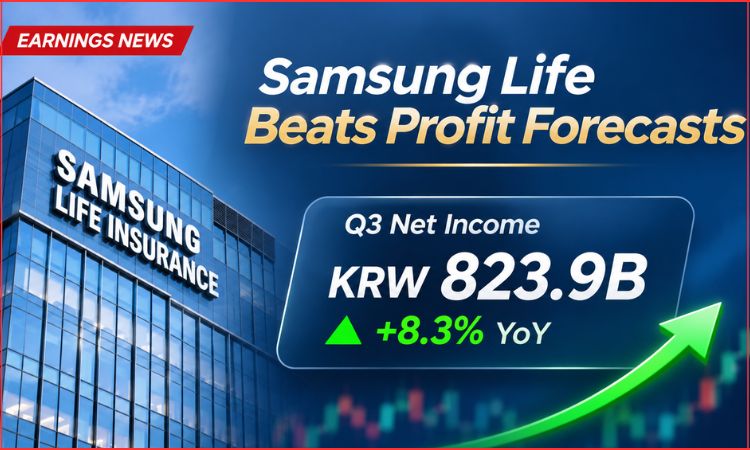
Consolidated net income reached KRW823.9 billion for the July–September period, up 8.3% from a year earlier. The figure exceeded the KRW707.4 billion average forecast compiled by Yonhap Infomax by approximately 16.5%.
Operating income increased 14.9% to KRW937.7 billion, while sales rose 15.8% to KRW8.67 trillion.
The Samsung Life Q3 2026 results were accompanied by a positive market response. Shares rose 3.84% to KRW257,000 in reported Thursday trading, reaching their highest level since November 4.
The composition of the earnings improvement deserves as much attention as the headline increase. Insurance service profit strengthened sharply during the quarter, while investment profit moved in the opposite direction.
What Drove The Quarterly Improvement?
Insurance service profit reached KRW529.5 billion, more than double the KRW261.6 billion recorded in the corresponding quarter.
The result benefited partly from an improvement in the difference between actual insurance experience and the assumptions used in the accounts. That measure moved from a KRW54.4 billion deficit a year earlier to a KRW136.6 billion surplus.
Profit recognised from the contractual service margin increased 19.8% to KRW366.1 billion.
Those figures help explain how Samsung Life earnings improved despite a weaker investment contribution. The quarter did not depend on every part of the business moving higher simultaneously.
The insurance result also represents a change from the first-half picture. Earlier reporting had highlighted investment gains alongside weaker insurance service profitability.
One better quarter does not establish a permanent change, but it gives investors a different set of operating developments to assess.
The next question is whether insurance earnings can retain that strength when claims experience and other assumptions change again.
Why Did The Investment Result Fall?
Samsung Life’s third-quarter investment result declined 21.9% to KRW540.5 billion from KRW692.1 billion a year earlier. It was also lower than the preceding quarter.
The decline was reported against a stock-market correction.
That quarterly weakness needs to be distinguished from the cumulative performance. Investment results for the first nine months reached approximately KRW2.40 trillion, up around 40% year on year.
Both comparisons can be correct.
A strong earlier period can leave nine-month earnings substantially higher even when the latest quarter is weaker. Reporting only the cumulative increase would obscure the recent change; focusing only on the quarter would leave out the gains already recorded.
For an insurer, this distinction matters because investment performance can fluctuate more quickly than the underlying policy portfolio.
The Samsung Life investment income figures therefore provide context for the result without describing a uniform trend across the year.
They also show why investors need to examine the sources of earnings rather than assume that one headline growth rate applies throughout the business.
Which Profit Figure Should Investors Use?
The results contain more than one net-income measure.
Total consolidated net income was KRW823.9 billion, up 8.3%. Net income attributable to owners of the parent was KRW792.4 billion, an increase of 9.6%.
The second figure excludes the portion attributable to non-controlling interests. It is therefore different from total consolidated profit.
Nine-month figures introduce another distinction. Reporting placed profit attributable to parent shareholders at approximately KRW2.69 trillion, up 26.9%.
That roughly 27% increase relates to the cumulative period, rather than the standalone third quarter.
Using the same label for all these numbers can create a misleading comparison. The period and ownership basis need to remain consistent when measuring growth.
For the Samsung Life profit outlook, the quarterly figures offer the more recent view, while nine-month earnings show the accumulated performance.
Neither should be substituted for the other simply because one produces a more striking percentage.
The latest numbers are preliminary, adding another reason to read them with the company’s subsequent financial disclosures.
What Does The Contractual Service Margin Show?
Samsung Life’s contractual service margin balance stood at approximately KRW14.56 trillion at the end of September, compared with KRW13.45 trillion at the end of the previous year.
CSM broadly represents unearned profit associated with insurance contracts that is recognised as services are provided. It is not equivalent to cash waiting to be distributed to shareholders.
The balance gives investors another way to examine the earnings embedded in the existing insurance portfolio.
Its movement also needs explanation.
New business can add to CSM, while the provision of insurance services releases part of it into earnings. Changes in assumptions and other factors can affect the balance as well.
A larger total is useful information, but it does not establish exactly when the associated earnings will emerge or whether all future assumptions will hold.
The latest quarter’s increase in profit recognised from CSM is therefore relevant alongside the closing balance. One describes a contribution to current earnings; the other concerns services still to be provided.
What Will Make The Improvement More Durable?
The next assessment will need to follow both sides of the business.
A sustained insurance contribution would provide support when markets are less favourable. Strong investment performance could add to it, although that source cannot be assumed to rise steadily every quarter.
Claims experience also deserves attention. A favourable difference between actual outcomes and expectations helped the latest result, but those comparisons can change.
Capital strength remains a separate consideration. Higher earnings can support retained capital, while market movements and regulatory requirements can influence the financial cushion an insurer needs to hold.
The Samsung Life share price response showed that the latest figures were received positively. It does not settle how investors will value the business after the initial earnings reaction.
For now, the third quarter offers a clear improvement in insurance profitability and an earnings result above forecasts. The next test is whether that operating strength can persist without depending on equally favourable conditions each time.