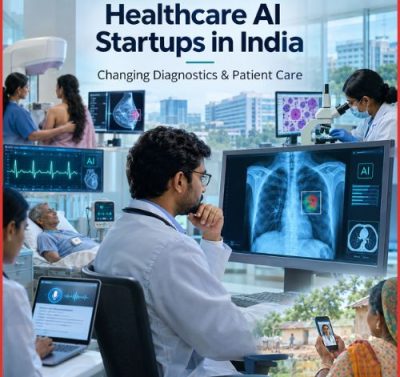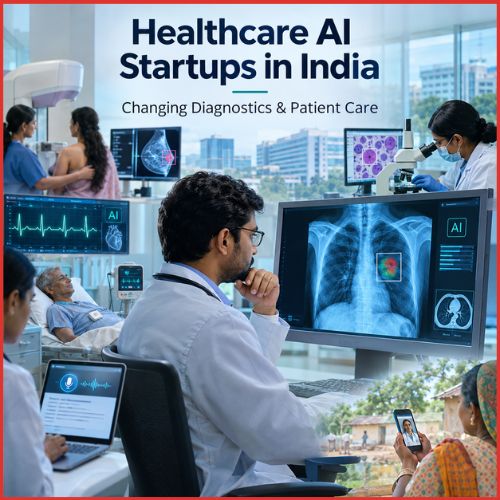
A radiologist at a district hospital may read hundreds of scans in a week. A village clinic may not have one at all. That gap explains much of the energy behind healthcare AI startups in India, a group of young companies trying to put specialist-level support within reach of ordinary patients.
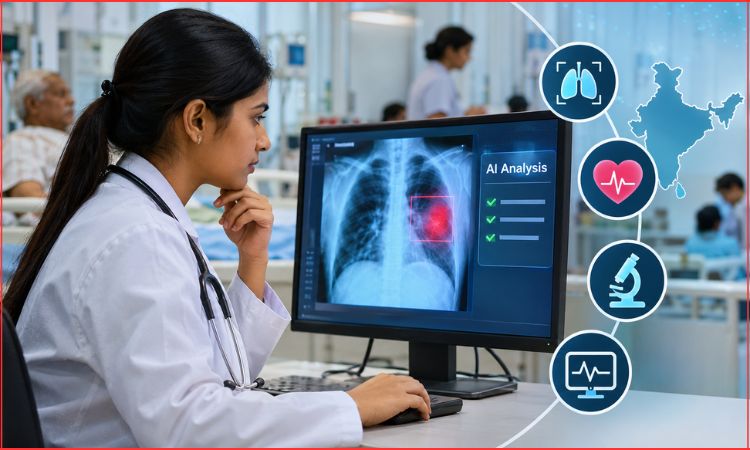
Artificial intelligence in healthcare India is no longer only a pilot-project story. Hospitals, labs and public health programmes now test tools that read chest X-rays, flag unusual ECGs, track vitals and cut down the typing doctors do every day. Many AI healthcare companies India has produced in the past decade began with one narrow problem and built outward from there.
The hype, though, often runs ahead of the evidence. Privacy, clinical proof, price and regulation decide which Indian healthtech startups last. This article looks at eight names worth knowing among healthcare AI startups 2026 has put in the spotlight, how they earn their keep, and what could slow them down.
Quick Glance: Healthcare AI Startups in India
| Startup | Primary focus | Healthcare application |
| Qure.ai | Medical imaging AI | Reading X-rays, CT scans and other images |
| Niramai | Breast health screening | Early breast cancer risk screening |
| SigTuple | Lab diagnostics | Automated analysis of blood smears |
| DeepTek | Radiology AI | Image interpretation and reporting |
| Tricog Health | Cardiac AI | Faster heart disease assessment |
| Dozee | Contactless monitoring | Tracking vitals and patient deterioration |
| HealthPlix | Clinical software | Records and decision support for doctors |
| Augnito | Medical voice AI | Speech-to-text for clinical notes |
A note on this list: these companies are at different stages. Being listed here does not mean every product has the same regulatory status, clinical validation or hospital adoption.
Why Healthcare AI Startups Are Growing in India
India has too few specialists for too many patients, and the shortage is sharpest outside big cities. Hospitals are stretched, treatment costs keep rising, and serious illness is often caught late. AI patient care solutions will not fix all of that, but they can help the people already working in the system get through information faster.
Take a radiologist who uses a tool that marks suspicious spots on a scan, so urgent cases rise to the top of the queue. Or a lab that hands repetitive image checks to software. This is where AI in medical diagnostics earns its place: it sorts and flags, and a trained professional makes the call.
A few things are pushing the sector forward:
- More digital data. Hospitals, labs and clinics now record more in digital form, and that gives AI something to learn from.
- Pressure on cost. Anything that trims manual work and stretches scarce specialists is attractive to Indian healthtech startups and their customers alike.
- A shift toward prevention. Catching a problem early is cheaper and kinder than treating it late.
- Telemedicine. Remote consultations have made digital monitoring and AI-supported care easier to pitch.
- Investor interest. Health technology promises scale, and funders have noticed.
One caution belongs here. AI does not make healthcare cheaper or more accurate by default. The value depends on evidence, on how well a tool fits real hospital routines, on medical supervision and on the quality of patient data behind it.
Top Healthcare AI Startups in India
1. Qure.ai: Faster Reading of Medical Images
Founded 2016 · Medical imaging AI · qure.ai
Qure.ai is one of the better-known AI healthcare companies India has produced. Its software studies X-rays, CT scans and other images and points out possible abnormalities, so clinicians can decide which cases need attention first.
Its tools cover tuberculosis screening, lung health, stroke-related imaging and other diagnostic pathways. They can matter most in public health programmes and in facilities where an experienced radiologist is hard to find.
How it earns: Qure.ai works with hospitals, diagnostic providers, healthcare networks and public health programmes through deployments and partnerships.
Why it matters: By helping with interpretation and prioritisation, the company aims to shorten diagnostic delays. The software supports doctors. It does not replace their judgement.
2. Niramai: Breast Screening Without Radiation
Founded 2016 · Cancer screening · niramai.com
Niramai’s product, Thermalytix, pairs thermal sensing with machine learning to spot temperature patterns that may point to a breast abnormality. It is designed to be contact-free and radiation-free, which sets it apart from conventional mammography.
The output is a risk assessment. It helps a provider decide whether a woman needs a clinical examination or further imaging. That makes it useful for community camps, workplace wellness drives and areas where standard screening equipment is scarce.
How it earns: The company sells to hospitals, diagnostic centres, healthcare organisations and screening programme operators.
Why it matters: Niramai shows how artificial intelligence in healthcare India can widen access to preventive care. A screening result, though, is not a cancer diagnosis, and it has to sit inside a proper clinical pathway.
3. SigTuple: Automating the Microscope
Founded 2015 · Digital microscopy · sigtuple.com
SigTuple combines AI, robotics and digital microscopy to automate parts of lab analysis. Its AI100 platform examines peripheral blood smears and helps identify and classify blood cells.
Manual microscopy needs trained people and plenty of time, which hurts in labs handling large volumes. SigTuple digitises the slide, lets the AI assist with analysis, and leaves lab specialists to review anything that needs a closer look.
How it earns: It supplies diagnostic technology to laboratories, hospitals and diagnostic networks.
Why it matters: More consistent slide analysis can ease workloads, especially where pathologists are few. Clinical review still stays in the loop.
4. DeepTek: AI Inside the Radiology Workflow
Radiology AI · deeptek.ai
DeepTek builds AI tools for imaging interpretation and reporting, including chest X-ray AI, deployment platforms and AI-assisted diagnostic reporting. Radiology departments are under pressure to turn scans around quickly without losing quality, and software that flags findings and organises reports can take some of that weight.
It also works on tuberculosis screening, where AI can help programmes get through very large numbers of chest X-rays.
How it earns: Its customers are hospitals, imaging centres, radiology providers and public health organisations.
Why it matters: DeepTek covers both individual diagnosis and population-level screening, which makes it a useful example of AI in medical diagnostics at scale. Results still depend on image quality, clinical setting and professional oversight.
5. Tricog Health: Cardiac Care Beyond the Big Cities
Founded 2014 · Cardiac diagnostics · tricog.com
Tricog Health mixes AI, digital technology and clinical expertise to support heart diagnosis. Its services include AI-assisted ECG interpretation and digital links between healthcare facilities and cardiac specialists.
When a heart attack is suspected, every minute counts. A small clinic may have no cardiologist on site, and the wait for a read can delay the next step. Tricog’s model is built to close that gap.
How it earns: It serves clinics, hospitals, diagnostic facilities and healthcare networks through technology-enabled diagnostic services.
Why it matters: Cardiac AI can narrow the specialist gap outside major cities. It does not replace emergency assessment, and test results must be read alongside symptoms.
6. Dozee: Monitoring Without Touching the Patient
Remote patient monitoring · dozeehealth.ai
Dozee uses sensors and AI algorithms to draw health indicators from subtle body movements. Depending on configuration, its systems can track heart rate and respiratory rate without wires on the patient.
Between nursing rounds, a patient’s condition can shift quietly. Continuous monitoring is meant to catch that and alert staff when readings need attention.
How it earns: It supplies monitoring solutions to hospitals and offers products for remote patient monitoring.
Why it matters: Among AI patient care solutions, monitoring may help hospitals watch patients more closely and use nursing time better. Every alert still needs a clinician’s assessment, and performance depends on validated use and deployment conditions.
7. HealthPlix: Software Built Around the Doctor’s Day
Digital health · Clinical software · healthplix.com
HealthPlix offers electronic medical record software with assistive AI features designed around how doctors actually work. The platform handles digital prescriptions, patient records and clinical decision support.
Less paperwork and better-organised histories make consultations smoother and follow-up visits easier. For many Indian healthtech startups, this quieter, workflow-focused side of the market is where steady demand sits.
How it earns: It sells software to doctors, clinics, hospitals and other healthcare stakeholders.
Why it matters: AI in healthcare is not only about reading scans. Tools that organise information can save time, as long as records stay accurate and patient data stays secure.
8. Augnito: Voice Technology for Clinical Notes
Healthcare speech recognition · augnito.ai
Augnito builds speech recognition and voice documentation tools for healthcare professionals. Doctors spend a lot of time typing patient notes, observations and radiology reports, and spoken dictation can cut that down.
Medical vocabulary is the hard part. One wrong word in a transcript can change what a record means, so tools tuned for clinical language matter.
How it earns: It offers healthcare-focused software and voice documentation to medical professionals and organisations.
Why it matters: Reducing admin work gives professionals more time with patients. Medical records still need checking by a person.
How Healthcare AI Startups Make Money
Most healthcare AI startups in India sell to businesses rather than patients. Revenue usually comes from subscriptions, licences, equipment deployments or technology-enabled services, depending on who the customer is and which clinical problem is being solved.
| Business model | How it works | Example |
| Software licensing | Providers pay to use an AI platform | Qure.ai, DeepTek |
| Screening services | Providers pay for AI-enabled screening | Niramai |
| Diagnostic technology | Labs buy or deploy AI-enabled equipment | SigTuple |
| Monitoring solutions | Hospitals pay for monitoring technology | Dozee |
| Clinical software subscriptions | Doctors and clinics use a digital platform | HealthPlix |
| Technology-enabled diagnostics | Providers pay for AI-assisted interpretation | Tricog Health |
Recurring contracts can make for steady income. But sales depend on proving clinical value, fitting into existing hospital systems and earning the trust of doctors, which takes longer than building the software.
Challenges Facing Healthcare AI Startups in India
The potential is real, and so are the obstacles.
- Data privacy and security. Medical information is sensitive. Startups must protect it and follow applicable Indian laws and healthcare requirements.
- Clinical validation. A tool has to work reliably in the setting it is meant for and across the patient groups it will meet.
- Hospital integration. Older systems and scattered records make deployment messy.
- Affordability. Smaller hospitals and clinics may struggle to pay, even for tools that would help them.
- Bias and accuracy. Models trained on narrow or unrepresentative data can perform differently across populations.
- Accountability. Doctors need to know an AI system’s limits and when a second assessment is needed.
Regulation matters too. Depending on intended purpose and function, medical AI products may need evaluation or authorisation under the rules for medical devices.
The Future of Artificial Intelligence in Healthcare India
The next stage is likely to move past single-purpose tools toward connected systems that follow a patient’s whole journey.
- Earlier detection. AI could spot warning signs in images, lab data and other records sooner.
- Rural reach. Remote diagnostic platforms could link primary health centres with specialists and flag cases for referral.
- Treatment support. By reading relevant patient data, tools may help clinicians weigh risk and care options.
- Hospital automation. Documentation, scheduling, monitoring and reporting could lose some of their administrative burden.
- Home-based care. Remote monitoring could help providers follow patients outside hospital walls, where that is clinically appropriate.
India’s digital health infrastructure and strong technology talent give AI healthcare companies India-wide a base to build for home and for export. Adoption, though, will follow reliable evidence and real benefits for patients, not announcements.
Conclusion
Healthcare AI startups in India are finding new ways to improve diagnostics, strengthen preventive care and ease the load on hospitals. Qure.ai and DeepTek work on imaging, Niramai on breast screening, SigTuple on lab analysis and Tricog Health on cardiac care. Dozee, HealthPlix and Augnito cover monitoring, records and dictation.
The real goal is not to push more AI into hospitals. It is to build tools that are affordable, trustworthy and useful for real clinical problems. The Indian healthtech startups that pair medical evidence with careful data practices and practical rollout are the ones best placed to matter.