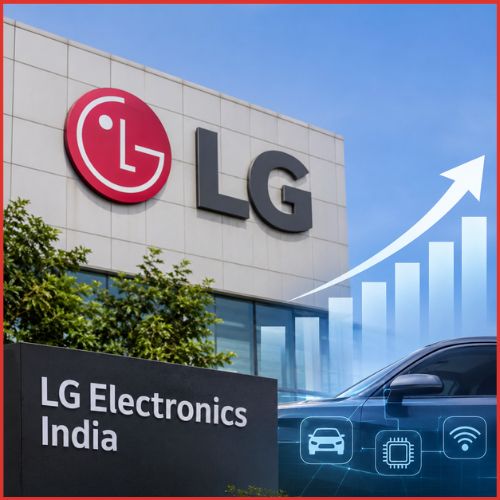
LG Electronics India reported a stronger September quarter and outlined plans to enter vehicle electronics, giving investors an earnings improvement to assess alongside a proposed expansion beyond its established consumer businesses.
Net profit increased 25.7% year on year to approximately ₹489 crore in the second quarter of FY27. Revenue from operations rose 19.5% to ₹7,380 crore, exceeding the ₹7,069 crore estimate in a CNBC-TV18 poll cited by Moneycontrol.
Operating earnings improved faster than revenue. EBITDA increased 27.9% to ₹701 crore, with the margin rising to 9.5% from 8.9% a year earlier.
The LG Electronics India Q2 results drew a positive market response. Shares traded at ₹1,751 in late-morning trading on November 5, up 3.5%. That quotation reflects an intraday position rather than the closing price.
The results give the proposed diversification a stronger financial backdrop. They do not yet show what the new business will contribute or how quickly it could become meaningful.
What Improved Beneath The Revenue Growth?
The margin increase is an important part of the quarter.
Higher sales can lift profit simply because a company is doing more business. An increase in the operating margin indicates that it also retained more operating earnings from each rupee of revenue.
LG’s 60-basis-point improvement was equivalent to 0.6 percentage points. Although modest in percentage terms, that change matters when applied to several thousand crore rupees of quarterly sales.
The numbers do not provide a complete explanation of the improvement.
Product mix, pricing, manufacturing utilisation and expense control can all influence operating profitability. Without a detailed attribution, it would be premature to identify one as the dominant driver.
The useful conclusion is narrower: revenue growth was accompanied by improved operating conversion. That is a stronger outcome than sales rising while the margin contracts.
Whether it continues will depend on the conditions behind the quarter.
Why Does The Earnings Beat Need Perspective?
The company exceeded the cited revenue estimate by approximately ₹311 crore, or 4.4%.
Profit was much closer to expectations. The reported ₹489 crore compared with a poll estimate of ₹486 crore, a difference of less than 1%.
That makes it important to avoid treating every part of the result as an equally large surprise.
The revenue outcome was clearly ahead of the cited forecast. Profit was broadly aligned with it. Investors assessing the LG Electronics share price response need to consider both the operating improvement and what had already been anticipated.
A forecast comparison is also only one reference point.
Year-on-year growth shows how performance changed from the corresponding period. Market estimates show how it differed from expectations. Cash flow and capital requirements help establish the quality of the earnings.
Together, those measures provide a more useful assessment than the headline profit percentage alone.
What Is LG Proposing In Vehicle Solutions?
The proposed vehicle solutions business would move LG India into automotive electronics and mobility technologies.
Its intended scope includes infotainment systems, digital cockpits, automotive displays, telematics, vehicle computing, connectivity and software. Manufacturing is planned at the company’s third plant in Sri City, Andhra Pradesh.
Investment would be phased according to requirements and market conditions. No specific investment amount was disclosed in the report, and the proposal requires shareholder approval through a postal ballot linked to an amendment of the company’s business objects.
The LG vehicle solutions business is therefore a proposed growth avenue, rather than an established earnings contributor.
Its broad scope gives the company several possible areas to pursue. It does not establish that every listed product will be manufactured immediately or that customer orders have already been secured.
Those distinctions will matter as implementation details emerge.
How Would Automotive Electronics Change The Business?
Supplying vehicle manufacturers involves a different commercial process from selling household appliances.
Consumer products are purchased by individuals through retail and other distribution channels. Automotive components generally need to meet a manufacturer’s specifications and fit within a wider vehicle programme.
That can involve extended development, validation and integration work.
For a supplier, the attraction is the possibility of recurring production volumes after a programme enters manufacturing. The challenge is that revenue may take time to arrive, while development and equipment expenses arise earlier.
This is general industry context, not a disclosed timetable for LG’s proposal.
The company’s eventual returns will depend on the products selected, customer agreements, production scale and the amount of capital committed.
A large potential market does not remove the need to win commercially viable contracts.
What Will Determine Whether Diversification Adds Value?
The first question is where LG chooses to compete.
Automotive displays, software and integrated computing systems have different requirements. They also involve different investment profiles and competitive pressures.
Investors will need more detail on the initial product focus before making meaningful assumptions about revenue or margins.
Customer concentration will be relevant as well. A business supplying a small number of vehicle programmes can become sensitive to production changes at those customers.
There is also the question of how much existing capability can be shared. Manufacturing expertise may offer advantages, but automotive requirements could still demand additional equipment, specialist staff and validation processes.
For the LG India automotive expansion, success will depend on the relationship between those additional costs and the earnings the business eventually produces.
The proposal’s strategic appeal will become easier to assess once commitments replace the current broad outline.
What Should Investors Watch After This Quarter?
The established operations remain the immediate source of reported earnings.
That means the next results should be examined for revenue momentum, operating margins and cash generation before assigning substantial value to the proposed new division.
A single stronger quarter does not establish a permanent margin level. The company will need to demonstrate that the improvement can survive changes in demand, product mix and costs.
On vehicle solutions, useful milestones would include shareholder approval, investment commitments, customer arrangements and a clearer production schedule.
LG India has delivered growth in both sales and operating profitability. Its next challenge is to maintain that performance while defining a new business with different customers and development demands. The earnings are already visible; the automotive opportunity still needs to take operational shape.
Source: Moneycontrol: LG Electronics India’s Q2 Results And Vehicle Solutions Proposal.