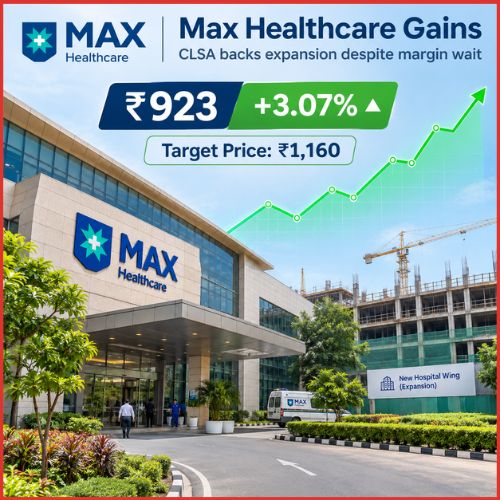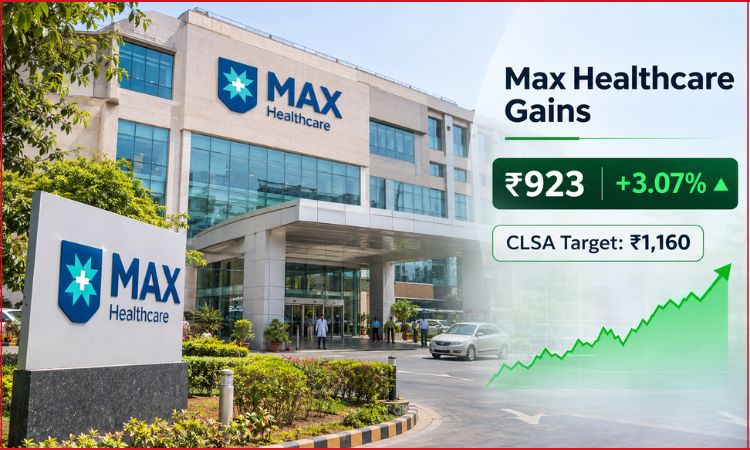
Max Healthcare shares advanced in morning trading on November 4 as investors weighed CLSA’s positive assessment of the hospital operator’s expansion programme and the potential for newer facilities to improve profitability.
The brokerage maintained its “outperform” rating and a ₹1,160 target price, according to Moneycontrol’s market updates. Its investment case rests partly on additional beds translating into higher occupancy and better margins as new hospitals establish themselves.
CLSA cited network revenue growth of 18% year on year, driven mainly by increased operational capacity. Margins remained broadly flat despite the addition of beds, while a planned capacity increase of approximately 65% over FY27–FY30 was progressing as expected.
A separate morning market report placed Max Healthcare shares at ₹923, up 3.07% from the previous close of ₹895.50. That was an intraday quotation, rather than the session’s closing price.
The immediate share-price response was positive. Delivering the underlying investment case will take considerably longer.
Why More Beds Create An Earnings Delay
A hospital begins incurring substantial expenses before all its beds are occupied.
Doctors, nurses, technicians and support staff need to be available from the start. Equipment must be maintained, utilities paid and clinical services organised, even while patient numbers are building.
That creates a period when a new facility can increase revenue without contributing proportionately to profit.
The economic improvement comes as more patients use infrastructure already in place. Some expenses rise with activity, but others can be spread across a larger revenue base.
This is the operating leverage behind CLSA’s margin argument.
It also explains why the Max Healthcare expansion programme needs to be assessed over several reporting periods. The opening of a hospital establishes capacity. A sustained increase in patient activity determines how productive that capacity becomes.
What CLSA Expects From New Facilities
CLSA’s assessment differentiated between entirely new hospitals and additions to existing operations.
According to Moneycontrol’s update, the brokerage expected greenfield facilities to break even within one year and brownfield facilities within one quarter. Those are expectations, rather than confirmed outcomes for every project.
The difference has a practical explanation.
An expansion at an established hospital may benefit from existing doctors, referral relationships, diagnostic services and local recognition. A new site has more work to do before those connections are fully developed.
Even so, the distinction does not remove execution risk. Additional beds must be supported by the right clinical teams and services. Demand in one location cannot automatically be transferred to another.
The relevant test is whether individual projects approach their expected operating milestones without requiring substantially more time or spending.
Why Occupancy Needs Careful Interpretation
Rising occupancy would support the investment case, but the headline percentage needs context.
That is not necessarily a setback during expansion.
Investors therefore need to examine the performance of mature hospitals separately from newer facilities. Otherwise, a network-wide average can obscure both the strength of established operations and the early progress of recent additions.
Patient volumes, operational beds and occupancy should be read together.
Length of stay also matters. A shorter admission can free a bed for another patient, changing activity without producing a straightforward increase in the occupancy ratio.
For hospital margin recovery, the question is how effectively the available capacity supports appropriate treatment and sustainable revenue.
How Revenue Growth Becomes Profit Growth
Hospitals provide services with different staffing, equipment and consumables requirements. A change in clinical mix can therefore influence margins even when admissions increase.
Revenue per occupied bed is useful, although it should not be read in isolation.
A higher figure can reflect more complex treatment or a different patient mix. It does not automatically mean the business is collecting more cash or using its assets more efficiently.
Employee expenses, doctor arrangements and procurement costs also need attention.
CLSA’s positive view assumes that newer facilities will become more productive as utilisation improves. Evidence of that change should eventually appear in operating profit and cash generation, alongside revenue growth.
What The Target Price Does And Does Not Establish
The CLSA target price gives investors a reference point for the brokerage’s valuation. It depends on assumptions about future performance and the value the market may assign to that performance.
It is not a guaranteed destination for the share price.
Changes in hospital opening schedules, occupancy, margins or broader market valuations can alter the outcome. Even a business that meets its operating plans can experience a weaker share price if investors become less willing to pay the same earnings multiple.
The appropriate comparison is therefore between the current valuation and the performance required to justify it.
A long expansion pipeline can support growth expectations. It can also increase the importance of disciplined execution because more of the investment case depends on results still to come.
Why Cash Generation Deserves Attention
Hospital expansion requires money before the resulting facilities reach maturity.
Construction, equipment and working capital can absorb cash while accounting earnings improve elsewhere in the network. Investors need to examine whether established hospitals generate enough to support those requirements and how any remaining funding is arranged.
A useful assessment follows the cash through the business.
Operating cash flow shows what day-to-day activity produces. Capital expenditure reveals the investment needed to expand and maintain facilities. Borrowing and financing costs show how the gap is managed.
For Max Healthcare stock, that connection between expansion and funding will help determine the quality of future growth.
What Investors Will Watch Next
The next reporting periods should offer more evidence on occupancy at recent additions, margins across the network and progress against the bed expansion schedule.
One strong quarter would be encouraging. A consistent pattern would carry more weight.
The central question is now straightforward: can the company fill additional capacity quickly enough to improve returns while continuing to expand?
Wednesday’s buying reflected confidence in that possibility. The next stage depends on hospitals moving from newly available beds to established, productive operations. That is where the brokerage’s forecast will meet the company’s operating results.
Sources: Moneycontrol’s November 4 Market Updates And CLSA Assessment and HDFC Sky’s Morning Market Report.