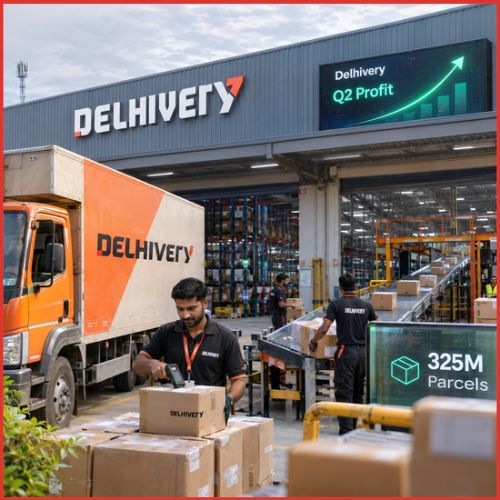
Delhivery is delivering more parcels, collecting payments faster and managing to earn better margins despite higher transport costs. Its September-quarter results brought those developments together, helping the stock rise sharply when trading resumed on Monday.
The Gurugram-based logistics company reported a net profit of ₹40.6 crore for the quarter ended September 30, against a loss of ₹50.3 crore a year earlier.
Revenue also crossed ₹3,000 crore for the first time in a quarter.
Investors reacted quickly. Delhivery shares opened at ₹400 on the NSE on November 2 before climbing to ₹419.85, a gain of nearly 9%.
Around 9:50 am, the stock was trading at ₹418.85. Close to seven million shares had changed hands, with trading value reaching approximately ₹272 crore.
The company’s latest numbers, released on October 30, suggest that higher shipment volumes and changes to customer pricing are beginning to make a difference to profitability.
Revenue Crosses ₹3,000 Crore as Shipments Increase
Delhivery handled 325 million express parcel shipments during the July-September quarter.
That was 32.1% more than a year earlier, with revenue from express deliveries increasing 22%.
Its part-truckload business, which transports freight from multiple customers in shared vehicles, also recorded growth.
Freight volumes reached 545,000 metric tonnes, up 14.2%, while revenue increased approximately 23%.
Across the business, Delhivery Q2 FY27 revenue stood at ₹3,066.3 crore, compared with ₹2,559.3 crore in the corresponding quarter of 2025.
There is a difference between carrying more shipments and earning more from each one. Delivery companies often compete heavily on price, particularly when transporting parcels for large e-commerce businesses.
That makes the relationship between volume, pricing and expenses particularly important.
Delhivery’s latest quarter benefited from a combination of higher shipment activity and improved revenue realisation.
The company reported a 4.1% sequential increase in express parcel realisation and a 5.6% improvement in its part-truckload business.
Those changes followed revisions to customer pricing, including charges linked to higher fuel costs.
Profitability Improves, Though Comparisons Need Context
Delhivery reported consolidated EBITDA of ₹205 crore for the September quarter.
A year earlier, EBITDA stood at ₹68 crore. The operating earnings measure has therefore more than tripled.
The reported EBITDA margin improved from 2.7% to 6.7%.
Adjusted EBITDA, which excludes certain items, reached ₹123 crore, compared with ₹83 crore in the same quarter last year.
Its adjusted margin stood at 4%, up from 3.3%.
The distinction between reported and adjusted earnings is important when examining the Delhivery quarterly results.
There is also a complication in comparing net profit with last year’s loss.
The earlier reporting period included the impact of Delhivery’s acquisition of Ecom Express. Excluding that effect, the company said profit after tax for Q2 FY26 would have been ₹59 crore.
The reported movement from a ₹50.3 crore loss to a ₹40.6 crore profit is accurate, but the adjusted comparison presents a less dramatic picture.
Profitability has improved sequentially, with reported net profit rising from approximately ₹32 crore in the June quarter.
The company is earning more from its operations, although the latest profit still represents a relatively small percentage of total quarterly revenue.
Diesel Prices Force Changes in Customer Contracts
The stronger margins came during a period when logistics companies were dealing with higher costs.
Delhivery reported pressure from diesel prices, labour availability and revisions to minimum wages in several states.
Fuel is a particularly important expense for a business operating delivery vehicles across the country.
When prices rise, logistics companies have to decide how much of that increase they can recover from customers without losing business.
Delhivery introduced fuel-linked pricing changes after diesel prices increased during the June quarter.
Management expects these pricing measures, along with better use of the existing network, to support margins during the remaining months of FY27.
The outcome will depend on freight demand and whether operating costs remain manageable.
Faster Collections Improve the Cash Cycle
One of the less obvious developments in Delhivery’s results concerns working capital.
At the end of September, the company’s net working capital requirement had fallen to five days.
Delhivery attributed the improvement partly to tighter credit controls, better customer selection and faster resolution of billing disputes.
The company has also been automating some of its billing and claims processes.
These changes can reduce the time between completing a delivery and receiving payment for the service.
The improvement in Delhivery working capital doesn’t mean every customer is paying within five days. The figure represents the company’s net working capital position relative to its operations.
Still, reducing that requirement can free up cash that would otherwise remain tied to day-to-day business activity.
Delhivery ended the quarter with approximately ₹4,676 crore in cash.
Local Delivery Business Expands to Eight Cities
Beyond its national parcel and freight network, Delhivery is building a business focused on deliveries within cities.
Delhivery Local now operates in Mumbai, Delhi NCR, Bengaluru, Hyderabad, Ahmedabad, Jaipur, Pune and Chennai.
The service has reached an annualised revenue run rate of approximately ₹200 crore, up from ₹100 crore at the end of the June quarter.
Management has raised its target for the business to around ₹280 crore by the end of FY27’s fourth quarter.
The company is also developing international parcel services and financial products for partners within its logistics network.
These operations remain smaller than Delhivery’s established parcel business, but management expects them to create additional sources of revenue.
Its international business has already reached an annualised revenue run rate of approximately ₹150 crore.
Brokerage Remains Positive Despite Lower Price Target
Jefferies maintained its Buy rating on Delhivery stock after the results, although it reduced its target price from ₹540 to ₹470.
The brokerage pointed to better-than-expected operating margins despite cost pressures and the timing of festive-season shipments.
It also revised its earnings estimates.
The FY27 earnings-per-share forecast was raised by 21%, while estimates for FY28 and FY29 were reduced by between 8% and 10%.
The changes suggest that analysts are encouraged by the latest quarter but remain cautious about profitability further ahead.
For Delhivery, the second half of the financial year will test whether the improved pricing and higher delivery volumes can keep supporting earnings.
October shipment volumes were already ahead of management’s initial expectations, according to the company’s shareholder letter.
That provides an encouraging starting point for the December quarter.
The latest Delhivery share price rally reflects stronger reported profit, rising parcel volumes and an improvement in margins.
What makes the results particularly interesting is that the company achieved these changes while dealing with higher fuel and labour expenses.
The remaining quarters will show whether the cost controls, pricing revisions and growing delivery network can produce more consistent profits.