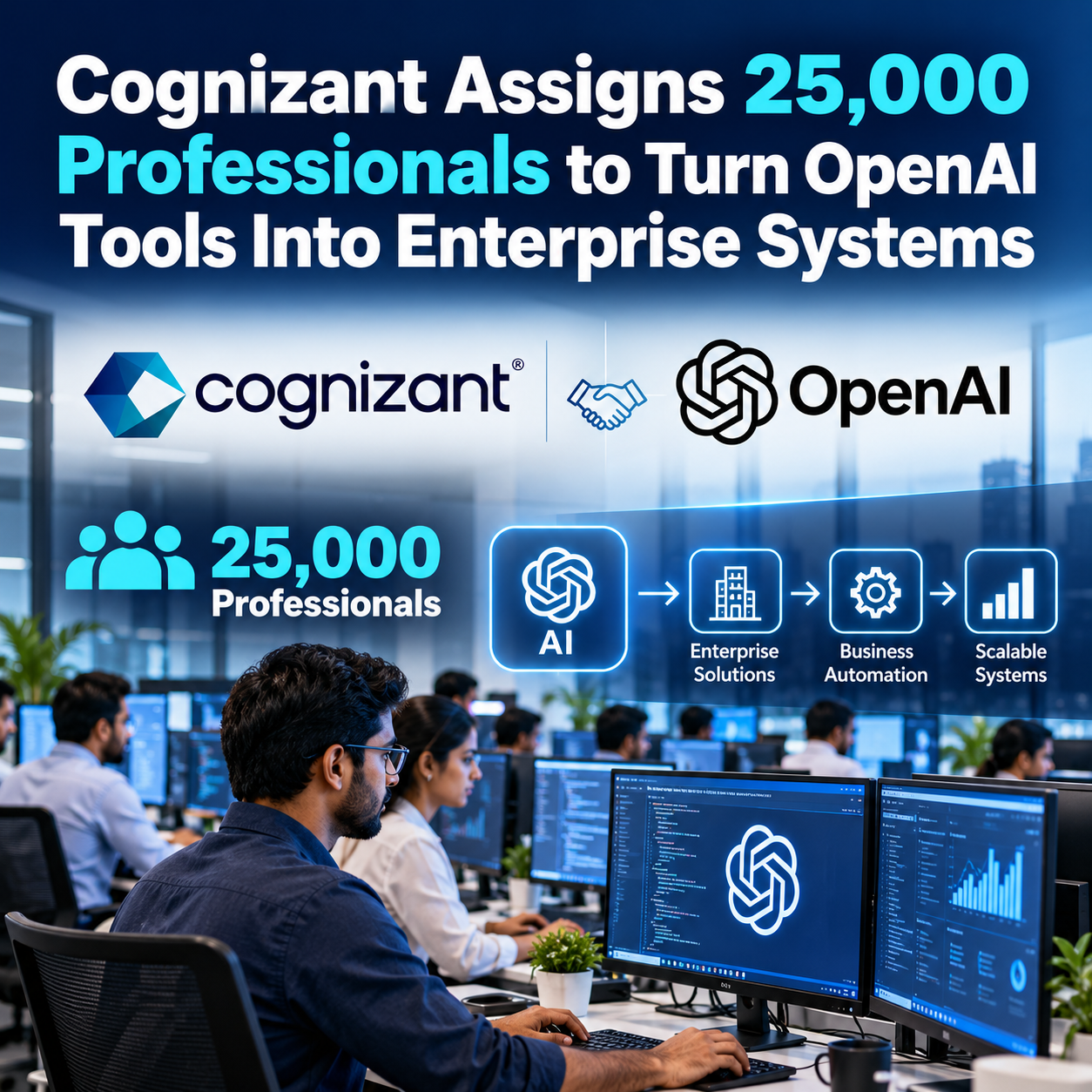
Cognizant is bringing more than 25,000 professionals into a dedicated OpenAI delivery group, placing a substantial workforce behind its effort to help businesses put artificial intelligence into everyday operations.
Announced on October 30, the OpenAI Frontier Capability Group will work with products including Codex and ChatGPT. Its initial assignments span software engineering, application modernisation and customer operations.
The announcement addresses a problem that often emerges after an enterprise gains access to an advanced model: someone still has to connect it to existing systems, adapt the workflow and keep the resulting service running.
Cognizant is positioning the new group around that implementation work. Its commercial opportunity depends on turning access to AI into systems that clients can use consistently.
A Delivery Group Rather Than a Hiring Announcement
The figure of more than 25,000 professionals describes the workforce Cognizant is bringing together for the initiative. It should not be read as an announcement of 25,000 newly created jobs.
The company said the group would build and support OpenAI-powered systems for clients. That places responsibility beyond the initial development stage, extending into the operation of those systems.
Cognizant’s stated view is that many enterprises are no longer held back primarily by access to advanced models. They lack enough people who can apply those models within business-critical technology.
That distinction shapes the initiative. A model may perform well in a demonstration, but introducing it into an established organisation requires knowledge of the software, business processes and decisions surrounding it.
The new group is intended to assemble those capabilities in a coordinated delivery organisation.
Training Provides the Workforce Foundation
Cognizant said more than 21,000 associates had earned over 40,000 OpenAI badges through completed learning tracks.
The two figures measure different things. The number of badges exceeds the number of participating employees because individuals can complete multiple tracks. Neither figure, by itself, measures the number of successful client deployments.
They nevertheless indicate the scale of the training effort supporting the new organisation. Cognizant is attempting to create a workforce that can work with OpenAI technologies across different assignments.
The group is also expected to draw on its Frontier workforce model, including Frontier Certified Engineers and Frontier Business Operators.
The inclusion of business operators alongside engineers reflects the scope of the work. Technical development is only one part of introducing AI into an organisation. The people responsible for the process must also understand how it changes.
Software Engineering Is an Early Priority
Codex will anchor the group’s work in AI-native software engineering. Cognizant plans to use it to support engineers as they write, test and release code.
For enterprise clients, the potential attraction extends beyond generating an individual piece of software. Development involves understanding requirements, working within existing codebases, checking changes and maintaining applications after release.
Cognizant’s opportunity is to introduce AI assistance into that wider process. The announcement does not establish a universal productivity improvement or a standard reduction in development costs.
Those outcomes will depend on the assignment and how the tools are used. Faster code generation, for example, has limited value if a project still encounters lengthy delays elsewhere.
The practical measure will be whether teams can deliver dependable software more efficiently while retaining responsibility for the result.
Legacy Applications Form a Second Workstream
Application modernisation is another initial focus. Cognizant plans to use its Application Modernizer, powered by OpenAI models, for work ranging from analysing legacy mainframe code to generating cloud-native code.
Older systems present a different challenge from building a new application. Their code may contain years of accumulated business rules, exceptions and dependencies.
Understanding those details is essential before replacing or restructuring them. A modern application that misses an important rule can create operational problems even if its code is technically sound.
Cognizant said engineers would review consequential decisions during modernisation work. It also cited experience modernising mainframe systems for more than 500 clients.
That experience is relevant to the initiative, although past client numbers do not guarantee the performance of future AI-assisted projects. Each migration still requires its own validation.
Customer Operations Draw on Internal Use
The third workstream covers agentic customer operations, including sales, service and support.
Cognizant said it is already using a solution built on OpenAI models within its sales and customer success teams to identify and pursue opportunities. It intends to draw on that experience when developing systems for clients.
Testing an approach internally gives the company a setting in which to observe adoption and operational difficulties. It can also reveal where a system requires changes before wider deployment.
Internal experience is a starting point, however, rather than proof that the same approach will work unchanged elsewhere. Client organisations have different products, customer relationships and operating requirements.
Cognizant will still need to adapt the technology to those circumstances. Its proposition is that clients can begin with methods already used inside a large enterprise.
Client Example Offers an Early Performance Claim
Cognizant pointed to work with an unnamed global biopharmaceutical company as an example of an existing deployment.
The enterprise assistant combined search, content creation, translation and approval workflows. According to Cognizant, it handled more than five million conversations and reduced content creation time by 60%.
Those figures are company-reported results from a particular deployment. They should not be treated as an expected outcome for every organisation adopting the group’s services.
The example is still useful because it identifies a specific workflow and a reported operational improvement. It moves the discussion beyond general claims about AI’s potential.
The inclusion of approval processes also shows that enterprise work involves more than producing an answer. The output must fit the organisation’s method of reviewing and using it.
Implementation Becomes the Commercial Test
The new group gives Cognizant a sizeable organisation through which to pursue OpenAI-related work. The company is also an Advanced partner in the OpenAI Partner Network.
For clients, the decision will ultimately concern delivery rather than workforce size. They will need to assess whether an implementation improves a defined process and whether the benefits justify its cost.
Cognizant’s announcement offers a clear account of where it intends to begin: engineering, legacy applications and customer operations.
The harder evidence will emerge from completed assignments. Training numbers show preparation; a dedicated organisation shows commitment. Sustained client outcomes will determine how much business the initiative can support.