Indian equities carried their recovery into early trading on November 3, with easing oil prices and renewed foreign buying giving investors reasons to stay in the market after Monday’s sharp advance.
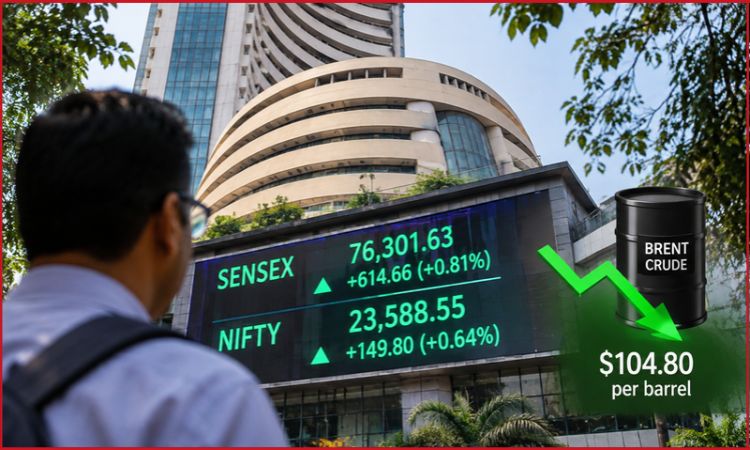
The Sensex rally pushed the benchmark up 614.66 points to 76,301.63 in the opening session. The Nifty gained 149.80 points to reach 23,588.55. These were early trading levels, rather than closing figures.
InterGlobe Aviation, UltraTech Cement, HDFC Bank, Asian Paints, Hindustan Unilever and Infosys featured among the gainers. Sun Pharma, Kotak Mahindra Bank, NTPC and Power Grid traded lower.
The advance followed a strong Monday session, when the Sensex added 1,233.25 points and the Nifty climbed 387.70 points. Foreign institutional investors bought Indian equities worth ₹3,114.68 crore that day, according to exchange data cited in the report.
Brent crude was around $104.80 a barrel on Tuesday morning. Its retreat from recent elevated levels helped sentiment, even though the price remained substantial for an oil-importing economy.
Why cheaper oil changes the calculation for Indian shares
Oil can influence Indian equities through several channels at once. It affects transport expenses, manufacturing costs, household spending and the country’s demand for foreign currency.
A fall in crude therefore gives investors more to consider than the immediate benefit to fuel-consuming businesses.
For an airline, lower fuel costs can improve operating economics. For a manufacturer, cheaper transport may ease distribution expenses. Households can also benefit if lower energy costs eventually feed into retail prices, leaving more money available for other purchases.
None of these changes happens uniformly.
Companies buy fuel under different arrangements. Some hedge their exposure, while others experience price changes more directly. Businesses may pass savings to customers, retain them to rebuild margins, or use them to offset increases elsewhere.
That makes the direction of oil prices useful, but insufficient on its own. The next earnings updates will show which companies actually retain the benefit.
For the Indian stock market, the immediate effect is often a reduction in anxiety. Investors become less worried that another rise in energy costs will upset forecasts already built into share prices.
What foreign buying adds to the recovery
Monday’s foreign purchases supplied a second source of encouragement.
Foreign institutional activity matters because large overseas investors can influence liquidity and the performance of heavily weighted shares. Their participation can help sustain an advance that might otherwise depend mainly on domestic buying.
Still, a single session cannot establish a durable change in positioning.
Funds may buy because of company results, changes in regional allocations, currency expectations or the need to rebalance portfolios. Those motives do not necessarily produce the same trading pattern the following week.
The more useful question is whether FII inflows persist across several sessions and spread beyond a small group of companies.
A recovery supported by repeated purchases would carry a different message from a brief burst of buying after a difficult period. Investors will also need to consider whether overseas demand remains firm when global markets become less supportive.
Tuesday’s early move offered encouragement on that front, but only an initial indication.
Why the mix of gaining stocks matters
The presence of aviation, cement, banking, consumer and technology companies among the early winners gave the advance several points of support.
That matters because a benchmark can rise sharply even when participation is narrow.
A few large constituents can lift an index while many other shares struggle. The headline gain then says more about those heavyweight businesses than about the market as a whole.
Early gains across different industries suggest investors were responding to more than one company-specific development. Yet the list of advancing Sensex constituents does not establish how smaller companies performed.
Market breadth, trading volumes and the behaviour of mid-cap and small-cap shares would provide a fuller picture.
The Nifty 50 gains should therefore be read alongside participation. A larger number of advancing shares would strengthen the recovery’s foundations. Weak participation would leave the market more dependent on a handful of stocks continuing to attract buyers.
How earnings will test the improvement in sentiment
Lower oil and stronger fund flows can support valuations. Company earnings ultimately determine how much support those valuations deserve.
Revenue growth alone may not answer that question.
A business can report higher sales while experiencing weaker margins, slower customer payments or rising interest expenses. Another may show modest revenue growth but produce substantially better cash flow.
Investors assessing the recovery will need to distinguish between those outcomes.
Management commentary also deserves attention. Order visibility, customer demand and pricing conditions can reveal whether a strong quarter is likely to carry into the next reporting period.
This is where a broad market rally becomes a more selective exercise.
Once the initial relief has been reflected in prices, companies face a higher burden of proof. Shares that have already advanced need results capable of supporting the expectations attached to them.
What could interrupt the advance
The recovery remains exposed to changes in the same conditions that helped it.
A renewed oil increase would complicate assumptions about costs and inflation. A reversal in foreign buying could remove an important source of demand. Disappointing results could also narrow the number of companies supporting the benchmarks.
There is a more ordinary risk as well: profit-taking.
After a strong session, some investors will sell simply because prices have moved in their favour. That does not automatically indicate a deterioration in the broader outlook. It does mean an advance rarely proceeds without interruption.
For now, Tuesday’s opening trade showed buyers willing to extend Monday’s recovery. The next test is whether that demand survives beyond the opening burst and continues as fresh corporate and global information arrives.
Source: Rediff: Indian markets extend their early trading rally