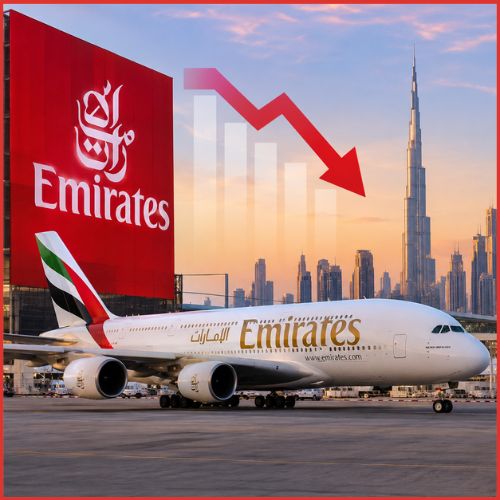
Emirates Group reported Dh3.6 billion in net profit for the first half of its 2026–27 financial year, remaining profitable despite regional disruption and elevated fuel costs.
The figure, equivalent to approximately US$980 million, was disclosed by the group’s chairman and chief executive on November 5, according to Reuters. It marks a substantially weaker outcome than the corresponding period a year earlier, when the group reported Dh10.6 billion in profit after tax.
The Emirates Group half-year results therefore present two distinct developments. The business has continued to earn money through difficult conditions, but the unusually strong profitability of the previous first half has not been sustained.
That distinction matters for a group investing in aircraft, cabin upgrades and infrastructure. Its ability to remain profitable provides support for those commitments. The amount of cash available after operating and investment requirements will determine how comfortably it can continue funding them.
How Far Has Profit Fallen From Last Year?
Using the published figures for both periods, group net profit fell by approximately 66% from Dh10.6 billion.
The comparison needs to remain consistent. Group profit should be compared with group profit, and after-tax earnings with after-tax earnings. Emirates airline is the largest part of the organisation, but its figures are not interchangeable with those of the wider group.
Last year’s first half was also an exceptional benchmark. The group reported record pre-tax earnings of Dh12.2 billion for that period, alongside revenue of Dh75.4 billion.
The latest decline does not, by itself, reveal how much came from revenue pressure, fuel expenditure, disruption or other costs. A complete explanation requires the detailed current-period accounts.
What it does establish is a narrower earnings cushion. When less profit remains after expenses, changes in demand or operating costs carry greater significance.
Why Do Fuel And Disruption Matter Together?
Fuel prices and regional operating difficulties can reinforce each other.
An airline may face a higher price for each unit of fuel while also adjusting schedules or flying less efficient routes. Disruption can create additional costs through aircraft positioning, crew arrangements and changes to passenger itineraries.
Those are general operating risks rather than a quantified breakdown of Emirates’ latest results.
The commercial response is not straightforward. Raising fares may recover some expenditure, but the ability to do so depends on demand and competition. Reducing capacity can limit exposure to weaker routes while also affecting connections elsewhere in the network.
For Emirates airline profitability, the relevant issue is therefore broader than the direction of oil prices. It includes how much flying can be operated efficiently and how much customers will pay for the available services.
A profitable result shows that revenue exceeded the relevant expenses overall. It does not mean those pressures have been fully absorbed.
What Financial Resources Did Emirates Bring Into The Year?
The group entered the current financial year from a strong starting position.
Its official 2025–26 results showed cash assets of Dh59.6 billion at March 31, 2026. During that financial year, it invested Dh17.9 billion in aircraft, facilities, equipment and technology.
Management said in May that the cash position would support continued investment without abrupt cost reductions. Emirates also described its fuel position as well hedged through 2028–29. Those statements describe the position and outlook disclosed at that time, rather than an updated November balance sheet.
Cash reserves can give an airline time to work through weaker trading conditions. They can also support payments that do not move in line with quarterly earnings.
However, cash assets are not a measure of money available for unrestricted distribution. Aircraft commitments, debt service and day-to-day liquidity requirements must also be considered.
The next important comparison will be how the group’s cash position has changed since March.
Why Is Emirates Continuing To Upgrade Its Fleet?
Investment can look difficult to justify when earnings fall. Delaying it can carry costs of its own.
Cabin refurbishment, connectivity and aircraft renewal influence the service passengers receive. They also affect which products an airline can offer on particular routes and how consistently it can deliver them.
In an October update reported by Gulf News, Emirates said 65 aircraft had been equipped with Starlink connectivity. It planned to add the service to another 10–12 aircraft each month. The same report said 104 aircraft had completed refurbishment, with 116 targeted by year-end.
Those programmes show that the Emirates fleet upgrade remains part of the operating strategy.
Their financial value will emerge over time. Better products may support customer preference, but investment still needs to produce sufficient revenue or operating benefits to justify its cost.
The commercial test is whether passengers choose those services at prices that sustain acceptable returns.
What Should The Next Results Clarify?
Passenger numbers will be useful, but they will not settle the earnings outlook alone.
An airline can carry more people while earning less from each journey. It can also improve revenue through a different cabin mix without increasing passenger volumes substantially.
Capacity, occupancy and yields therefore need to be examined together. Cargo performance and the contribution from other group businesses add further context.
The distinction between accounting earnings and cash generation will also matter. A profitable period can still involve substantial cash outflows when investment payments fall due.
For the Emirates Group financial outlook, the strongest evidence would be a combination of improving operating earnings, healthy cash generation and continued investment within available resources.
The latest result establishes that the group remained profitable through a difficult first half. It also leaves a demanding second-half task: rebuilding earnings while maintaining the network and products on which future revenue depends.