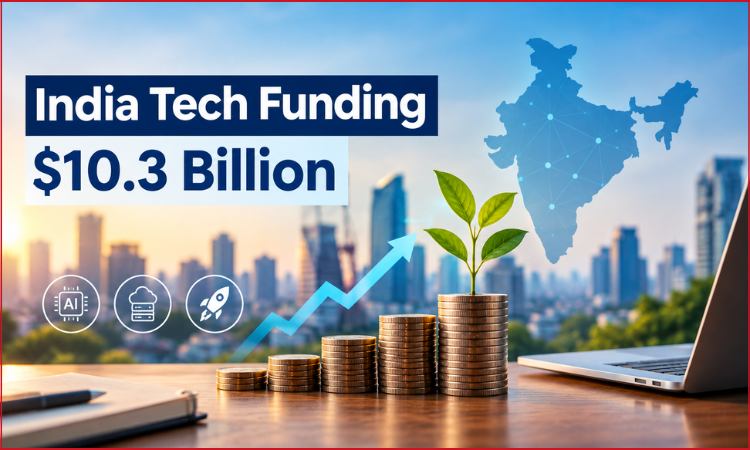
India’s technology sector attracted $10.3 billion in equity funding during the first nine months of 2026, but the headline increase hides a major change in how investors are putting money to work.
Total India tech funding rose 7% from $9.7 billion during the same period last year. At the same time, the number of funding rounds dropped sharply, falling 38% from 1,838 to 1,134.
The two numbers tell the story of the current startup market. Capital has not disappeared, but it is becoming more concentrated. Investors are placing larger bets on a smaller group of companies while becoming more selective about new and very early-stage businesses.
Fewer Deals Are Attracting More Capital
The $10.3 billion raised between January 1 and September 21 was also about 3% higher than the $10 billion recorded during the first nine months of 2024.
That gives the market two consecutive comparison points showing that total funding remains relatively resilient.
Deal activity tells a different story. With just 1,134 rounds completed, thousands of founders are competing for a smaller number of investment opportunities than they were a year ago.
First-time funded companies fell 30% to 338. The number of Series A and later rounds also declined 23% to 409.
The figures suggest the Indian startup funding market has become much less interested in spreading capital widely. Investors appear more comfortable writing substantial cheques for selected businesses with stronger scale, infrastructure or revenue prospects.
Mega-Rounds Are Lifting the Overall Funding Total
Large transactions played an unusually important role in pushing total funding higher. India recorded 18 rounds worth at least $100 million during the first nine months of the year.
The largest was Nxtra’s $1 billion private-equity round for data-centre expansion. Neysa followed with $600 million, while CRED raised $540 million in its Series H round.
Deals of that size can change the annual funding picture considerably. A market can therefore show higher total capital even when many smaller startups are finding it harder to raise money.
That is exactly what appears to be happening in 2026.
The startup funding in India numbers are growing at the top, but the wider deal pipeline is becoming narrower.
Early-Stage Funding Grew but Seed Funding Fell
The picture changes further when funding is divided by stage. Early-stage companies raised approximately $4.2 billion, up 27% from the same period last year.
Late-stage funding remained relatively stable at around $5.4 billion. Seed funding, however, fell 37% to just $698 million.
That decline is important because seed capital supports companies at the earliest point in their development, often before they have predictable revenue or a proven business model.
Investors appear willing to back selected companies once they have moved beyond that initial phase, but appetite for the most speculative bets has weakened.
That could make fundraising particularly difficult for new founders trying to secure their first institutional cheque.
AI Infrastructure Is Attracting Serious Money
Artificial intelligence is one of the clearest areas where capital remains available.
AI infrastructure attracted around $1.2 billion, making it the most-funded individual theme during the period.
Digital lending followed with $799 million, while payments businesses secured approximately $773 million.
At the broader sector level, Enterprise Applications attracted $3.5 billion, an increase of 49%.
FinTech raised $2.2 billion, up 13%, while Enterprise Infrastructure jumped 436% to approximately $1.6 billion. Those numbers show where investor conviction is currently strongest.
Rather than funding every company that adds AI to a product, investors are increasingly putting large sums into the infrastructure, data centres and enterprise technology needed to operate AI systems at scale.
India Added Six New Unicorns
The slowdown in deal volume did not prevent more companies from reaching billion-dollar valuations.
India created six new unicorns during the first nine months of 2026, compared with four during the same period last year.
More interestingly, those companies appear to have reached the milestone with less capital.
The average amount raised before the unicorn round fell to about $101 million from $205 million a year earlier.
The time required to move from Series A to a billion-dollar valuation also shortened. New unicorns took an average of 4.9 years after Series A to reach that level, compared with 6.6 years in the corresponding period last year.
That points to greater capital efficiency among the small group of startups successfully reaching the top of the market.
Bengaluru Still Dominates Startup Funding
Bengaluru remains comfortably ahead of other Indian cities when it comes to technology startup funding.
Companies based in the city raised approximately $4.4 billion, accounting for 43% of the country’s total.
A year earlier, Bengaluru represented about 38% of overall funding, meaning its share has grown even further.
Mumbai ranked second with $1.8 billion, representing about 18%. Gurugram followed with $1.6 billion and a 16% share, helped heavily by the $1 billion Nxtra transaction. Noida attracted approximately $660 million, while Delhi received around $446 million.
The figures once again show how concentrated India’s startup ecosystem remains around a handful of major technology centres.
IPO Activity Held Steady While Acquisitions Declined
Startup exits produced a mixed picture. Twenty-nine technology companies went public during the period, the same number recorded in comparable periods during both 2025 and 2024.
Among the larger listings were Fractal Analytics, Molbio Diagnostics and Amagi. Shiprocket also entered the public market.
Acquisition activity was weaker. The number of acquisitions fell 31% to 91 from 131 a year earlier.
One of the biggest transactions was L’Oréal’s $434 million purchase of Innovist. Other major deals included Adani Energy Solutions’ $319 million acquisition of IntelliSmart and UpGrad’s $218 million acquisition of Unacademy.
The decline suggests buyers are being selective in M&A just as investors are becoming more selective in funding.
India’s Funding Market Is Growing More Concentrated
The $10.3 billion headline could easily suggest that the startup funding environment has broadly improved.
The numbers underneath it show something more complicated.
India tech funding is higher, more unicorns are being created and major sectors such as AI infrastructure and enterprise technology are attracting substantial investment.
But fewer companies are receiving money. Seed-stage activity has weakened, first-time funded startups have declined and the total number of rounds has fallen by more than a third.
That means 2026 is not necessarily an easier year for founders. It is a year in which investors appear willing to commit serious money when they have high confidence in a company, while being much more cautious everywhere else.
For India’s startup ecosystem, the shift towards fewer but larger bets may continue to push founders towards stronger revenue models, clearer paths to profitability and greater capital efficiency before they approach investors.
Source:
TICE: India Tech Funding Hits $10.3 Billion in 9M 2026 as Capital Shifts to Bigger Bets