Meta used its Connect 2026 event to make one thing clear: the company sees glasses, not phones, as one of the most important places for artificial intelligence to live next.
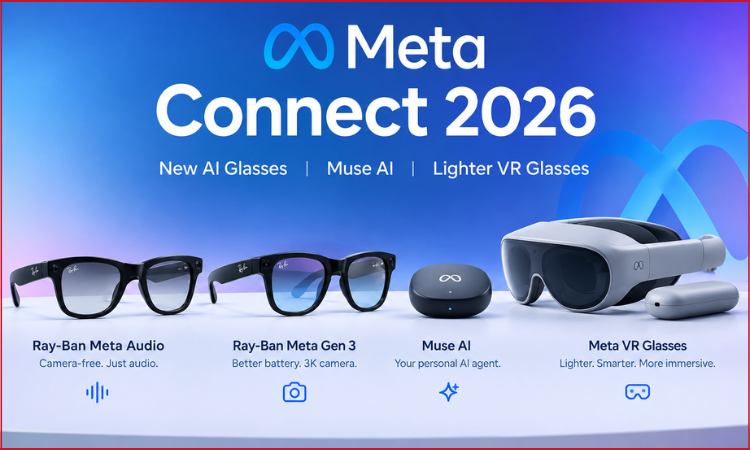
The company introduced Ray-Ban Meta Audio, refreshed its camera-equipped smart glasses, revealed much lighter Meta VR Glasses and showed how its Muse personal AI agent will work across wearable devices. Meta also announced new styles, software features and wider availability for several existing products.
Taken together, the announcements show Meta trying to build a much broader wearable lineup rather than relying on one pair of smart glasses to suit everyone.
Ray-Ban Meta Audio Drops the Camera
One of the biggest announcements was Ray-Ban Meta Audio, Meta’s first pair of AI glasses built without a camera.
The glasses retain open-ear speakers, microphones and access to Meta’s AI services, allowing users to listen to music, make calls and speak with Muse without taking out a phone. Removing the camera also gives Meta a simpler option for buyers who like the idea of smart glasses but do not need photo or video capture.
At 43 grams, Meta says these are its lightest and slimmest AI glasses yet. Battery life is rated at up to 12 hours, while the charging case can provide another 48 hours.
The lineup includes Clubmaster and Burbank frame designs, with 23 colour and lens combinations available. Prescription lenses are also supported.
Prices start at $349.
Ray-Ban Meta Gen 3 Gets Better Battery Life
Meta also introduced the third generation of its more familiar camera-equipped Ray-Ban glasses.
The new Ray-Ban Meta Gen 3 keeps the basic formula intact but improves several areas that matter in day-to-day use. The frames are slimmer, the fit has been adjusted and battery life increases to around nine hours.
Meta has added a customisable action button as well. Users can assign the button to frequently used functions rather than depending entirely on voice commands or touch controls.
The glasses include a 12-megapixel camera capable of recording 3K Ultra HD video. A six-microphone array is designed to improve voice pickup, with Meta claiming a substantial reduction in background noise during calls and commands.
Three frame styles are available: Wayfarer, Aviator and a new cat-eye design called Zena.
Prices start at $449.
Muse Is Moving Beyond Phones and Computers
Hardware was only half of Meta’s Connect story.
The company spent considerable time showing how Muse AI will become part of its glasses ecosystem. Muse is designed as a personal AI agent rather than a basic voice assistant, meaning it can work on longer tasks and continue doing things in the background.
On Meta’s glasses, users will eventually be able to call Muse by name and ask it to act on whatever they are looking at.
For example, a wearer could look at a product on a shelf or a list on a wall and ask Muse to help without first explaining what is in front of them.
Meta is also giving Muse its own email address and expanding the number of services it can connect with. Shopping and productivity integrations include platforms such as Shopify, PayPal, Notion and GitHub, with more partners being added.
The company also previewed Muse Charm, a small pocket-sized device designed mainly for voice interaction with the AI agent.
Meta VR Glasses Shrink the Headset
The most ambitious piece of hardware shown at Connect was the new Meta VR Glasses.
Instead of using the large headset format associated with the Quest range, Meta has reduced the wearable portion to roughly 100 grams. That makes the device about five times lighter than a Quest 3.
The trick is that not everything sits on the user’s face.
Meta has moved the battery and processors into a separate puck that can be placed in a pocket, clipped to clothing or carried in a bag.
The glasses themselves use micro-OLED panels and what Meta calls a 5K Infinite Display.
They are designed for more than gaming. Meta is pitching them as a personal cinema, work setup and spatial-computing device.
Users can create several virtual displays and even turn an ordinary desk or table into a keyboard and touchpad surface.
Control is handled largely through eye tracking and hand gestures rather than traditional VR controllers.
Meta Is Asking $1,299 for Its New VR Glasses
The lighter design does not come cheaply.
Meta VR Glasses will cost $1,299.99 when they go on sale in spring 2027.
That puts them well above Meta’s mainstream Quest products and into a more premium category.
Entertainment is an important part of the pitch. The glasses are expected to support major streaming platforms and are being positioned as the first IMAX Enhanced-certified VR device.
Meta is also working with sports broadcasters to offer immersive live events, including more than 100 US sporting events each year.
A new hologram feature will let users create a photorealistic digital version of themselves for calls. The avatar is created from a quick smartphone capture and is designed to reproduce facial expressions in real time.
AI Glasses Are Getting More Health and Navigation Features
Meta also announced a long list of software updates for its wider smart-glasses family.
Supported models will receive hearing enhancement aimed at adults with perceived mild to moderate hearing loss. In the US, the feature will cost $149.99 as a standalone addition or be included through a Meta One subscription.
Fitness is another area being expanded. Hands-free guided workouts for running and cycling are coming, alongside nutrition tracking and personalised insights.
Navigation will become more conversational too. Instead of relying only on street names, directions can use visible landmarks, telling the wearer to turn near a shop or another recognisable place.
Meta Ray-Ban Display is also getting cycling and public-transport navigation.
Meta Wants More Than 100 Glasses Options
Perhaps the clearest sign of Meta’s strategy is simply the size of the lineup.
By the end of 2026, the company expects to offer more than 100 different AI-glasses options across Ray-Ban, Oakley and its own Meta Glasses range.
New collaborations include glasses designed with LISA, while additional frames and colour combinations are being introduced across the portfolio.
Meta is effectively treating AI glasses more like ordinary eyewear, where design, fit and personal preference matter just as much as technical features.
The announcements at Meta Connect 2026 suggest the company believes wearable AI will not succeed through one universal device. Instead, it is building different products for different users: camera-free audio glasses for everyday wear, camera-equipped models for visual AI, display glasses for information and premium VR hardware for immersive computing.
Whether consumers want that many AI devices remains the bigger question.
For Meta, though, the direction is now unmistakable. Muse is becoming the intelligence layer, while glasses are becoming the hardware through which the company wants people to reach it throughout the day.
Source:
Gadgets 360: Everything Announced at Meta Connect 2026: Ray-Ban Meta Audio, Meta VR Glasses, Muse and More