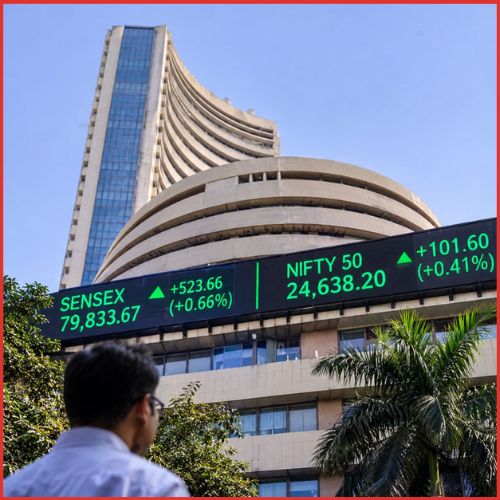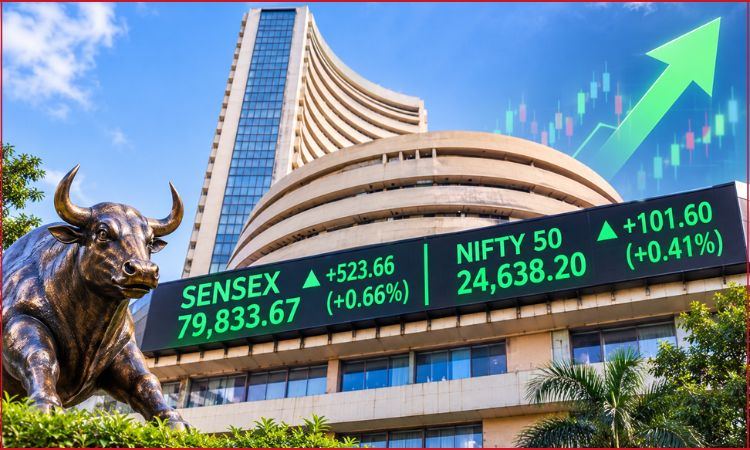
The Sensex gained more than 500 points in Friday morning trading. Across the wider market, declining shares comfortably outnumbered those advancing.
That contrast defined the November 6 session.
At 9:57 am, the Sensex stood at 79,833.67, up 523.66 points, or 0.66%. The Nifty had added 101.60 points, or 0.41%, to reach 24,638.20, according to Moneycontrol.
Yet around 2,201 shares were lower, compared with 1,165 that had risen. Another 162 were unchanged.
The Indian stock market rally was continuing, but it was reaching investors unevenly. Buying in influential companies was strong enough to lift the benchmarks while a much larger group of shares struggled.
Foreign purchases offered one explanation for the support. Geojit Investments chief investment strategist V K Vijayakumar cited ₹35,781 crore of buying over five trading days, alongside better-than-expected earnings.
He also argued that the retreat in the overseas AI trade could benefit India. That is a view about how capital might be allocated, rather than evidence that every investor selling foreign technology shares is buying Indian stocks.
A Green Index Did Not Mean A Green Portfolio
For someone holding shares outside the day’s strongest companies, the benchmark advance may have offered little comfort.
The Sensex and Nifty are weighted indices. Large constituents have greater influence on their direction than smaller ones. Enough buying in a few important companies can outweigh declines elsewhere.
There is nothing unusual about that calculation. What matters is remembering it when reading the headline.
Friday’s morning breadth showed a market with considerable selling beneath the positive index levels. It did not establish that the rally was about to end. It did show that confidence was selective.
The distinction is especially relevant after a strong run.
Investors may continue favouring companies whose earnings and valuations they find easier to assess, while avoiding businesses with less predictable results. That can keep the benchmarks moving without lifting the market uniformly.
For Sensex and Nifty gains to become more widely shared, participation would need to improve.
More advancing companies, stronger sector breadth and sustained demand beyond the existing leaders would provide evidence of that change. Until then, the index remains an incomplete description of what individual shareholders are experiencing.
Foreign Purchases Have Supplied Support, But Their Motives Vary
The scale of recent overseas buying is significant. Several sessions of purchases suggest a more sustained commitment than a single day’s activity.
Even so, the total does not explain every transaction behind it.
One fund may be increasing its allocation to India. Another may be replacing a holding within an existing portfolio. A third could be responding to earnings or adjusting exposure after changes in currency expectations.
Those decisions can produce the same buying figure for different reasons.
Large, liquid shares are also easier places to deploy substantial amounts of capital. This can help explain why institutional demand supports the main indices more visibly than the broader market.
The recent FII buying in India is therefore useful evidence of demand already present. Whether it continues depends on the choices investors make next.
Prices themselves influence those choices. A company that looked attractive before a rally may offer a different balance of risk and return after it.
Foreign institutions can keep buying while becoming more selective about what they purchase. The market does not need to move as one.
India Still Has To Earn The Capital It Attracts
The weakness in overseas technology shares has encouraged discussion about where investors might turn next.
India is one possible destination. Cash, bonds and other equity markets are alternatives.
A sale in one part of a portfolio does not create a compulsory purchase elsewhere. Some investors may simply want less exposure to shares.
For India to benefit consistently, its companies need to offer a convincing investment case at the prices available. Earnings growth, balance sheets and valuations remain part of that assessment.
There are also important differences within technology.
Indian services businesses do not have the same spending model as companies building large AI infrastructure networks. Investors may treat them differently when reassessing the returns from the AI boom.
That distinction offers a possible explanation for divergent share-price performance. It does not eliminate exposure to customers abroad.
If global businesses become more cautious about spending, the effect can eventually reach service providers and suppliers. A market can outperform overseas exchanges while remaining connected to the same economic cycle.
The relative strength seen in morning trade should be read in that context.
Earnings Will Face A Higher Test After Prices Rise
Vijayakumar’s assessment gave corporate earnings an important place in the rally. Sustaining that support will require companies to keep delivering against expectations.
A higher share price makes the comparison more demanding.
Strong sales may already be anticipated. Investors then look more closely at margins, expenses and the cash generated from those sales. A company can grow revenue and still disappoint if too little reaches the bottom line.
That is relevant to the Nifty 50 outlook because the benchmark’s next advance needs support from the businesses within it.
Foreign demand can help prices move quickly. Repeated earnings improvements would give investors a firmer reason to remain involved after the initial buying slows.
Management commentary will matter alongside the numbers. Orders, customer spending and investment plans offer clues about whether recent growth can continue.
There is also a basic timing point. The November 6 figures describe morning trading, not the closing result. During volatile sessions, that distinction can be substantial.
By the reported snapshot, Indian heavyweights had held up well against weak overseas markets. Much of the rest of the market had not.
The next test is whether more companies join the advance, or whether the same leaders continue carrying the indices.
Source: Moneycontrol: Indian Markets Rise Despite Weak Global Cues.