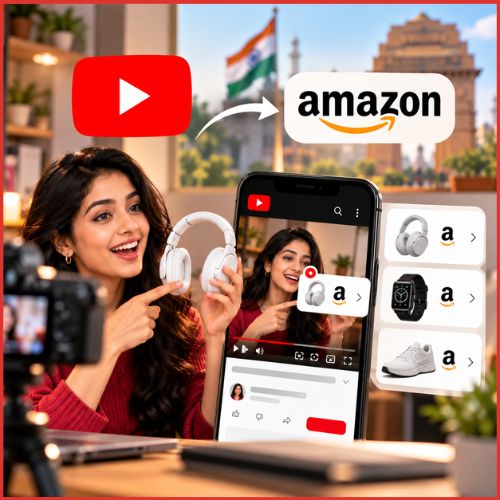
YouTube is expanding its shopping business in India by allowing eligible creators to tag products sold on Amazon directly inside their videos, Shorts and livestreams. The move is part of a larger set of updates announced at Made on YouTube 2026, where the company also introduced personalised Custom Feeds, new artificial intelligence tools and several changes to livestreaming.
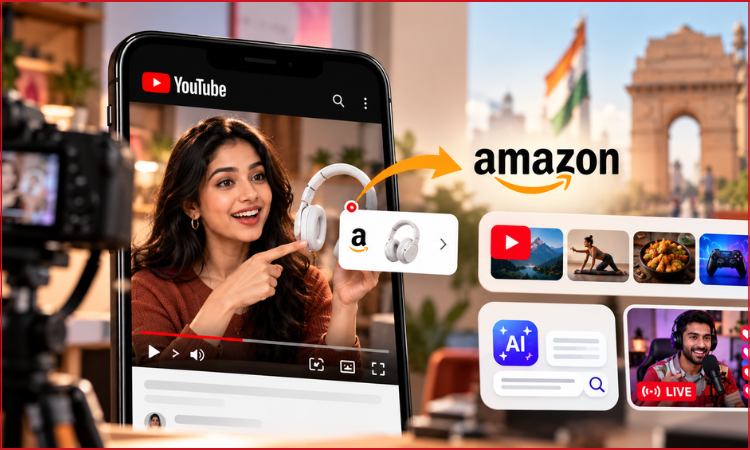
The Amazon product tagging feature is expected to arrive in India in the coming weeks, giving creators another way to earn commissions when viewers buy products they recommend.
For YouTube, the broader goal is clear. The platform is trying to bring content discovery, shopping and creator monetisation closer together instead of sending users outside the app every time they want to purchase something mentioned in a video.
Amazon Product Tagging Is Coming to Indian Creators
Amazon recently joined the YouTube Shopping Affiliate Programme in the US. YouTube is now extending that partnership to India and Brazil, with additional markets planned before the end of the year.
Eligible Indian creators will be able to tag Amazon products directly in long-form videos, Shorts and livestreams.
A viewer watching a gadget review, beauty tutorial or home-improvement video could therefore see the featured product within the YouTube interface and follow the shopping link without searching for it separately on Amazon.
Creators can earn affiliate commissions when qualifying purchases are made through those tags.
The arrangement makes YouTube Shopping more useful in India because Amazon already has a large product catalogue and a substantial customer base in the country.
Until now, creators may have relied more heavily on links placed in descriptions or comments. Product tags make recommendations more visible while viewers are actually watching the content.
YouTube Says Product Tags Get More Clicks
The company has been steadily building Shopping into a larger part of the creator business.
More than 1.3 million creators are already participating in the affiliate programme globally, while gross merchandise value generated through YouTube Shopping has increased 13-fold over the past two years.
YouTube has also found that shopping tags can generate more than twice as many clicks as conventional links placed in video descriptions.
That helps explain why the platform is putting more emphasis on commerce.
A product mentioned naturally inside a video often reaches someone at exactly the moment they are considering a purchase. Making the product immediately accessible can shorten the gap between discovering something and buying it.
For creators, Amazon product tagging can turn existing recommendation content into another revenue stream without requiring a separate sponsorship agreement.
Product Links Will Adjust to the Viewer’s Location
YouTube is also changing how shopping links work for creators with international audiences.
Product tags will increasingly display localised offers based on the country from which a viewer is watching.
That solves a fairly common problem.
A creator in the US may recommend a product that is also sold in India, Japan or another market, but an ordinary affiliate link may send everyone to the same regional store or display an offer that is not available locally.
With localised product tagging, YouTube can show a more appropriate shopping destination while still allowing the creator to earn from qualifying international purchases.
This becomes especially useful for larger YouTube channels whose audiences are spread across several countries.
Custom Feeds Let Viewers Build Their Own Homepages
Shopping is only one part of the latest update.
YouTube is introducing Custom Feeds, which allow users to create personalised sections on their homepage using conversational prompts.
Instead of relying entirely on the main recommendation feed, someone could ask YouTube to create a feed for a particular mood, routine or interest.
A viewer might request documentaries suitable for evening viewing, discover new DIY channels or build a feed around podcasts that fit a daily commute.
Multiple feeds can be saved to the homepage and will continue updating as new relevant videos become available.
This gives users more direct control over recommendations without forcing them to repeatedly search for the same type of content.
YouTube plans to begin rolling out Custom Feeds in the US first, with broader availability expected later.
Ask YouTube Is Becoming a Shopping Assistant
YouTube’s AI-powered search and discovery features are also being expanded.
Ask YouTube will increasingly work as a product recommendation tool, helping viewers understand and compare items they encounter on the platform.
That could become particularly useful when combined with YouTube Shopping.
Someone watching several smartphone reviews, for example, may be able to ask questions about the products before opening the relevant shopping links.
The platform is effectively trying to keep more of the buying journey in one place: discovery happens through videos, questions can be answered through AI and purchases can begin through product tags.
That makes shopping less like a separate feature and more like another layer of the regular viewing experience.
AI Tools Are Coming Deeper Into Creator Workflows
Creators are receiving their own set of artificial intelligence features.
YouTube is integrating Gemini technology into editing tools for Shorts and the YouTube Create app.
Creators will be able to use conversational prompts to perform common editing tasks such as trimming speech, rearranging frames, adding text hooks and synchronising music.
The idea is not to generate every video automatically.
Instead, YouTube is using AI creator tools to reduce some of the repetitive work that happens between recording footage and uploading the finished video.
YouTube Studio is also getting more AI assistance. Ask Studio will help creators respond to brand briefs, prepare pitches and improve media kits when looking for commercial partnerships.
For smaller creators who do not have managers or dedicated sales teams, those tools could remove some of the administrative work involved in earning money from a channel.
Livestreaming Is Getting More Interactive
YouTube also announced significant changes to Live.
More than 600 million logged-in viewers watched live content on an average day in August, including archived livestreams, making the format a major part of the platform.
New Live Showdowns will let creators compete against each other during co-hosted broadcasts. Viewers will be able to influence the competition through chats, gifts and Super Chats.
YouTube is also developing automatic real-time dubbing for livestreams.
More than 40% of live watch time already comes from people outside a creator’s home country, so automatic dubbing could help channels reach audiences who currently speak a different language.
The feature is expected to begin testing in early 2027.
YouTube Is Building a Bigger Creator Commerce Business
The latest announcements show how much YouTube has changed from a straightforward video-hosting platform.
Creators can now earn through advertising, memberships, fan payments, sponsorships and increasingly through product sales.
Bringing Amazon into YouTube Shopping in India gives that commerce strategy a much stronger local partner.
At the same time, Custom Feeds and AI tools are designed to make it easier for users to find content and for creators to produce it.
The pieces are closely connected.
Better discovery can bring more viewers to creators. More viewers create larger opportunities for shopping and brand partnerships, while simpler production tools can help creators publish more consistently.
For Indian creators, Amazon tagging may be the most immediately useful part of the announcement. It gives product-focused channels another route to monetisation using a shopping platform their audience already knows.
The larger shift, though, is that YouTube increasingly wants the entire cycle — discovering a video, researching a product and starting a purchase — to happen without viewers needing to leave the platform.