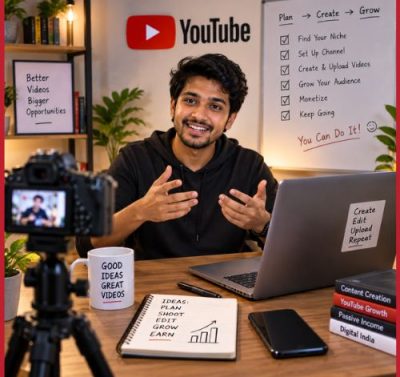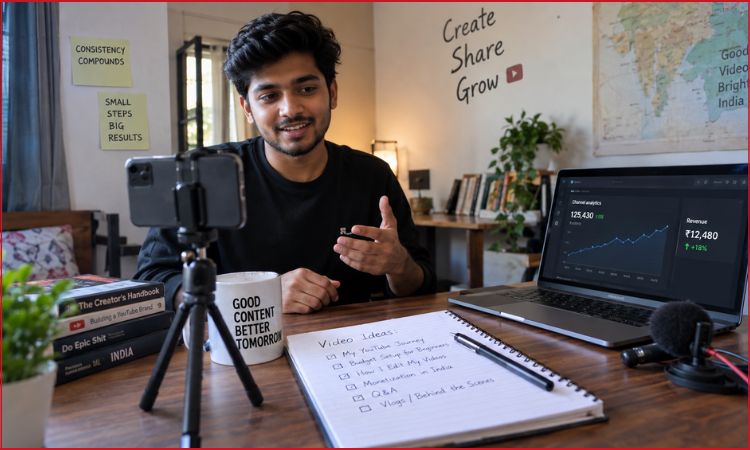
You do not need a studio, an expensive camera or thousands of followers to start a YouTube channel in India.
A smartphone, a clear topic and enough patience to publish your first few dozen videos can be enough to begin. The harder part is figuring out what to make, who it is for and how the channel can eventually become a source of income.
That last point matters. YouTube is no longer just an advertising platform for creators. In 2026, eligible creators can earn through ads, YouTube Premium, memberships, Super Thanks, Super Chat, Shopping and brand partnerships. But reaching those income streams requires more than simply uploading videos and waiting for views.
How YouTube works as a business
A YouTube channel has two sides.
The first is audience building. You publish videos that people choose to watch, return to and recommend.
The second is monetisation. Once you have enough audience and meet the relevant requirements, that attention can be converted into advertising revenue, sponsorships, affiliate commissions, product sales and other income.
This is why subscriber count alone is a poor measure of a channel’s earning potential. A smaller channel in a focused niche can sometimes have a more valuable audience than a much larger channel whose viewers are difficult to monetise.
Ankur Warikoo makes a similar point in his guide on YouTube monetisation. His discussion looks beyond ad revenue to sponsorships and other income streams, treating YouTube as a business asset rather than simply a place to collect views.
Step 1: Choose a niche you can actually sustain
The first mistake many beginners make is choosing a niche because it looks profitable.
A better question is: what can I make 50 useful videos about without running out of ideas?
Popular options in India include personal finance, technology, education, careers, fitness, gaming, food, travel, business, beauty and practical how-to content. But a broad category is not a niche by itself.
“Technology” is broad. “Budget smartphones for Indian college students” is more specific.
“Personal finance” is broad. “Money management for first-job professionals in India” gives you a clearer audience.
Sean Cannell of Think Media puts strong emphasis on this clarity-first approach. In his 2026 beginner’s guide, he argues that creators should start by deciding who the channel is really for and then build a repeatable system around that audience.
You do not have to stay inside one narrow topic forever. But your first videos should give viewers a reason to understand what your channel is about.
Step 2: Create the YouTube channel
The technical part is easier than most beginners expect.
You need a Google Account and a YouTube channel. YouTube’s current setup process allows you to create a personal channel or a channel using another name through a Brand Account. You can choose the channel name, profile picture and handle during setup.
Once the channel is created, complete the basic profile:
- A simple, recognisable channel name
- Profile image or logo
- Banner
- Short description explaining what viewers will get
- Relevant links, where appropriate
It is also worth completing phone verification early. YouTube says phone verification unlocks features such as custom thumbnails, live streaming and videos longer than 15 minutes.
Do not spend a week designing the banner before making your first video. Your content will matter far more.
Step 3: Decide whether to make Shorts, long-form videos or both
YouTube now offers several formats, but beginners often make the mistake of treating Shorts and long-form videos as the same thing.
They are not.
Shorts can help you reach new viewers quickly and test ideas.
Long-form videos give you more room to teach, explain, review, compare or tell a story.
A practical strategy for a new channel is to use both. For example, a creator making videos about budget technology could publish one detailed smartphone comparison and then turn several useful moments from that video into Shorts.
The goal is not to upload everywhere just because you can. The goal is to create a system in which one strong idea can produce multiple pieces of useful content.
Step 4: Start with the equipment you already have
You do not need a DSLR to make your first YouTube video.
For many Indian beginners, a smartphone is enough. Good lighting and understandable audio can make a much bigger difference than buying a ₹1 lakh camera.
A basic setup can be:
Camera: Your smartphone
Audio: Wired earphones, a budget microphone or the phone’s microphone in a quiet room
Lighting: Window light or an affordable LED light
Editing: A mobile or desktop editor you are comfortable using
Thumbnail: YouTube’s own tools or a simple design app
Upgrade equipment after the channel gives you a reason to upgrade it.
A new camera will not fix an uninteresting topic.
Step 5: Find video ideas before you start recording
Do not open the camera app and ask yourself, “What should I make today?”
Build an idea list first.
Look at the questions people repeatedly ask in your niche. Search YouTube for subjects related to your topic and study which videos continue to attract viewers. Read comments. Look at autocomplete suggestions. Check competitor channels for patterns, not just individual viral videos.
Sean Cannell’s 2026 advice is particularly useful here. His framework emphasises researching ideas that already have demand, then building videos around those opportunities rather than uploading random topics.
Ali Abdaal takes a related approach. In his 2026 guide, he focuses on choosing the right videos, creating a strong “complete video package” and building a library of content that encourages viewers to watch more than one video.
That leads to a simple rule: do not chase every trend. Find repeatable demand.
Step 6: Make the title and thumbnail before the video
This sounds backwards, but it can improve the video itself.
Before recording, decide: what is the promise of this video?
Suppose your topic is college finances.
“5 Financial Tips for College Students” is functional but generic.
“How I Would Manage ₹10,000 a Month as a College Student” gives the viewer a more specific situation.
The title should make the value clear. The thumbnail should support it rather than simply repeat the title.
YouTube says viewers usually see the title and thumbnail before deciding whether to watch, and recommends accurate, concise titles and clear, uncomplicated thumbnails. YouTube also reports that 90% of its best-performing videos have custom thumbnails.
That does not mean a flashy thumbnail guarantees views. It means packaging is part of the product.
Step 7: Keep the first 30 seconds useful
A viewer who clicks a video can leave almost immediately.
So avoid long introductions such as: “Hello guys, welcome back to the channel. I hope you are all doing well…”
Get to the point.
Tell viewers what they are going to learn, show the problem or present the most interesting part of the story.
YouTube’s audience-retention guidance specifically recommends experimenting with the first 30 seconds and bringing compelling material earlier when strong moments are buried later in a video.
You do not need an artificial hook in every sentence. You simply need to respect the viewer’s time.
Step 8: Publish consistently, but do not confuse consistency with daily uploads
You do not have to upload every day.
For someone studying or working full-time, one strong long-form video a week may be more realistic than seven rushed uploads.
The important thing is to create a schedule you can maintain.
This is one of the recurring themes in Sean Cannell’s 2026 advice. Think Media’s current beginner framework places consistency alongside clarity, content and monetisation as part of a longer-term YouTube system.
Your first objective should not be “go viral”.
It should be to publish enough videos to learn what your audience actually responds to.
How YouTube monetisation works in India in 2026
YouTube Partner Program eligibility is often misunderstood because there are different thresholds for different monetisation features.
As of 2026, eligible creators can get earlier access to features such as memberships, Super Chat, Super Thanks and Shopping at:
500 subscribers + 3 public uploads in the last 90 days + either 3,000 qualified long-form watch hours in the last 365 days or 3 million qualified Shorts views in the last 90 days.
For ad revenue from Watch Page ads and Shorts Feed ads, the threshold is:
1,000 subscribers + either 4,000 qualified long-form watch hours in the last 365 days or 10 million qualified Shorts views in the last 90 days.
Meeting the numbers does not automatically guarantee approval. YouTube reviews the channel for compliance with its monetisation policies, and a channel must meet additional requirements such as having no active Community Guidelines strikes and having two-step verification enabled.
Important 2027 update
YouTube has announced that from February 1, 2027, new creators seeking access to ad and YouTube Premium revenue will face a higher entry threshold of 8,000 qualified watch hours in the previous 365 days or 20 million qualified Shorts views in the previous 90 days, while still requiring 1,000 subscribers. Existing YPP creators are not affected by this change to their status.
That makes it even more important to check YouTube’s current requirements before building a monetisation plan around a particular threshold.
Also Read: Why YouTube Videos Are Not Getting Views
7 ways to make money from a YouTube channel in India
1. YouTube ad revenue
Once you qualify for the relevant YPP level, you can earn from ads shown on eligible content.
But there is no fixed amount that YouTube pays for every 1,000 views. Revenue varies based on factors including audience, advertiser demand, format and other conditions. YouTube itself says there are no guarantees about how much a creator will be paid.
That is why videos with the same number of views can generate very different revenue.
2. YouTube Premium
Creators can also receive a share of revenue when YouTube Premium subscribers watch their content.
3. Brand sponsorships
A company may pay a creator to feature a product or service in a video.
For a small creator, a highly targeted audience can be more useful to a brand than a huge but unrelated audience. YouTube has also expanded Creator Partnerships, including availability for eligible creators in India.
4. Affiliate marketing
A creator can earn a commission when viewers purchase products through qualifying affiliate links.
For example, a budget-tech channel could review headphones and provide purchase links. A finance education channel might promote software or books where appropriate.
YouTube also has a Shopping affiliate programme available to eligible creators in India.
5. Channel memberships and fan funding
Eligible creators can earn recurring membership payments or receive support through features such as Super Thanks, Super Chat and Super Stickers.
6. Your own products or services
YouTube can become a distribution channel for something you already sell.
That could be a course, ebook, consulting service, digital product, merchandise or another legitimate business.
For many creators, this can eventually matter more than advertising because they are selling something they control rather than relying entirely on ad rates.
7. Use YouTube to grow another business
YouTube can also generate leads rather than direct payments.
A person teaching coding could attract students. A fitness creator could attract clients. A business channel could generate enquiries for a consulting company.
In that model, YouTube is the audience engine. The business is where the revenue happens.
Can a faceless YouTube channel make money?
Yes, but “faceless” does not mean “copied”.
You can build channels around screen recordings, animation, tutorials, narrated explainers, documentaries or other formats without appearing on camera.
The important question is whether the content is original and adds real value.
YouTube’s monetisation policy says content should be original and authentic and should not be mass-produced, generic or repetitive. Its reused-content rules also apply when creators repurpose material from other sources without significant original commentary or transformation.
This matters even more as AI makes it easier to produce large volumes of videos. A channel that simply combines copied clips, generic scripts and automated narration may produce uploads quickly, but speed alone does not make content monetisable.
What should a beginner track in YouTube Studio?
Do not obsess over subscriber count after every upload.
Watch how viewers respond.
YouTube Studio provides data on impressions, click-through rate, audience retention and traffic sources. YouTube specifically warns creators not to view CTR in isolation because performance changes depending on audience and traffic source.
A simple review after every few videos is enough:
Did people click? Look at impressions and CTR.
Did they stay? Study audience retention.
Did the right people watch? Look at traffic sources and returning viewers.
What should I make next? Look for topics or sections that performed better than your usual content.
Ali Abdaal’s idea of building a “bingeable” content library fits here. A successful video should ideally make the next relevant video on your channel easier to discover and watch.
Common YouTube mistakes beginners should avoid
Buying expensive equipment before making enough videos is one.
Changing niches every two weeks is another.
Uploading videos without researching whether anyone wants the topic is a third.
There is also a growing temptation to use AI to produce dozens of nearly identical videos. YouTube’s current monetisation policy specifically warns against mass-produced and repetitive content.
And perhaps the biggest mistake is quitting too early.
Your first ten videos are not a final judgement on your channel. They are data.
A creator who studies what worked, improves the packaging, tightens the opening and chooses better topics can make the twentieth video much stronger than the first.
A simple 30-day YouTube plan
You do not need a complicated content calendar.
Week 1: Choose the niche, define the audience and write 20 video ideas.
Week 2: Produce your first two or three videos using the equipment you already have.
Week 3: Publish, study audience retention and note which parts viewers respond to.
Week 4: Improve the next batch using what you learned. Turn useful sections from long-form videos into Shorts where appropriate.
The aim of the first month is not to make a full-time income. It is to build the habit of creating, publishing, reviewing and improving.
Conclusion
Starting a YouTube channel in India in 2026 is technically easy. Building one that people return to is the difficult part.
Start with a clear audience. Pick a topic you can sustain. Use the equipment you already have. Research video ideas before recording. Treat titles and thumbnails as part of the content, not decoration. Then use YouTube Analytics to understand what viewers actually respond to.
The money comes later.
YouTube currently offers several routes to monetisation, from advertising and Premium revenue to memberships, Shopping, sponsorships and products. But none of them removes the basic requirement: people need a reason to watch your videos.
As Sean Cannell’s Think Media framework suggests, a new creator benefits from building a system around clarity, content, consistency and cash rather than waiting for one lucky viral upload.
And as Ali Abdaal’s approach shows, the goal is not merely to make individual videos. It is to build a library that makes viewers want to watch the next one.
For a beginner, that is a much more useful target than simply asking how many subscribers are needed to make money.
Frequently Asked Questions
1. How much does YouTube pay for 1,000 views in India?
There is no fixed amount. YouTube says creator earnings depend on advertising revenue and other factors, and there is no guaranteed payment amount. Audience location, topic, advertiser demand, video format and other variables can affect the result.
2. How many subscribers do you need to make money on YouTube in India?
For some YPP features, eligible creators can qualify at 500 subscribers along with other requirements. For ad revenue, the current 2026 threshold is 1,000 subscribers plus either 4,000 qualified long-form watch hours in 365 days or 10 million qualified Shorts views in 90 days.
3. Can I start a YouTube channel with only a phone?
Yes. YouTube allows creators to upload from mobile devices, and a smartphone can be enough to produce useful videos, particularly when lighting and audio are handled well. The equipment can be upgraded later as the channel grows.
4. Is a faceless YouTube channel eligible for monetisation?
A faceless format can be monetised, but the content still needs to follow YouTube’s monetisation policies. Original, authentic content can qualify, while mass-produced, repetitive or inadequately transformed reused content may not.
5. Is YouTube Shopping available in India?
Yes. YouTube’s Shopping affiliate programme is currently available to eligible creators in India, subject to YPP and other programme requirements.
6. Do YouTube earnings get taxed in India?
YouTube states that creators may be liable to pay taxes on income earned through monetised videos and advises creators to check the rules applicable in their country of residence. Indian creators should therefore maintain proper records of their YouTube income and expenses and obtain professional tax advice where necessary.