Rajeev Jain’s business journey at Bajaj Finance is what happens when calculated risk-taking meets relentless execution, year after year, for nearly two decades. This is the Rajeev Jain success story behind India’s largest and most consistently profitable NBFC.
When he joined the Bajaj Finserv Group in 2007, Bajaj Finance was, in effect, a captive auto-finance arm with a narrow mandate. Today it’s one of India’s largest and most diversified non-banking financial companies, running a technology-led model across dozens of product lines. Few Rajeev Jain Bajaj Finance timelines capture just how complete that transformation has been.
FY2026 is the year the numbers stopped feeling like ordinary growth. Bajaj Finance’s consolidated assets under management touched ₹5,09,975 crore, a threshold nobody in the Indian NBFC space had crossed before, while profit after tax attributable to owners came in at ₹19,017 crore, up roughly 15% over the year. Customer franchise reached 119.33 million, and the company booked 52.45 million new loans along the way. This is the backbone of the Rajeev Jain success story.
Quick Glance
| Full Name | Rajeev Jain |
| Date of Birth | September 6, 1970 |
| Current Role | Vice Chairman and Managing Director, Bajaj Finance |
| Company | Bajaj Finance Limited (Bajaj Finserv Group) |
| Joined Bajaj Finance | 2007, as CEO; became Managing Director in 2015 |
| Prior Roles | GE, American Express, AIG (Deputy CEO, Consumer Lending) |
| Known For | Transforming Bajaj Finance from an auto-financier into India’s largest diversified NBFC |
| FY2026 Consolidated AUM | ₹5,09,975 crore (+22% YoY) |
| FY2026 Customer Franchise | 119.33 million |
| FY2026 Profit After Tax (owners) | ₹19,017 crore (+~15% YoY) |
| FY2026 GNPA / NNPA | 1.01% / 0.41% |
| Nickname | The “Return King” of Indian NBFCs |
Who Is Rajeev Jain?
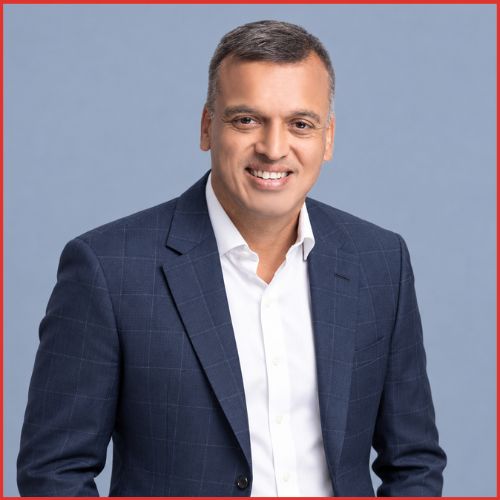
Rajeev Jain is the Vice Chairman and Managing Director of Bajaj Finance.
Born on September 6, 1970, he carries nearly three decades of experience across consumer lending and financial services, a Rajeev Jain biography that reads more like a tour of blue-chip lenders than a straight climb to the corner office.
Before Bajaj, he held senior roles at GE, American Express, and AIG, where he was Deputy CEO of the consumer lending business and helped build the strategic framework for the company’s India entry. He joined Bajaj Finserv in 2007 as CEO of Bajaj Finance, moving up to Managing Director in 2015. His brief wasn’t to grow the existing book faster; it was to rethink what the company could become entirely, a mandate most incoming CEOs never get.
The Starting Point: From Auto Finance To A Bigger Opportunity
Bajaj Finance began life as Bajaj Auto Finance, incorporated in 1987 with a tight focus on vehicle loans. Jain looked at that business and saw something narrower than it needed to be. India, at the time, was in the middle of a consumption boom: rising incomes, growing aspiration, and a large population still sitting outside the formal credit system. So Bajaj Finance began pushing into consumer durables, personal loans, business loans, and eventually housing finance.
The underlying philosophy was almost stubbornly simple: don’t build a company around one loan product, build a relationship around the customer. That one idea shaped nearly everything that followed in the Bajaj Finance growth story.
The Diversification Strategy That Changed Bajaj Finance
Turning a single-product lender into a diversified NBFC didn’t happen through one bold stroke. It happened through years of steady expansion across segments: consumer finance, personal loans, commercial lending, SME finance, rural lending, housing finance, insurance distribution, investments, and digital payments. By FY2026, Bajaj Finance was running 27 products across 46 variants – a portfolio with almost nothing in common with the auto-financing outfit Jain inherited in 2007.
What matters here isn’t the product count so much as the mindset behind it. Bajaj Finance increasingly treats each product line as one entry point into a longer customer relationship. A customer who first shows up buying a refrigerator on EMI might come back for a personal loan two years later, then an insurance policy, then an investment product. Every additional product raises what the company can eventually earn from that one relationship a pattern that shows up again and again across the Bajaj Finance success story.
The Cross-Sell Machine Behind Bajaj Finance’s Growth Story
None of Bajaj Finance’s growth story makes sense without its cross-selling engine. The company’s stated aim, across several annual reports, has been to increase its share of each customer’s wallet and sell more products to people it already knows rather than spend heavily acquiring strangers. Acquiring a new customer costs real money; selling an existing customer a second or third product is comparatively cheap, provided you have the data to know what to offer and when.
Bajaj Finance built exactly that data layer. By FY2026, the average customer held 6.07 Bajaj Finance products or services, active and closed combined a number that says more about the company’s underlying model than any single AUM figure does. It isn’t really running a lending business so much as a long-term financial-services relationship, sold one product deep at a time.
Technology Became Jain’s Competitive Weapon
Lending, traditionally, means paperwork, branch visits, and slow approvals. Jain pushed Bajaj Finance in exactly the opposite direction from early on. Digital platforms, automated underwriting, and data-driven customer journeys became core to how the company operates, not an add-on bolted onto a legacy process. By FY2026, the Bajaj Finance app had crossed 86 million net installs, and the company operated more than 242,000 active distribution points across 4,098 locations.
The next stage of this philosophy has a name: FINAI, Bajaj Finance’s push to embed artificial intelligence across the business – vision AI, data AI, conversational AI, content AI, and agentic AI, according to the company’s own FY2026 annual report. For Jain, technology was never just about a better-looking app. It’s steadily becoming the business model itself, and it’s one of the clearest threads running through his business journey as Bajaj Finance CEO.
Risk Management: The Other Half Of The Bajaj Finance Success Story
Growth this fast can turn dangerous quickly if credit quality slips, which is exactly why risk management has stayed as central to Jain’s playbook as expansion itself. The company has poured resources into credit analytics, underwriting systems, and portfolio monitoring for years, and FY2026’s numbers back the discipline up: gross NPA at 1.01%, net NPA at 0.41%, among the lowest in the industry with a standalone capital adequacy ratio of 21.55%, well above what regulators require. Jain’s approach was never simply to lend more; it was to lend at scale without letting portfolio quality slip, through good years and bad.
The Numbers Behind The Rajeev Jain Success Story
| Metric | FY2026 | FY2025 |
| Consolidated AUM | ₹5,09,975 crore (+22% YoY) | ₹4,16,661 crore |
| Customer franchise | 119.33 million | 101.82 million |
| New loans booked | 52.45 million | 43.42 million |
| Net total income | ₹53,324 crore | ₹44,954 crore |
| Profit after tax (owners) | ₹19,017 crore (+~15%) | ₹16,779 crore |
| GNPA / NNPA | 1.01% / 0.41% | N/A |
| Standalone capital adequacy | 21.55% | N/A |
Source: Bajaj Finance Limited Annual Report FY2025-26; Bajaj Finserv Annual Report FY2025-26.
Consolidated profit after tax attributable to owners came in at ₹19,017 crore for FY2026, up roughly 15% year-on-year, on 22% AUM growth. Numbers like these are why Jain gets tied so closely to Bajaj Finance’s reputation as a shareholder-return machine.
Why Rajeev Jain Is Called A “Return King”
The nickname isn’t really about the share-price chart, though that chart helps make the case. It’s about building a business that can compound returns on capital while still growing fast a harder combination than it sounds. Bajaj Finance’s own strategic framework has targeted 21-23% through-the-cycle shareholder returns, with prudence built into the target rather than bolted on as an afterthought.
Diversification, cross-selling, technology, scale, and risk management aren’t five separate initiatives at Bajaj Finance; they reinforce each other. More customers generate more data. More data sharpens underwriting. Sharper underwriting supports faster, safer growth. More products per customer raise lifetime value. Technology strips out friction and cost. Scale compounds all of it through distribution and acquisition. That loop, running for nearly two decades, is the real engine behind the Rajeev Jain success story.
Building Financial Inclusion Alongside Profitability
There’s a less-discussed side to Jain’s legacy. Bajaj Finance says it has brought 42 million new-to-credit customers into India’s formal financial system over 18 years people who, without this kind of underwriting innovation, would likely have stayed outside formal lending altogether. Commercial ambition and financial inclusion aren’t always compatible goals for a lender, but Bajaj Finance has largely managed to run both at once, provided borrowers can service what they take on and underwriting standards stay tight.
The Next Chapter: Bajaj Finance 3.0
The Rajeev Jain story is still being written, not wrapped up in a case study. The company now describes its current phase as BFL 3.0, a “FINAI company” with a 2026-2030 roadmap built around customer centricity, technology leadership, and long-term value creation rather than growth for its own sake. Artificial intelligence sits at the centre of that next phase. The real test, though, is one Jain has already passed once before: growing fast without letting credit quality, customer trust, or returns slip.
Conclusion
Rajeev Jain didn’t build Bajaj Finance around one breakthrough product. He built a financial-services ecosystem, product by product, over eighteen years. From a captive auto-finance business, the company has grown into a diversified NBFC serving consumers and businesses across India, with an AUM near ₹5.10 lakh crore, a customer franchise past 119 million, and profit after tax attributable to owners of ₹19,017 crore in FY2026 alone.
The real Rajeev Jain success story was never just about the scoreboard. It’s about recognising, early and consistently, that lending could be rebuilt around customer intelligence, diversification, technology, and risk discipline, working together rather than in isolation. As Bajaj Finance moves into its AI-driven next phase, the open question isn’t whether Jain can keep transforming the company. It’s how far the model he built can still scale, and that’s what keeps the Rajeev Jain Bajaj Finance story worth watching.
Frequently Asked Questions
1. Who is Rajeev Jain of Bajaj Finance?
Rajeev Jain is the Vice Chairman and Managing Director of Bajaj Finance, India’s largest NBFC by AUM. He joined in 2007 as CEO and led its transformation from a single-product auto financier into a diversified lender across personal loans, gold loans, credit cards, and housing finance.
2. What is the Rajeev Jain success story in brief?
Jain took over a captive auto-finance business in 2007 and built it into a company with a consolidated AUM of ₹5,09,975 crore and a customer franchise of 119.33 million by FY2026 – one of the most closely watched growth stories in Indian NBFC history.
3. Why is Rajeev Jain called the “return king”?
Bajaj Finance has been one of the strongest long-term shareholder-return stories in Indian financial services, built on a strategic target of 21-23% through-the-cycle returns – which is why the “return king” tag has stuck to Jain’s tenure.
4. What is Rajeev Jain’s educational and professional background?
Before joining Bajaj Finance, Jain held senior roles at GE, American Express, and AIG, where he was Deputy CEO of the consumer lending business. He brought nearly three decades of consumer-lending experience into the CEO’s chair at Bajaj Finance in 2007, a background that shows up throughout his Rajeev Jain biography.