A credit card works on a simple promise: the issuer sets a pre-approved limit, and the cardholder draws against it, in person or online, to pay for purchases or draw cash advances under agreed terms. That instrument has scaled fast in India, powered by contactless technology and rising digital payment habits. RBI data puts the country’s credit card base at 121.5 million by June 2026, the sharpest monthly jump since December 2023 (RBI data via Kotak Neo, 2026), a number large enough to raise a bigger question: who are the top 10 credit card companies in the world actually running this industry?
Zoom out and the pattern holds globally too. Analysts peg the worldwide credit card market at $1.7 trillion in 2023, on track to reach $2.3 trillion by 2028 on an annual growth rate near 8.5 percent (Fintech Magazine, 2024). That trajectory is precisely why founders and operators building anything payments-adjacent are paying attention.
How we ranked Top Credit Card Companies
This list isn’t ranked by one metric like transaction volume or cards issued – that wouldn’t let you fairly compare a network like Visa against an issuer like Bank of America or a closed-loop player like American Express. Instead, ranking reflects overall industry standing: card and transaction volume, network ownership, geographic reach, historical influence, and recent strategic moves like Capital One’s Discover acquisition.
Since these companies span different segments – networks, national systems like UnionPay, and issuers riding on others’ rails – this is a broad comparison, not a strict one-axis ranking. The aim is simply to spotlight who carries the most weight in the credit card industry today, and who’s positioned to shape it next.
Quick Glance
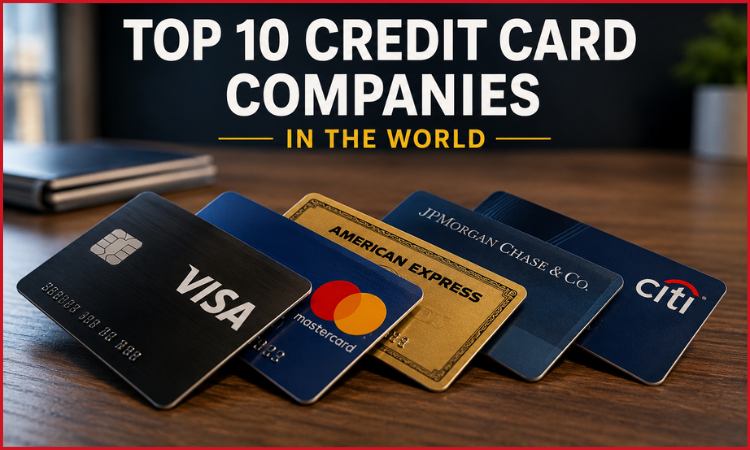
The table below lines up ten global credit card companies by origin, focus, and the metric that best captures their scale.
| Name | Founded | Sector / Focus | Key Metric |
| Visa | 1958 | Global payment network | 4.81 billion active cards worldwide |
| Mastercard | 1966 | Global payment network | 3.39 billion active cards worldwide |
| American Express | 1850 | Premium charge/credit cards, closed-loop network | 86.6 million proprietary cards in force |
| JPMorgan Chase | 1799 | Retail and commercial card issuing | 197.4 million active card accounts |
| Citigroup | 1812 | Retail and co-brand card issuing | $616 billion in 2024 purchase volume |
| UnionPay | 2002 | National payment network, China | 2nd most-used card network worldwide |
| Capital One | 1994 | Card issuing, now also network owner | $35.3 billion Discover acquisition, closed 2025 |
| Bank of America | 1904 | Retail and business card issuing | $502 billion in 2024 purchase volume |
| HSBC | 1865 | Global retail and premium card issuing | Operations across 60+ countries |
| Barclaycard | 1966 | UK card issuing and merchant acquiring | 419 million transactions worth £23.8bn in one month |
1. Visa
Visa began life as BankAmericard in 1958 before Bank of America spun it off and renamed it in 1976. It no longer issues cards itself; it just moves money between roughly 14,500 financial institutions and does it at a scale nothing else touches. In its 2025 fiscal year, Visa processed 257.5 billion transactions across 4.81 billion active cards (Capital One Shopping Research, 2026). That reach is why it, along with UnionPay and Mastercard, handles 97 percent of the world’s credit card transaction volume.
2. Mastercard
Interbank was the modest name attached to Mastercard‘s start in 1966, a coalition of regional banks banding together to counter BankAmericard. The brand went through one more identity, Master Charge, before settling on Mastercard in 1979. It now counts 3.39 billion active cards in circulation worldwide (Capital One Shopping Research, 2026), and in several markets outside the US, its merchant acceptance actually edges past Visa’s.
3. American Express
Long before it issued its first card, Amex was a 19th-century parcel and money-transport firm founded in 1850. It didn’t enter payments until 1958, and it never fully left the courier-era habit of doing everything itself — issuing cards, running the network, and settling transactions in-house. That closed-loop design now supports 86.6 million proprietary cards, plus another 66.2 million issued through partner banks (Capital One Shopping Research, 2026). The tradeoff for that control has always been narrower merchant acceptance than Visa or Mastercard.
4. JPMorgan Chase
Chase doesn’t run a network. It runs the biggest single stack of Visa and Mastercard-branded cards in the US, with 197.4 million active accounts, more than any other issuer on earth (Capital One Shopping Research, 2026). The bank itself traces back to 1799, and that account base alone places it among the largest credit card companies anywhere, network-owning or not. Scale like this is why co-brand deals with airlines and retailers keep landing at Chase’s door before anyone else’s.
5. Citigroup
Citibank issued its “Everything Card” back in 1966, the same year rival banks were forming what became Mastercard, and the institution behind it dates to 1812. In 2024, Citi’s cards moved $616 billion in purchase volume, the third-highest among US issuers (WalletHub, citing Nilson Report data, 2025). Its rewards ecosystem and dense international footprint keep it among the leading credit card providers for cross-border and co-brand products, competitive against issuers with deeper US-only concentration.
6. UnionPay
China built its own card rails rather than depend on Visa or Mastercard, and UnionPay, launched in 2002 under central bank backing, is the result. It now ranks as the second-most-used card network in the world after Visa, dominating both domestic and outbound Chinese spending (Rapyd, 2026). India’s own card and UPI ecosystem, propelled by players like Razorpay under Harshil Mathur, is following a similar logic of building rails suited to local scale rather than importing them wholesale.
7. Capital One
Founded in 1994 as a spinoff built entirely around data-driven underwriting, Capital One spent three decades as an issuer riding on Visa and Mastercard rails. That changed in 2025, when it closed a $35.3 billion acquisition of Discover, instantly making it the only US company that owns both a major issuing business and its own payment network (Upgraded Points, 2026). Analysts now watch whether that combination can chip away at the Visa-Mastercard duopoly.
8. Bank of America
Bank of America launched the card that eventually became Visa in 1958, then lost direct control of it a decade later. The bank itself was founded in 1904 and still counts among the top credit card issuers in the US on its own terms, generating $502 billion in 2024 purchase volume (WalletHub, citing Nilson Report data, 2025). Corporate and small-business cards remain a disproportionate share of that volume.
9. HSBC
HSBC took a different route than most names on this list, building its card business outward from Asia rather than the US. It was set up in Hong Kong in 1865 to finance trade flows between Europe and Asia, and that trade-finance DNA still shows: the bank now issues premium and retail credit cards in more than 60 countries (Quartz, 2026), giving it one of the widest geographic footprints among global credit card companies. Founders eyeing cross-border expansion could do worse than study how those century-and-a-half-old roots have kept HSBC relevant through multiple banking cycles.
10. Barclaycard
The UK’s first credit card wasn’t born in a boardroom; it came out of a converted shoe factory in Northampton, where Barclays stood up Barclaycard in June 1966 with just 30 staff and a tight budget. Six decades later, that same business pushes through roughly 419 million transactions worth £23.8 billion in a single month (Barclays, 2026), a volume that puts it among the best credit card companies in the world on domestic UK footing. Barclaycard has held the title of the UK’s largest card issuer ever since it first mailed out 1.25 million cards, a lead it has never once given up.
What These Companies Have In Common
Every name on this list either owns a payment rail or leans hard on one it doesn’t control, and that single fact decides its margins. Ranking the best credit card companies in the world always comes down to which lens you use: cards issued, dollars moved, or network ownership. The ones that own their network, Amex and now Capital One, trade lower merchant acceptance for higher fee capture, while the rest compete on distribution, rewards, and underwriting instead.
Conclusion
None of the top credit card issuers got here by accident, and none of them are standing still either. Capital One’s move on Discover shows that even the largest players still see white space in owning infrastructure, not just renting it. For founders and investors tracking where the next disruption in leading credit card providers might come from, the more interesting question isn’t who’s biggest today, but who’s willing to rebuild their own rails the way UnionPay and Capital One just did.
Frequently Asked Questions
1. Which network processes the most credit card transactions?
Visa comes out on top by both measures, with 4.81 billion active cards and more than 257 billion transactions run through its rails in its 2025 fiscal year. Mastercard and UnionPay sit close behind, though which one edges ahead depends on whether you’re counting cards or transaction volume.
2. What is the difference between a card network and a card issuer?
A network, Visa or Mastercard being the obvious examples, exists to route transactions between banks and merchants; it isn’t the one lending money to cardholders. That job belongs to the issuer, a bank like Chase or Citi, which sets interest rates, extends the actual credit line, and ships out the physical card.
3. Why did Capital One acquire Discover?
The $35.3 billion deal, closed in 2025, gave Capital One ownership of a proprietary payment network for the first time, letting it compete more directly with the closed-loop model American Express has run for decades.
4. Is American Express a bank or a network?
Both. Amex is unusual among the largest credit card companies because it issues cards, extends credit, and processes transactions all within one closed-loop system, rather than relying on outside issuing banks.
5. Which issuer has the most cards in circulation?
In the US, that’s JPMorgan Chase, with 197.4 million active accounts to its name. Take the global view instead, and Visa pulls ahead on card count with 4.81 billion active cards, spread across thousands of issuing banks rather than concentrated in one.
6. How is India positioned in the global credit card industry leaders conversation?
India isn’t yet home to a global network on the scale of Visa or UnionPay, but its card and UPI ecosystem, built by companies like Razorpay, is growing fast enough that global issuers are increasingly designing products specifically for the market.