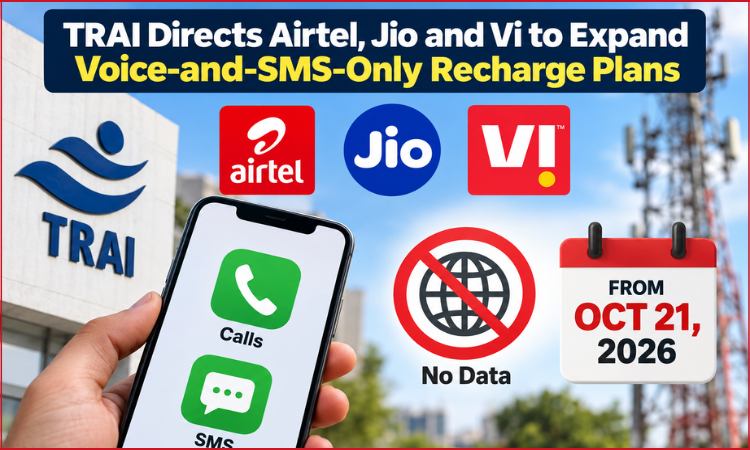
Mobile users who mainly need calling and text messaging will soon have more recharge choices in India. New telecom rules require operators to expand their range of voice and SMS-only plans, including shorter-validity packs that do not force customers to pay for mobile data they may never use.
The revised framework will apply to operators including Airtel, Reliance Jio and Vodafone Idea from October 21, 2026. It follows concerns that most data-free recharge options available in the market were concentrated around longer validity periods, leaving fewer practical choices for customers looking for a short-term or monthly recharge.
Shorter Voice and SMS Packs Are Coming
Under the new TRAI recharge rules, telecom companies must offer Special Tariff Vouchers for voice and SMS with validity periods of 30 days or less.
That is an important change for users who do not need internet access on their primary SIM. Until now, customers looking specifically for calling and SMS benefits often had far fewer options than someone buying a regular bundled plan with daily mobile data.
The revised structure gives those users the ability to recharge for a shorter period instead of paying upfront for a long-duration plan simply because they want a data-free option.
TRAI’s existing consumer information describes voice-and-SMS-only packs as prepaid plans that provide calls and text messaging without mobile data. Such plans can continue to be offered with validity extending up to 365 days.
Monthly Renewal Will Become Easier
The rules also address one of the more frustrating parts of prepaid validity: the difference between a fixed number of days and an actual calendar month.
Operators will need to offer at least one plan that can be renewed on the same date every month. If that date does not exist in a particular month, renewal will move to the final day of that month.
For example, someone recharging on the 31st would not have to manually calculate when a 28-day or 30-day pack ends during every billing cycle.
The change should make prepaid recharge plans easier to manage for customers who prefer a predictable monthly payment rhythm.
Along with the monthly renewable option, operators must also retain at least one voice-and-SMS-only voucher with a longer validity period.
Users Will Not Have to Pay for Unwanted Data
The biggest practical benefit is choice.
A large part of India’s mobile recharge market is built around bundles containing unlimited calling, SMS allowances and daily data. Those packs work well for smartphone users who regularly rely on mobile internet, but they are less useful for people who simply want an active number for calls and messages.
That group can include feature-phone users, customers who rely mainly on home Wi-Fi, people maintaining a secondary SIM and users whose internet needs are handled through another connection.
For them, bundled mobile data may add little value.
The expanded voice and SMS-only plans are intended to give such customers a clearer alternative rather than requiring them to choose from packages designed primarily around mobile internet usage.
Airtel, Jio and Vi Will Need to Rework Their Portfolios
The new framework means Airtel Jio Vi will need to review how their existing prepaid portfolios are structured.
Telecom companies already offer a variety of recharge combinations, but voice-centric options have generally been more limited than mainstream data bundles.
The regulation does not mean every operator must charge exactly the same amount or offer identical plans.
Telecom providers continue to have flexibility over pricing within the regulatory framework. TRAI does not normally fix retail mobile tariffs directly; operators can design their own combinations based on commercial conditions while complying with transparency and consumer-protection requirements.
What changes is the range of choices they must make available.
Customers should therefore expect different prices and benefits across Airtel, Jio and Vi even after all three update their recharge menus.
The Final Rules Changed From the Earlier Proposal
The regulations followed several months of consultation.
An earlier draft released in April had proposed a more extensive structure under which providers would have been required to create corresponding voice-and-SMS-only alternatives for bundled plans across validity periods.
Feedback was submitted by consumer groups, industry bodies and telecom companies during the consultation process. The final regulations adopted a different structure centred around shorter-duration vouchers, a monthly renewable option and at least one longer-validity offering rather than requiring a direct one-for-one equivalent for every existing bundled plan.
That gives operators more room to design their portfolios while still increasing the number of data-free choices available to customers.
Prices Could Matter More Than the Number of Plans
Simply adding new packs will not automatically make them attractive.
For customers to see a real benefit, the price difference between a voice-only plan and a regular data bundle needs to be meaningful.
A recharge that removes data but costs almost the same as an existing bundled offer may have little appeal.
This will make the eventual pricing decisions from telecom operators worth watching once the new plans begin appearing.
For low-usage customers, even modest monthly savings can add up over a year. For operators, however, data bundles have become an important part of average revenue per user, so they will need to balance regulatory requirements with their commercial goals.
Older Users and Secondary SIM Customers May Benefit Most
The new rules could be particularly useful for people whose mobile usage does not match the way modern telecom packages are normally structured.
Some users keep a second SIM primarily for incoming calls, banking messages or account verification. Others use a mobile phone mainly for traditional calling.
There are also customers who already have broadband or Wi-Fi throughout most of the day and rarely consume mobile data.
These users have historically had to look through recharge menus dominated by daily-data allowances they may not need.
More flexible prepaid recharge plans should make it easier to select a pack around actual usage rather than paying for extra services simply because they are bundled together.
What Customers Should Expect From October 21
The changes will not remove existing data plans. Smartphone users who want bundled calling, SMS and internet access will continue to have those options.
Instead, telecom companies will add or revise voice-and-SMS-only vouchers to comply with the updated rules.
Customers should therefore begin seeing shorter-duration data-free plans, a monthly renewable option and at least one longer-validity choice across operator recharge platforms.
The biggest change is not a new technology or service. It is a simpler idea: mobile users should have more freedom to pay only for the services they actually need.
For people who mainly make calls and send messages, the expanded voice and SMS-only plans could finally make prepaid recharge menus a little less complicated.