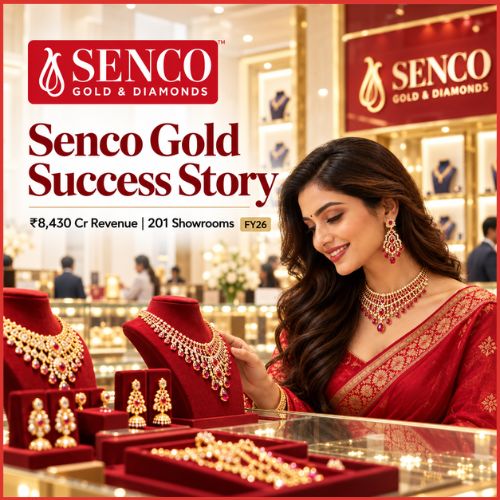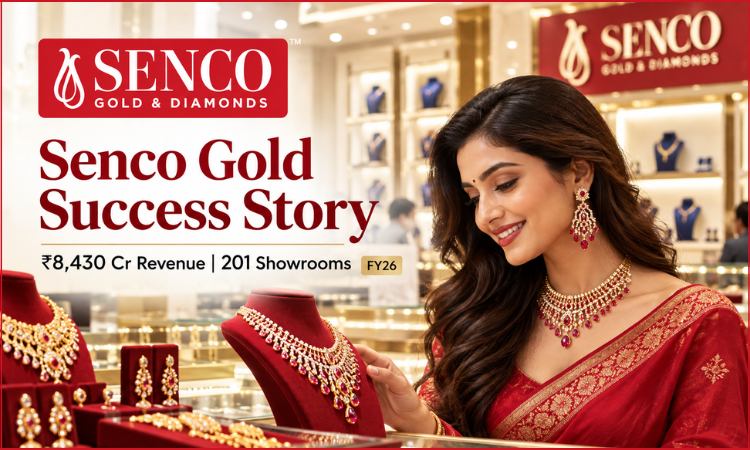
Senco Gold Limited has evolved from a family jewellery business with roots in pre-independence India into one of India’s notable organised jewellery retailers. Its growth has been driven by a combination of brand trust, regional expertise, franchise-led expansion, product innovation, store productivity and omnichannel retail.
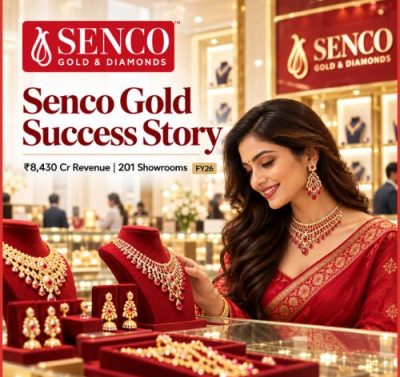
In FY26, Senco Gold reported ₹8,430 crore in consolidated revenue, up 33% year over year. EBITDA reached approximately ₹969 crore and profit after tax was about ₹574 crore. Its retail network expanded to 201 showrooms by the end of the year.
But the most interesting part of the Senco Gold success story is not simply its revenue or store count. The company’s growth has come from combining new-store expansion with strong performance from existing stores. Senco reported approximately 24% same-showroom sales growth in FY26, with existing stores contributing around 70% of total revenue growth.
This article explains how Senco Gold makes money, how its business model works, what drove its revenue growth, and why its expansion strategy has worked.
Senco Gold at a Glance
| Metric | FY26 |
| Revenue from operations | ₹8,430 crore |
| Revenue growth | 33% YoY |
| EBITDA | ₹969 crore |
| Profit after tax | ₹574 crore |
| Same-showroom sales growth | ~24% |
| Total showrooms | 201 |
| Company-operated stores | 102 |
| Franchise-operated stores | 85 |
| Sennes stores | 12 |
| Dubai stores | 2 |
What Is Senco Gold?
Senco Gold Limited is an Indian jewellery retailer selling gold, diamond, silver, platinum and other jewellery products through physical stores and digital channels.
The company traces its roots to a family jewellery business established in Dhaka in 1938. After Partition, the business moved to Kolkata and gradually developed into a regional jewellery brand before expanding across India.
Today, Senco operates through a combination of:
- Company-operated showrooms
- Franchise-operated showrooms
- Sennes stores
- Digital and e-commerce channels
- Corporate sales
- Export channels
- International retail
This combination of traditional retail, franchising, digital channels and multiple brands forms the foundation of its business model.
Senco Gold History: From Family Business to 200+ Showrooms
Senco’s history is important because its current strategy is closely connected to how the business developed.
1938: The beginning
The family jewellery business was established in Dhaka in 1938.
Post-Partition: Kolkata
Following Partition, the family moved the business to Kolkata, where it developed its customer base.
1979: A new generation joins
Shaankar Sen joined the family business and subsequently played an important role in expanding the company.
2000: Franchise expansion
Senco opened its first franchise showroom in Durgapur, creating a new route for geographic expansion.
2010–2013: Expansion beyond West Bengal
The company entered Assam in 2010, Jharkhand through franchising in 2012 and Delhi in 2013.
2020: 100-showroom milestone
Senco crossed 100 showrooms.
2023: Stock-market listing
Senco Gold listed on the NSE and BSE.
2024: International expansion
The company entered Dubai and continued expanding its Indian network.
2026: 201-showroom network
By FY26, Senco’s broader showroom network had reached 201 locations.
The timeline shows a gradual transformation: family business → regional jeweller → franchise network → organised national retailer → omnichannel jewellery company.
Senco Gold Revenue Growth
Senco’s revenue growth illustrates how quickly the company has scaled.
| Financial Year | Revenue from Operations |
| FY21 | ₹2,660 crore |
| FY22 | ₹3,535 crore |
| FY23 | ₹4,077 crore |
| FY24 | ₹5,241 crore |
| FY25 | ₹6,328 crore |
| FY26 | ₹8,430 crore |
Senco’s revenue increased from approximately ₹2,660 crore in FY21 to ₹8,430 crore in FY26. That represents more than a threefold increase in five years.
The headline growth is impressive, but there is an important detail behind it. Senco has been growing both its store network and the productivity of existing stores.
In FY26, same-showroom sales growth was approximately 24%, while management said existing stores contributed around 70% of overall revenue growth. This makes the company’s growth story more interesting than a simple store-expansion story.
How Does Senco Gold Make Money?
Senco Gold’s core business is jewellery retail. The company sells jewellery through company-operated and franchise-operated stores, while also generating revenue through digital, e-commerce, export and corporate channels.
Its business model can be simplified into five components:
1. Company-operated stores
These stores allow Senco to directly control the customer experience, inventory, merchandising and brand execution. The company had 102 company-operated stores in FY26.
2. Franchise-operated stores
Franchising allows Senco to expand into new markets without relying entirely on company-funded stores. Senco had 85 franchise-operated stores in FY26.
3. Digital and e-commerce
Customers can discover products and interact with the brand through digital channels, creating an online-to-offline customer journey.
4. Corporate and export sales
These channels diversify the company’s revenue beyond domestic showroom retail.
5. Multiple jewellery categories and brands
Senco serves different customer segments through gold, diamond, silver, platinum, lightweight jewellery and other product categories.
In short: Senco’s business model combines physical retail scale, franchising, multiple customer segments and increasingly important digital channels.
Why Senco Gold’s Franchise Model Is Important
Franchising is one of the most important elements of the Senco Gold growth strategy.
The model allows the company to combine Senco’s brand, central capabilities and local franchise partners. The franchise partner can bring local market knowledge and operating resources, while Senco provides its brand, product portfolio, systems and broader retail capabilities.
This model is particularly useful in India’s smaller cities and towns, where local relationships and cultural understanding can be important in jewellery retail. Senco has identified franchise expansion as an important route for entering Tier 3 and Tier 4 markets.
The strategic benefit is straightforward: more franchise partners lead to more locations, broader customer reach and greater brand visibility.
Senco Gold’s Growth Strategy
The Senco Gold growth strategy is built around several connected levers rather than a single initiative.
1. Expanding the showroom network
Senco reached 201 showrooms in FY26, adding 26 stores during the year. Store expansion increases geographic reach and allows the company to access new customer markets.
2. Growing existing stores
New stores are only part of the equation. Senco’s approximately 24% FY26 same-showroom sales growth indicates that the company has also been able to increase revenue from its existing network. This can come from:
- More customers
- Higher conversion
- Higher transaction values
- Better product mix
- Repeat purchases
- Local marketing
- Product innovation
3. Franchise-led geographic expansion
Franchising gives Senco another mechanism for entering new cities and towns. This is especially relevant as organised jewellery retail expands beyond India’s largest metropolitan markets.
4. Lightweight jewellery
Rising gold prices can make jewellery less affordable. Senco responds partly through lightweight products designed to reduce the total purchase value while retaining the jewellery proposition.
Its Everlite brand is an important part of this strategy. The company has also introduced lower-carat offerings aimed at improving affordability.
This creates a useful business response: higher gold prices lead to lower affordability, which lightweight products address through a lower entry price, sustaining continued customer demand.
5. Premiumisation
At the other end of the market, Senco is also increasing its exposure to higher-value products. Average transaction value increased approximately 30% in FY26 to around ₹95,100.
That means revenue growth can come from both more customers and higher-value purchases.
6. Old-gold exchange
The old-gold exchange programme is another important part of Senco’s strategy. Customers can use existing gold toward a new jewellery purchase, reducing the amount of fresh cash required.
The strategy becomes particularly relevant when gold prices are high. Senco reported strong exchange activity during FY26, and management later indicated that old-gold exchange represented approximately 44% of FY26 sales.
This can create a customer-retention loop: existing jewellery leads to exchange, which leads to a new purchase and a repeat relationship with Senco.
7. Multiple brands for different customers
Senco doesn’t rely on a single product proposition. Its portfolio includes brands such as Senco Gold & Diamonds, Everlite, Gossip, Aham and Sennes, allowing it to target different customer segments and price points.
This is important because jewellery customers are not one homogeneous market. A customer buying a wedding necklace has very different needs from someone buying lightweight everyday jewellery or fashion-oriented silver jewellery.
8. Digital and omnichannel growth
Jewellery purchases may happen in a showroom, but the buying journey increasingly starts online. Senco has invested in digital initiatives including Digi Gold, Digi Silver and other digital experiences while maintaining its physical retail network.
According to FY26 annual-report data, digital and e-commerce sales grew substantially during the year. The strategic role of digital is therefore larger than online transactions. It helps with:
- Product discovery
- Customer acquisition
- Brand awareness
- Lead generation
- Retargeting
- Store visits
- Younger customers
Senco Gold’s Hyperlocal Strategy
One challenge for a national jewellery retailer is maintaining local relevance. Jewellery preferences differ significantly between regions because of:
- Wedding traditions
- Festivals
- Cultural preferences
- Local designs
- Income levels
- Gold-buying habits
Senco has therefore emphasised a hyperlocal approach to products, marketing and customer communication. This gives the company an interesting combination: national scale with regional relevance. That can be particularly valuable when competing against long-established local jewellers.
Senco Gold’s Product Strategy
Senco’s product portfolio covers multiple jewellery categories and customer needs.
Gold jewellery
The company’s core category and the largest contributor to its business.
Diamond jewellery
A growing premium category that can increase customer spending and improve product mix.
Lightweight jewellery
Designed to make jewellery more accessible when gold prices are high.
Silver jewellery
Supported by brands such as Gossip and aimed partly at younger and fashion-conscious consumers.
Men’s jewellery
The Aham brand expands the company’s presence in men’s jewellery.
Lab-grown diamonds
Sennes gives Senco exposure to an emerging category with different customer economics and positioning.
The underlying strategy is clear: more categories lead to more customer segments, more occasions and greater customer lifetime value.
What Drove Senco Gold’s FY26 Growth?
Senco’s FY26 growth can be understood through a combination of factors.
Store expansion
The company increased its showroom network to 201 locations.
Same-store growth
Existing stores delivered approximately 24% same-showroom sales growth.
Higher transaction values
Average transaction value increased approximately 30%.
Product mix
Diamond and other higher-value categories contributed to the company’s growth.
Lightweight jewellery
Lower-ticket products helped address affordability concerns.
Old-gold exchange
Exchange activity supported purchases in an environment of high gold prices.
Geographic expansion
The company continued expanding outside its traditional East India stronghold.
The key insight is that these drivers reinforce one another.
Senco Gold’s Growth Flywheel
Senco’s business can be visualised as a growth flywheel:
- Brand trust
- Customer acquisition
- More stores and greater geographic reach
- Higher customer access
- Better existing-store productivity
- Higher revenue
- Ability to expand further
- Greater brand visibility
At the same time, lightweight jewellery, multiple brands, digital channels and old-gold exchange reduce barriers to purchase and create additional customer touchpoints.
This is arguably the most important lesson from the Senco Gold success story: the company’s growth is not dependent on one strategy. It is the interaction between distribution, product, brand and customer-retention strategies.
Senco Gold’s Competitive Advantages
Senco competes with large national jewellery chains as well as thousands of regional jewellers. Its competitive position is built around several factors.
Heritage
The business has roots dating back to 1938 and has been developed across multiple generations.
Regional expertise
Its historical strength in East India provides established brand recognition.
Franchise capability
The franchise model provides a scalable way to enter additional markets.
Product segmentation
Multiple brands allow Senco to target different consumer groups.
Store productivity
Strong same-store sales growth indicates that the existing network can contribute significantly to growth.
Customer ecosystem
Exchange programmes, digital channels and repeat purchases can help deepen customer relationships.
Together, these create a positioning that can be summarised as: heritage, trust, local relevance, organised retail and scalable distribution.
Challenges Facing Senco Gold
A balanced Senco Gold analysis should also consider the risks.
Gold-price volatility
Higher gold prices can increase the value of jewellery sales, but they can also reduce affordability and alter customer purchasing behaviour.
Competition
Senco competes against major organised jewellery companies as well as strong local jewellers.
Expansion execution
Rapid store expansion increases operational complexity and requires effective inventory, talent, supply-chain and store management.
Margin normalisation
FY26’s profitability should not automatically be treated as a permanent run rate. Management has indicated that margins can normalise after certain favourable factors associated with metal-price movements.
New-business execution
Newer formats and categories must achieve sufficient scale and profitability without distracting from the core jewellery business.
Therefore, the real test for Senco is not simply whether it can grow revenue. It is whether it can maintain healthy returns while continuing to expand.
Senco Gold’s FY27 Growth Strategy
As of 2026, management’s strategy is focused on continuing the expansion of the showroom network while increasing penetration among younger and value-conscious customers. The company has highlighted:
- New showroom additions
- Franchise expansion
- Lightweight jewellery
- Digital marketing
- Old-gold exchange
- Expansion into new geographies
- Continued omnichannel development
Management has discussed a ₹10,000 crore turnover target for FY27 and a longer-term ambition of reaching ₹20,000 crore.
These targets are forward-looking management objectives, not guaranteed outcomes. That distinction is important when evaluating the company’s future growth.
What Entrepreneurs Can Learn From Senco Gold
Senco’s journey offers lessons beyond the jewellery industry.
1. Build trust before scaling
A strong brand can make geographic expansion easier.
2. Use franchising strategically
Franchising can accelerate expansion while leveraging local knowledge.
3. Make existing customers more valuable
Growing the productivity of existing stores can be as important as opening new ones.
4. Adapt products to customer economics
Lightweight jewellery demonstrates how businesses can respond to affordability pressure rather than simply accepting lower demand.
5. Turn problems into customer propositions
Old-gold exchange turns customers’ existing assets into purchasing power.
6. Serve multiple customer segments
Different brands and price points allow a company to broaden its market without relying on a single customer profile.
7. Combine local relevance with national scale
Senco demonstrates how regional understanding can remain valuable even as a company expands.
8. Build multiple growth channels
Stores, franchises, digital, exports and corporate sales reduce dependence on a single distribution mechanism.
Frequently Asked Questions
What is Senco Gold’s business model?
Senco Gold operates an organised jewellery retail business through company-operated and franchise-operated stores, supported by digital, e-commerce, export and corporate channels.
What is Senco Gold’s revenue in 2026?
Senco Gold reported approximately ₹8,430 crore in consolidated revenue from operations for FY26, representing 33% year-over-year growth.
How many Senco Gold stores are there?
Senco reported 201 showrooms at the end of FY26, including 102 company-operated stores, 85 franchise-operated stores, 12 Sennes stores and two Dubai stores.
How does Senco Gold make money?
Its primary business is jewellery retail through company-operated and franchise stores, supplemented by exports, e-commerce, corporate sales and other channels.
What is Senco Gold’s growth strategy?
The company’s strategy combines showroom expansion, franchising, same-store sales growth, lightweight jewellery, premiumisation, old-gold exchange, multiple brands, hyperlocal marketing and digital initiatives.
Why is Senco Gold successful?
Senco’s growth has been supported by its long-established brand, regional customer trust, franchise model, expanding showroom network, product segmentation, existing-store productivity and ability to adapt its offering to changing customer economics.
Conclusion: The Senco Gold Success Story
Senco Gold’s journey shows how a traditional family business can evolve into a modern organised retailer without abandoning the strengths that built its original customer base.
Its model combines heritage and modern retail, company-owned stores and franchising, local relevance and geographic expansion, physical showrooms and digital channels, affordability and premiumisation.
The FY26 numbers demonstrate the scale of the transformation: approximately ₹8,430 crore in revenue, 201 showrooms and around 24% same-showroom sales growth.
But the more valuable lesson is the system behind those numbers.
- Trust attracts customers
- Stores create reach
- Franchising accelerates expansion
- Product innovation addresses affordability
- Exchange programmes encourage repeat purchases
- Digital channels increase discovery
- Existing-store productivity strengthens the economics
Together, these elements create a growth flywheel that explains why Senco Gold has become an important case study in India’s organised jewellery retail market.