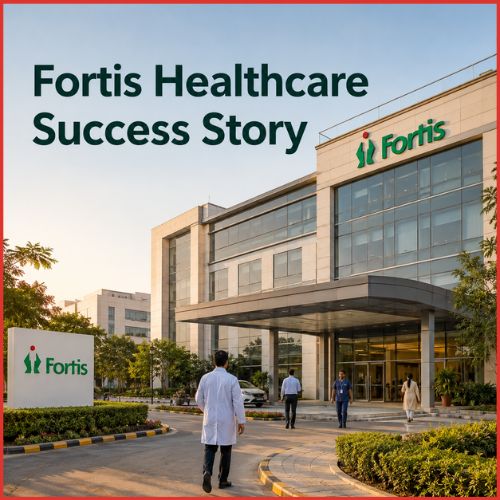
Two brothers built one of India’s biggest hospital chains, then very nearly lost it to a boardroom war fought across three countries. That is the short version of the Fortis Healthcare success story, and the long version is far more instructive for anyone running a company today.
Malvinder and Shivinder Singh grew up watching their grandfather Bhai Mohan Singh build Ranbaxy Laboratories into a pharmaceutical giant, and both studied at St Stephen’s College before Malvinder went on to Duke University’s Fuqua School of Business. After selling the family’s Ranbaxy stake to Japan’s Daiichi Sankyo in 2008, the brothers turned to healthcare delivery, and Fortis quickly became a byword for private, premium hospital care in India.
Then came the unravelling: fraud allegations, an arbitration award, and a scramble for survival that forced the founders out entirely. What followed was a foreign buyer, a seven-year regulatory tangle, and a hospital chain that is, in 2026, more profitable than it has ever been. For founders and CXOs, the arc from Mohali’s first hospital bed to a Malaysian-controlled listed giant offers a working case study in governance, distressed M&A, and what a real hospital chain revival looks like on a balance sheet.
Quick Glance
| Founders | Malvinder Mohan Singh & Shivinder Mohan Singh |
| Company | Fortis Healthcare Limited |
| Founded | 1996 (incorporated); first hospital opened 2001, Mohali |
| Sector | Private hospital chain, healthcare industry India |
| Key Stat | IHH Healthcare bought a 31.1% stake for $585 million in 2018 |
| Current Status | Controlled by Malaysia’s IHH Healthcare; ~33 facilities, ~5,800 beds across 11 states |
The Early Journey
Fortis Healthcare history begins in a pharmaceutical family, not a hospital ward. Malvinder and Shivinder Singh were grandsons of Bhai Mohan Singh, who had bought Ranbaxy Laboratories in 1952, and both brothers inherited a 33.5% stake in Ranbaxy after their father Parvinder Singh’s death in 1999.
They incorporated Fortis Healthcare in February 1996, but the business only opened its doors in 2001, with a hospital in Mohali, Punjab. The bet was simple. India’s rising middle class wanted organised, tertiary-care hospitals, not just government wards or small nursing homes.
Early growth leaned on acquisition rather than ground-up building. The 2005 purchase of the Escorts Heart Institute in New Delhi gave Fortis instant credibility in cardiac care, a specialty that still anchors much of the chain’s revenue today, a growth pattern also visible among more recent entrants such as Pristyn Care, which scaled through partner hospitals before building its own facilities.
Building The Business: Model And Strategy
Hospital Network And Specialty Mix:
Fortis built its brand around cardiac sciences, oncology, orthopaedics, neurosciences, and renal care, the specialties that still drive most of its average revenue per occupied bed. It also expanded into diagnostics through SRL Diagnostics, now Agilus Diagnostics, adding an asset-light revenue stream alongside hospital beds.
Growth Through Acquisition:
Rather than only build greenfield hospitals, Fortis bought its way into scale, absorbing the Escorts Group’s cardiac assets and later the Wockhardt Hospitals chain. Acquire clinical credibility first, then cross-sell diagnostics and specialty care across the combined footprint, a template several newer healthcare players, including BharatPe outside healthcare and Pristyn Care within it, have since borrowed in their own categories.
Asset-Light Financial Engineering:
In 2012, the Singapore-listed RHT Health Trust acquired several Fortis hospital properties and leased them back to the company, freeing up capital but tying future cash flows to a related-party structure. It looked efficient at the time. It became a complication once ownership and governance came under scrutiny.
Growth & Turning Points
| Year | Milestone |
| 2001 | First hospital opens in Mohali, Punjab |
| 2005 | Escorts Heart Institute acquisition strengthens cardiac care in Delhi NCR |
| 2012 | RHT Health Trust sale-and-leaseback restructures Fortis’s hospital real estate |
| 2018 | IHH Healthcare Berhad acquires a 31.1% controlling stake for about $585 million |
| 2025 | SEBI clears IHH’s delayed open offer for a further 26.1% stake, seven years on |
Malaysia’s IHH Healthcare became Fortis’s largest shareholder in 2018, buying its 31.1% stake for $585 million and outbidding a rival Manipal-TPG consortium (Forbes, 2025). The stock has since more than quadrupled, and the Securities and Exchange Board of India finally approved IHH’s long-delayed open offer for a further 26.1% stake in October 2025, nearly seven years after the original deal was struck (Business Standard, 2025).
Challenges & Setbacks
The unravelling had little to do with hospital operations and everything to do with the promoters’ other businesses. Daiichi Sankyo, which had bought the brothers’ Ranbaxy stake in 2008, later accused them of concealing material information about US regulatory violations at Ranbaxy before the sale.
A Singapore arbitration tribunal ruled against the brothers, and Daiichi pursued enforcement through Indian courts for an award reported at roughly Rs 3,500 crore. Malvinder and Shivinder were also arrested in 2019 on charges of criminal breach of trust connected to loans allegedly routed out of Religare Finvest, a separate group company.
The fallout hit Fortis directly: promoter shares were pledged, funds were allegedly diverted between group entities, and the resulting cash crunch and governance vacuum forced the Singh brothers off the Fortis board entirely by 2018, years before the legal cases concluded. It is a sharp lesson in how founder-level trouble in one entity, similar to leadership disputes that have periodically clouded companies like Bajaj, can drag down an otherwise healthy operating business built on a different balance sheet.
Key Takeaways
- A hospital chain’s clinical brand can stay strong even while its promoters’ finances collapse; Fortis kept treating patients through its worst boardroom years.
- Related-party structures like the RHT Health Trust lease-back look efficient until governance questions surface, then they turn into liabilities.
- A strategic buyer, not just a lender, can rescue a distressed listed company; IHH’s 2018 stake purchase stabilised Fortis when promoter capital had evaporated.
- Legal disputes tied to unrelated group companies, in this case Ranbaxy and Religare, can freeze a fully separate business’s ownership structure for years.
- Diagnostics and specialty-care diversification gave Fortis a second income stream that cushioned the hospital business during the crisis years.
- Regulatory delay is itself a business risk; IHH waited nearly seven years to complete its open offer because of court proceedings it did not control.
Conclusion
Fortis Healthcare’s arc, a family-built chain, a governance collapse, and a foreign strategic buyer stepping in, is now a reference case in Indian boardrooms. For anyone tracking the healthcare industry India story, the company shows that clinical scale and promoter integrity are separate variables, and a business can survive even when the second one fails badly.
IHH’s move to raise its holding toward 50% signals confidence in Fortis Healthcare revenue growth going forward, not just in the assets it bought at a discount in 2018 (Business Standard, 2025). The bigger lesson for founders is less about hospitals and more about structure: keep related-party dependencies auditable, and never let a separate company’s legal exposure sit close enough to touch the one you are actually building.
Frequently Asked Questions
1. Who founded Fortis Healthcare?
Fortis Healthcare was founded by brothers Malvinder Mohan Singh and Shivinder Mohan Singh, grandsons of Ranbaxy founder Bhai Mohan Singh. The company was incorporated in 1996, though its first hospital opened in Mohali, Punjab, in 2001.
2. Why did the Singh brothers lose control of Fortis Healthcare?
Fraud allegations tied to their other companies, Ranbaxy and Religare Finvest, triggered arbitration awards, arrests, and a cash crunch that forced them off the Fortis board by 2018. That is the central fall in the Fortis Healthcare success story.
3. Who owns Fortis Healthcare now?
Malaysia’s IHH Healthcare Berhad is the controlling shareholder, having bought a 31.1% stake in 2018 and cleared SEBI approval in October 2025 to acquire up to 26.1% more through an open offer.
4. What was the IHH Healthcare acquisition worth?
IHH paid roughly $585 million for its initial 31.1% stake in 2018. The pending open offer, delayed seven years by litigation, was expected to be priced far higher given how much the stock has climbed since then.
5. Is Fortis Healthcare profitable today?
Yes. Fortis reported hospital business revenue growth of close to 14.8% for FY25, alongside rising occupancy and average revenue per occupied bed, pointing to a durable Fortis Healthcare revenue growth trend rather than a one-off recovery.
6. What can founders learn from the Fortis hospital chain revival?
Keep core operating businesses structurally separate from promoters’ personal or unrelated financial dealings, and treat related-party leases or loans as a governance risk rather than a balance-sheet convenience.