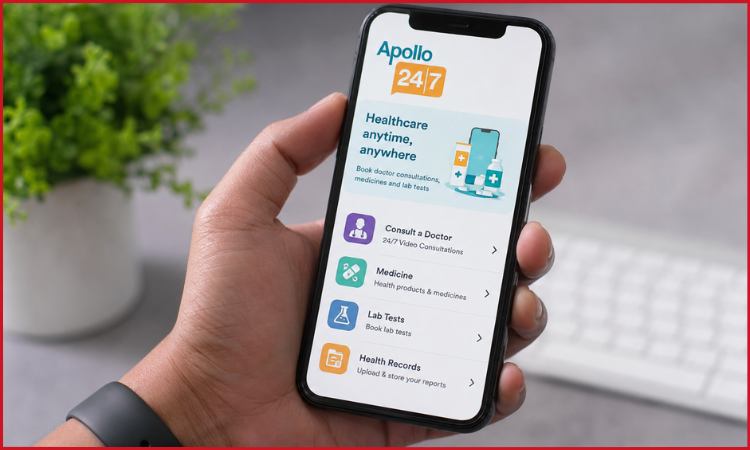
If you thought the concept of ‘Apollo 24/7’ was born out of spotting a market void and setting up a tech-first startup to fill the space then you are mistaken. In fact, this business model of blending together services ranging from e-pharmacy logistics, teleconsultation and diagnostics with physical hospitals is actually being run by India’s largest hospital chain which set up this entity within just 45 days during the height of pandemic-induced lockdowns when everyone around the globe went indoors making brick and mortar facilities for health care inaccessible.
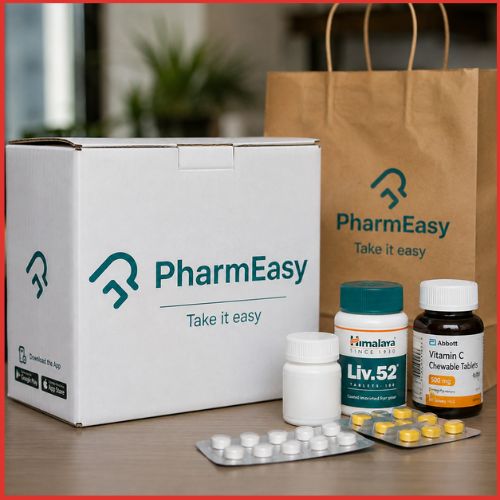
Now six years on, the company continues to be one of the most-watched business models in the Indian context regarding the growing importance of digital health spaces. This guide explains how Apollo 24/7 generates revenues, why their approach seems unique in comparison to others like those of Pharm Easy or Practo, etc., and how finances point towards potential growth trajectories across such segments.
What Is Apollo 24/7?
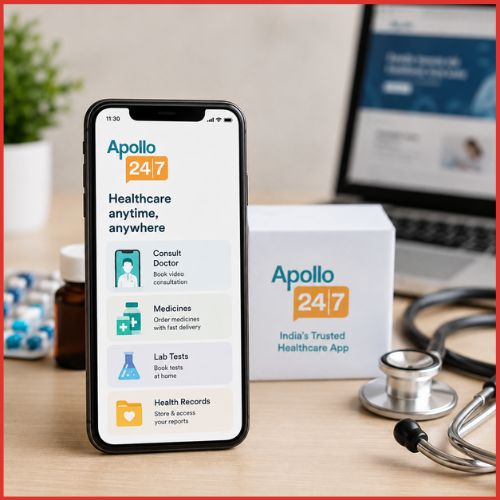
Apollo Hospitals’ digital healthcare platform Apollo 24/7 has been in talk this year. Launching in Feb 2020 on the vision of founder Dr Prathap C Reddy, Apollo 24/7 now offers multiple services — e-consultations with Apollo affiliated doctors, online ordering for medicines delivered at your doorstep, home diagnostic tests booked online, and even storage of prescriptions & reports into a ‘vault’. All these happen in one app which comes under Apollo HealthCo. The same parent organisation which owns Apollo’s offline pharmacy distribution business and its backend pharmaceutical supplier Keimed.
Unlike other digital health challenger apps, Apollo 24/7 isn’t just another stand-alone application, it is a gateway to a large-scale legacy system. To be specific, it connects you with Apollo Group’s network of over 70 hospitals, thousands of pharmacies and physicians that others simply can’t touch. This massive infrastructure base serves as Apollo 24/7’s edge across all of its various monetization avenues, discussed below.
The Apollo 24/7 Revenue Model: Core Pillars
Apollo 24/7’s business model is not built on a single income source. It is a layered structure where four to five distinct revenue engines feed off one shared user base, each with a different margin profile.
1. Online Pharmacy (E-Pharmacy) — The Largest Revenue Driver
The e-pharmacy vertical is, by a wide margin, the biggest contributor to Apollo 24/7’s topline. Users order prescription and over-the-counter medicines through the app, and fulfilment happens through a combination of Apollo’s own retail pharmacy network and dedicated dark stores, with delivery typically promised within a couple of hours in serviceable cities. Apollo HealthCo’s own quarterly disclosures show the digital platform’s gross merchandise value climbing steadily, with the company’s leadership pointing to the e-pharmacy business as the primary engine behind its overall growth ambitions, reportedly touching a monthly run-rate of roughly ₹165–170 crore across the platform and supporting channels in 2025.
The margin logic here works on two levels. Apollo earns retail margin on the medicine sold, and because a large share of that inventory flows through Apollo’s own back-end distribution and store network rather than third-party logistics, it captures value that a pure online-only competitor would have to share with delivery and fulfilment partners.
2. Online Doctor Consultations (Teleconsultation)
Every consultation booked through the app — via chat, audio, or video — generates a consultation fee, split between the treating doctor and the platform. Apollo 24/7 markets rapid access to specialists, historically promising patients a doctor connection within a defined time window, which has made teleconsultation a strong retention driver even where it is not the single largest revenue line.
The real value of teleconsultation, however, is less about the fee itself and more about what it triggers downstream. A consultation nearly always ends in a prescription, and a prescription converts into a pharmacy order. This is the central design principle of the entire platform: teleconsultation functions as the customer acquisition funnel for the far more lucrative pharmacy business.
3. Diagnostics and Home Sample Collection
Apollo 24/7 allows users to book lab tests and health check-up packages that are fulfilled through home sample collection or partner diagnostic centres. This segment benefits from the same cross-sell logic as teleconsultation — a doctor’s consultation frequently recommends a diagnostic test, and the app is designed to make booking that test a one-tap action immediately after the consultation ends. Diagnostics also carries healthier margins than pharmacy distribution, since it is a service rather than a physical goods business with procurement costs.
4. Digital Monetisation and Advertising
A newer and increasingly important layer of the business is what Apollo HealthCo’s leadership has referred to as “monetisation initiatives” — advertising, brand placements, and partnership revenue layered on top of transaction volume rather than tied to it. Apollo 24/7 has entered branded partnerships with consumer health and pharma companies, using its app traffic and prescription data patterns to place relevant products in front of high-intent users. A tie-up bringing L’Oréal’s dermatology-focused La Roche-Posay range onto the platform, and a partnership with Protinex around diabetes-care nutrition, are examples of how the platform monetises its audience beyond pure transaction margin. Management has indicated this monetisation layer is expected to contribute a growing share of revenue independent of gross merchandise value growth.
5. Insurance — The Emerging Fifth Pillar
Apollo HealthCo has begun building an insurance line, still in its early stages as of 2025–26, designed to work in both directions: as a standalone revenue stream and as a feeder that drives more users into the pharmacy and consultation businesses through bundled health cover. This mirrors a pattern seen globally in health-tech, where insurance distribution deepens customer lifetime value far beyond what transaction fees alone can achieve.
Why the Hybrid (Online + Offline) Model Is Apollo 24/7’s Real Moat
Most Indian e-pharmacy and telehealth startups had to build fulfilment infrastructure, doctor networks, and consumer trust from zero. Apollo 24/7 inherited all three from a group that has been operating hospitals since 1983 and running India’s largest retail pharmacy chain since 1987. This changes the unit economics considerably.
- Trust transfer: Patients booking a consultation through Apollo 24/7 are implicitly trusting the same brand behind a nationwide hospital network, which lowers customer acquisition cost compared with a standalone digital-health brand.
- Fulfilment leverage: Medicine orders can route through existing pharmacy stores in a city rather than requiring the platform to build dark-store density from scratch everywhere it operates.
- Data-driven cross-sell: A single patient record spanning consultation, prescription, diagnostics, and hospital visit history allows Apollo to personalise recommendations in a way pure-play digital competitors, who only see fragments of a patient’s healthcare journey, cannot match.
This is also precisely why analysts have historically debated whether the digital arm helps or dilutes group profitability — building and marketing a technology platform is expensive, and for several years Apollo 24/7 operated at a loss even as its parent hospital business remained solidly profitable.
The Path to Profitability
Apollo 24/7’s financial story has shifted meaningfully in the past two years. Apollo HealthCo, the entity housing the digital platform alongside offline pharmacy distribution, reported a swing to profitability at the net level in the first nine months of FY25, posting a profit after tax of roughly ₹38 crore against a loss of about ₹178 crore in the same period a year earlier, with revenue rising to around ₹6,717 crore for that nine-month stretch. EBITDA also turned positive, moving from a loss to a positive figure over the same comparison period.
Group leadership has since laid out an ambitious target: a revenue run rate of roughly ₹25,000 crore by FY27 for the restructured entity that will combine Apollo 24/7, offline pharmacy distribution, Keimed, and telehealth services, alongside a plan to list this combined business separately. Management has projected year-on-year growth in the 20–23% range for this unit, driven primarily by the e-pharmacy segment, with consultation and diagnostics also contributing steady uplift.
Apollo 24/7 vs Competitors: Apollo Business Model
| Factor | Apollo 24/7 | Pure-play e-pharmacy/telehealth startups |
| Fulfilment network | Backed by Apollo’s own hospitals and pharmacy stores | Built independently, often asset-light or venture-funded dark stores |
| Doctor network | In-house Apollo-affiliated physicians | Aggregated or freelance doctor networks |
| Customer trust | Inherited from a 40-plus-year hospital brand | Built from scratch through marketing spend |
| Funding dependency | Backed by a profitable parent group and select PE investment | Often dependent on repeated venture funding rounds |
| Data depth | Full patient journey across OPD, IPD, pharmacy, and diagnostics | Typically limited to the transaction captured on-platform |
The key point that makes these comparisons incomplete are differences in structure. So while you can compare your business to companies like MediBuddy or Practo, or even the erstwhile PharmEasy, Apollo 24/7 is actually less of a startup fighting for existence and more the digital extension arm of an existing healthcare conglomerate. And this affects things from the risk profiles to eventual monetisation strategies.
Key Takeaways
Apollo 24/7 also exemplifies an important trend in the space – those with connections into the ground floor (offline) health care infrastructure seem better able to hold their own against the pure play online ones which lack physical assets but have other strengths.
The Apollo 24/7 business plan involves using revenue from tele-consultation and diagnostics to fund the high volume pharmacy side of things. A more recent development is building up income streams beyond transactions through ads, brand partnerships and insurance. It’s also planning to list separately once it has been restructured, giving the opportunity for some interesting benchmarks for hybrid models for healthcare in this country. Can it continue at the sort of double digit growth rate without losing all of the new found profitability?
Frequently Asked Questions
How does Apollo 24/7 make money?
Apollo 24/7 earns revenue primarily through online medicine sales (e-pharmacy), consultation fees from teleconsultation, diagnostic test bookings, and a growing layer of advertising, brand partnerships, and early-stage insurance distribution.
Is Apollo 24/7 profitable?
Apollo HealthCo, the entity housing the digital platform, reported a swing to net profitability in the first nine months of FY25, after several years of losses driven by technology and marketing investment.
What is the largest revenue source for Apollo 24/7?
The online pharmacy business is Apollo 24/7’s largest revenue contributor, benefiting from Apollo’s existing offline pharmacy network and back-end distribution infrastructure.
How is Apollo 24/7 different from PharmEasy or Practo?
Unlike standalone digital-health startups, Apollo 24/7 is backed by an established hospital and pharmacy network, giving it fulfilment infrastructure, doctor access, and brand trust that asset-light competitors must build independently.