AI chatbots have become familiar enough that many people no longer think twice before asking one a question, whether to explain a topic, recommend a product, summarise a document or help a customer find an answer.
AI agents are entering the same conversation, but they are aimed at a different problem. Instead of stopping at an answer, an AI agent can be designed to work towards an objective: it may gather information, use software tools, make decisions and complete several steps without waiting for the user to tell it what to do next.
That distinction is becoming important for businesses deciding where AI belongs in their operations. A chatbot may tell an employee how to submit an expense claim, while an agent could potentially find the relevant receipts, check the company’s policy, prepare the claim and send it for approval.
Both systems use artificial intelligence. The difference lies in what happens after the user makes a request.
What is an AI chatbot?
An AI chatbot is a software system that communicates with users through natural language. Modern chatbots are often built around large language models, which allow them to understand questions and produce responses that are more flexible than the fixed replies used by older rule based chatbots.
A customer might ask an online store: “Can I return an item after 30 days?” The chatbot could explain the company’s return policy, tell the customer whether the item appears to qualify and provide instructions for starting a return. That is a useful job, and there is no need for the system to take control of the entire process.
AI chatbots are commonly used for customer support, product questions, employee help desks, education, information retrieval and general assistance. IBM describes chatbots as systems that can interact with users through natural language and notes that modern versions can be connected to business information and other systems. The important point is that conversation remains central to the experience.
A chatbot can sometimes perform actions too, and that is where the terminology starts to become less precise. Once a chatbot can access databases, call external tools and carry out tasks, it begins to acquire characteristics associated with an AI agent.
What is an AI agent?
An AI agent is an AI system designed to pursue a goal by deciding what actions are needed and using available tools to carry them out. The user does not necessarily have to provide every step.
Suppose a manager asks an AI system to review this week’s customer complaints, identify urgent cases, group similar problems and prepare a report. A basic chatbot might help write the report if the manager supplies the information, but an agent could potentially retrieve the complaints from the company’s support system, sort them, identify patterns, prepare the report and place it in the appropriate workspace. That additional ability to act is what makes agents different.
OpenAI describes agents as systems that can independently accomplish tasks on a user’s behalf, using a combination of models, tools, instructions and safeguards. An agent does not have to be completely autonomous; in a sensitive workflow, it may stop and ask a person for approval before taking an important action.
The useful question is not whether the AI works alone. It is how much of the work the AI can carry out after receiving the objective.
AI agents vs AI chatbots: what is the difference?
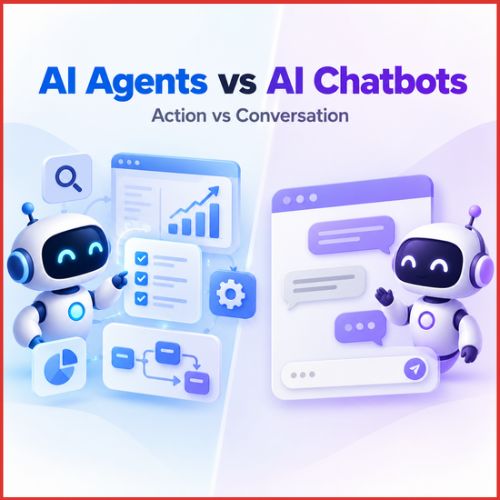
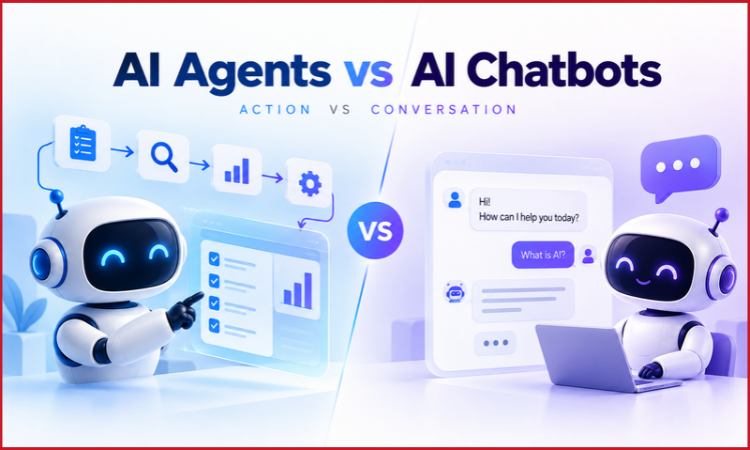
The simplest distinction is this: a chatbot is mainly built to respond, while an AI agent is built to pursue a task. That sounds straightforward, but the practical difference is easier to see in a real workflow.
Imagine that an employee asks an AI assistant to find the status of an unpaid invoice. A chatbot could retrieve the information and tell the employee that the invoice is overdue. An agent might go further, identifying the invoice, checking the payment history, looking up the customer record, determining whether a reminder is due and preparing the appropriate message. The second system has more responsibility, and that also gives it more ways to make a mistake.
Conversation versus action
Chatbots are generally centred on the exchange between a person and an AI system: the user asks, the system responds, and the user may ask another question.
Agents can work through a sequence of actions after receiving a goal. The conversation can still be the interface, but the work happening behind it is broader. This is one reason the two terms are increasingly difficult to separate, as a product may look like a chatbot on the screen while using agent based processes in the background.
One response versus several steps
A chatbot can be very effective when the task has a clear answer, such as “What is our refund policy?”, “Where can I find the employee handbook?” or “What documents do I need for this application?” These are primarily information requests.
An agent becomes more useful when the answer is not the end of the task, such as “Review these applications and flag the ones that need human attention,” “Check our inventory and prepare a purchase order if stock is below the threshold,” or “Research these companies and prepare a briefing for tomorrow’s meeting.” These requests involve several steps.
User control
A chatbot usually leaves the user in control of the next move. Agents can be given greater freedom to decide what happens next, and that can save time, but it also makes permissions important.
An agent connected to a calendar might be allowed to suggest meetings but not book them. Another system might be allowed to book meetings automatically but require approval before sending an external message. The amount of autonomy is therefore a design choice, not a fixed feature of every AI agent.
Tool access
An AI model on its own can generate text and reason about information available to it. An agent can be connected to tools that let it interact with the outside world, such as a customer relationship management system, a database, a browser, an email service, a calendar, a payment system or internal company software.
OpenAI’s guidance on agents places considerable emphasis on tools because they allow the system to gather information and take actions rather than simply generate a response.
Risk and oversight
There is an obvious tradeoff. A chatbot that gives an incorrect answer may confuse a customer, but an agent with permission to change a record, send an email or place an order can turn the same misunderstanding into an operational problem.
For that reason, businesses need to think about permissions, monitoring, approval points and the consequences of mistakes before giving an AI system significant autonomy. The more valuable the action, the more important those controls become.
AI chatbot use cases
AI chatbots are not becoming obsolete simply because AI agents are attracting attention. In many situations, a chatbot is still the sensible choice.
Customer support
Customers often want a quick answer rather than an autonomous system handling their entire account. A chatbot can answer questions about delivery times, return policies, product specifications, account procedures and service availability.
Internal employee support
Companies can use chatbots to help employees find information buried in policies and internal documents. An employee might ask about leave rules or expense procedures and receive an answer without searching through several documents.
Education
Students can use conversational AI to ask follow up questions, request explanations and explore unfamiliar subjects. The interaction itself is valuable, and the student remains responsible for deciding what to ask next.
Product discovery
A shopper may describe what they are looking for in ordinary language rather than using a website’s filters. A chatbot can narrow the choices and explain why particular products may fit the request. For these situations, adding more autonomy may not improve the experience.
AI agent use cases
Agents become more interesting when a task involves several connected systems or repeated decisions.
Customer service resolution
Instead of simply answering a customer’s question, an agent could retrieve the relevant account information, examine an order, check company rules and prepare the next action. A human can remain involved when the case requires judgement.
Research
An agent can potentially search multiple sources, collect information, compare findings and prepare a working document. The quality of the final result still depends on the quality of the sources and the checks applied to the process.
Software development
Coding agents can work across files, inspect code, run tests and make changes based on a broader objective. That is different from asking a chatbot to explain a programming error.
Business operations
Agents may be useful for repetitive processes involving several applications. A sales operation, for example, could involve checking new leads, updating customer records, preparing follow up messages and assigning tasks to the appropriate team.
The attraction is not that an agent can write an email, since a chatbot can already do that. The attraction is that the agent may be able to handle the surrounding workflow.
Which is better for a business?
There is no universal winner. The right choice depends on the job.
A company should consider an AI chatbot when people mainly need answers, explanations or guidance. It is often easier to control and can be enough for a large share of customer and employee questions. An AI agent makes more sense when the business wants to delegate a repeatable workflow involving several steps and systems.
A useful test is to finish this sentence: “We want the AI to tell the user…” If that completes the requirement, a chatbot may be enough. If the sentence is closer to “We want the AI to take care of…” an agent may be worth considering.
There is another practical question that businesses sometimes overlook: what happens when the AI is wrong? For a simple information request, the answer may be easy to correct, but for an automated transaction, the cost can be much higher. That difference should influence how much autonomy the system receives.
Are AI agents replacing AI chatbots?
Not exactly. The more likely development is that chat interfaces and agent based systems will merge.
A user may continue to interact with an AI through a familiar conversation window. Behind that interface, however, the system may be searching databases, calling tools and carrying out tasks. From the user’s point of view, it may still feel like a chatbot, while from the software’s point of view, it may be doing considerably more.
Recent developments in the market already point in this direction. AI systems are increasingly being presented as assistants that can perform practical tasks rather than simply answer questions, and the rise of personal AI agents is also bringing questions about privacy, trust and how much control users are willing to give these systems.
That suggests the chatbot is unlikely to disappear, though its role may simply change. The conversation could become the front door to a much larger system.
Which will dominate: AI agents or AI chatbots?
If “dominate” means handling complex business work, AI agents have the stronger long term position. If it means the interface through which people interact with AI, chatbots are likely to remain important. That distinction matters because the two technologies are not really competing for exactly the same space.
A person asking for a definition does not need an agent, while a company trying to automate a lengthy claims process may benefit from one. The bigger shift is therefore from answering questions to completing objectives.
As AI systems become better at using tools and handling longer sequences of work, more tasks can move in that direction. But technical capability alone will not decide where agents succeed. Trust will matter, and so will cost, reliability, security and the ability to recover when something goes wrong.
A company may have a technically impressive agent that performs poorly in practice if employees cannot understand what it is doing or customers do not trust its decisions. This is one reason the future is unlikely to consist entirely of autonomous agents.
Many organisations will use a mixture of systems. Simple questions can remain with chatbots, more complicated workflows can move to agents, and human employees can handle decisions that require judgement or carry significant consequences.
What will AI assistants look like in the future?
The most interesting change may be less visible than the current debate suggests. Users are becoming accustomed to describing what they want in ordinary language, and the next step is to let software do more of the work that follows.
Today, someone might ask an AI assistant to write an email. Tomorrow, the same person may ask it to review a customer issue, find the relevant information, prepare the response and wait for approval. The interface has barely changed, but the amount of work performed by the system has.
That is the real significance of AI agents. They are not simply another type of chatbot; they represent a shift in where the boundary between a person and software is drawn.
But that boundary will not move equally for every task. For low risk questions, conversation will remain enough. For structured business processes, greater autonomy could be valuable. For high consequence decisions, people are likely to remain firmly in the loop.
AI agents vs AI chatbots: the final verdict
The debate is sometimes presented as if AI agents are the next generation of chatbots and will eventually replace them. That is too simple.
AI chatbots are designed primarily around interaction, while AI agents extend that interaction into planning, tool use and task execution. Neither is automatically better: a chatbot is often the better product when a user needs a fast, reliable answer, while an agent becomes more useful when the user wants the system to take responsibility for several steps.
The likely winner, then, is not one technology. It is the combination of the two. People will continue to talk to AI, and increasingly, they may also expect the software behind that conversation to get things done.
For businesses, the practical question is not whether an AI agent sounds more advanced than a chatbot. It is whether giving the system more autonomy solves a real problem without creating a bigger one. That is the decision that will determine where each technology belongs.
Frequently asked questions
What is the main difference between an AI agent and an AI chatbot?
An AI chatbot is primarily designed to communicate with a user and provide information or assistance. An AI agent can go further by planning actions, using tools and completing several steps towards a defined objective.
Is an AI agent the same as a chatbot?
No. The two can overlap, and an agent can use a chat interface, but their underlying roles are different. A chatbot focuses on conversation, while an agent is designed to carry out tasks with a degree of autonomy.
Are AI agents better than chatbots?
Not always. Chatbots are often better for simple questions, information retrieval and customer conversations, while agents are more suitable for workflows that involve multiple steps, tools and decisions.
Can an AI chatbot become an AI agent?
Yes. A chatbot can be extended with access to tools, external systems, memory and task planning. However, simply adding tools does not automatically make a system a useful agent, since its ability to pursue and complete a goal is what matters.
Will AI agents replace customer service chatbots?
They may take over some tasks currently handled by chatbots, particularly cases that require several actions. However, conversational chatbots will remain useful for straightforward questions and low risk support.
What are the main risks of AI agents?
The main concerns include incorrect actions, excessive permissions, security problems, privacy issues and insufficient human oversight. These risks become more important when an agent can change records, send communications or perform transactions.
Which should a small business choose, an AI chatbot or an AI agent?
A small business should start with the problem rather than the technology. If customers mainly need answers, a chatbot may be sufficient. If employees spend significant time completing repetitive, multi step processes across several systems, an agent may provide greater value.
What is the future of AI chatbots and AI agents?
The two are likely to converge. Users may continue interacting through conversational interfaces while increasingly capable AI systems work behind those interfaces to retrieve information, use tools and complete tasks.